What Does “LED Driver Production Line Supplier” Mean for a B2B Buyer?
A buyer searching for an LED driver production line supplier may be looking for one of two very different things.
The first is a machinery vendor that sells SMT machines, assembly equipment, potting equipment, test systems, aging racks, or a complete turnkey line for manufacturing LED drivers.
The second is an LED driver manufacturer that operates production lines and supplies finished LED drivers to lighting brands, fixture manufacturers, distributors, signage companies, and project contractors.
This guide addresses the second search intent.
It is written for buyers sourcing finished LED drivers from a production-capable supplier. It is not a guide to purchasing manufacturing machinery.
That distinction matters because the qualification criteria are completely different.
A machinery buyer evaluates equipment specifications, installation, training, maintenance, spare parts, and factory layout.
A finished-product buyer needs to evaluate whether the supplier can repeatedly convert an approved LED driver specification into stable, traceable, shipment-ready batches.
The supplier must be able to control:
- Product configuration
- Approved components
- Production instructions
- Assembly workmanship
- Potting or sealing where applicable
- Electrical testing
- Full-load aging
- Failure handling
- Label and packaging accuracy
- Batch release
- Repeat-order consistency
- Delivery capacity
A production workshop can look modern and organized while still being unsuitable for a buyer’s program.
The more useful question is not:
“Does this supplier have a production line?”
It is:
“Can this supplier transfer our approved LED driver into controlled production, scale the order, manage changes, and reproduce the same result six or twelve months later?”
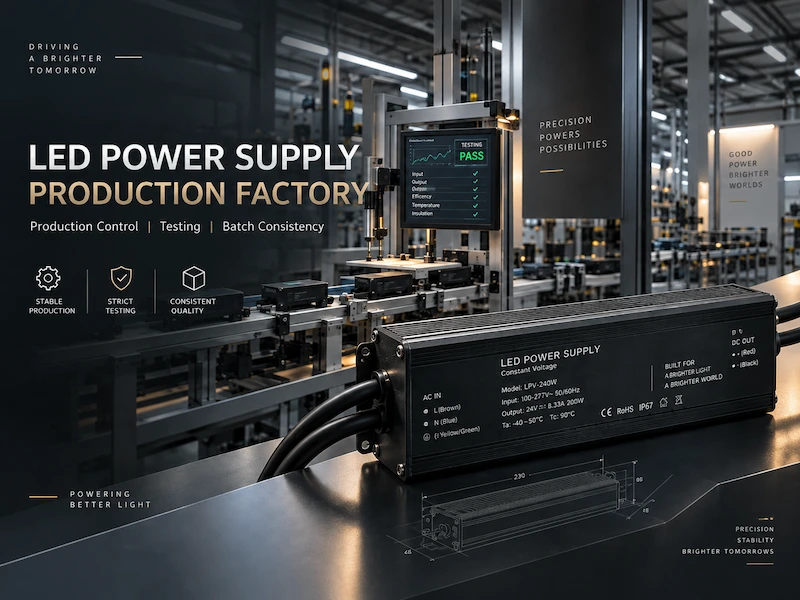
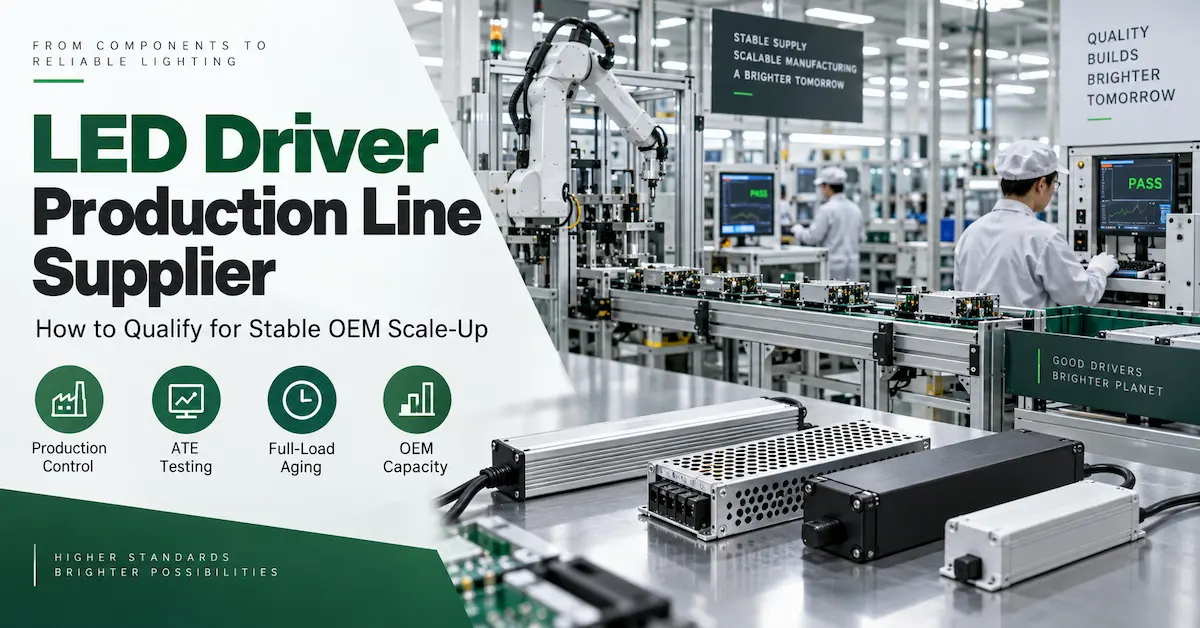
For a stage-by-stage explanation of assembly, testing, aging, and batch release, buyers can first review JMHC’s LED power supply production line guide. This article goes further by focusing on supplier qualification, program launch, capacity scale-up, and long-term supply management.
Why This Search Is Different From a Basic Factory Audit
A conventional factory audit often answers broad questions:
- Is the factory real?
- What equipment is available?
- How large is the workshop?
- How many employees work there?
- What products are manufactured?
- Which certifications are displayed?
- Does the factory have quality-control personnel?
These questions are useful, but they do not fully answer whether the supplier is suitable for a specific LED driver program.
A buyer may approve a factory and still experience problems during scale-up.
Typical issues include:
- The approved sample is not connected to a controlled production revision
- The bulk-order cable or connector differs from the sample
- Test limits are not updated after an output change
- An alternative component enters production without buyer review
- Production capacity is quoted without considering aging or curing bottlenecks
- Several similar voltage variants are mixed during assembly
- Label or carton artwork is approved separately from the electrical configuration
- Delivery dates are based on assembly completion rather than final release
- Reworked units are included in yield figures without explanation
- Repeat orders use a different material or process than the first order
A supplier qualification process must therefore connect factory capability to the buyer’s actual product.
The goal is not to collect the largest number of audit photos.
The goal is to verify that the supplier has a practical system for taking one defined product from engineering approval through pilot production, volume ramp, batch release, and repeat ordering.
Which Buyers Need a Detailed Production-Line Supplier Evaluation?
Not every purchase requires the same level of qualification.
A small trial order for an existing standard model may only require basic product verification and commercial review.
A deeper assessment is more valuable when the buyer is building a long-term product or supply program.
Lighting Brands
Lighting brands may integrate one driver into several luminaires and continue purchasing the same configuration for years.
They need confidence that the supplier can control:
- Product revisions
- Approved materials
- Compliance documents
- Private labeling
- Packaging
- Repeat production
LED Fixture Manufacturers
Fixture manufacturers depend on the driver as a functional component of the complete luminaire.
A change in dimensions, cable direction, output behavior, temperature, or dimming compatibility can affect assembly and field performance.
Distributors and Wholesalers
Distributors frequently carry multiple wattages and output voltages.
They need clear model identification, consistent labels, stable packaging, and reliable replenishment.
A production-line supplier must prevent similar variants from being mixed.
Signage and Light Box Manufacturers
These buyers may require specific constant-voltage outputs, cable arrangements, compact housings, waterproof construction, or extended operating performance.
Commercial and Architectural Project Suppliers
Project buyers may need hundreds or thousands of units delivered in scheduled batches.
Late delivery or inconsistent versions can delay installation and commissioning.
OEM and Private-Label Buyers
OEM buyers may request their own product code, label, carton, connector, cable, or output configuration.
Their main concern is whether the customized version can be controlled as a production product rather than handled as an informal exception.
Buyers Who May Not Need a Full Evaluation
A detailed production-line qualification may be excessive for:
- A one-time purchase of a small standard quantity
- A non-critical prototype
- A project with no planned repeat order
- A buyer who has not yet defined voltage, wattage, application, or quantity
- A buyer comparing only generic products without a controlled specification
The qualification depth should match the commercial and technical risk.
Build the Sourcing Brief Before Comparing Suppliers
Supplier comparison should begin before the first quotation.
If the buyer sends only a keyword such as “24V LED driver” or “100W waterproof power supply,” each factory may quote a different construction.
The prices will appear comparable, but the products may differ in input range, output tolerance, wiring, thermal behavior, protection, testing, documentation, and compliance scope.
A useful sourcing brief should define the following areas.
| Requirement Area | Information the Buyer Should Provide | Why It Matters |
|---|---|---|
| Application | Fixture, signage, landscape, retail, architectural or industrial use | Determines operating environment and risk |
| Input | Required AC range and frequency | Influences platform and test conditions |
| Output | Constant voltage or constant current, voltage/current rating | Defines the primary electrical function |
| Load | Actual operating load and rated output requirement | Supports thermal and margin evaluation |
| Environment | Indoor, outdoor, humidity, temperature and enclosure | Affects construction and product selection |
| Dimensions | Maximum length, width, height and mounting limits | Prevents mechanical incompatibility |
| Wiring | Cable type, length, polarity and connector | Controls assembly and field integration |
| Control | Dimming or control interface where required | Requires functional compatibility |
| Compliance market | Destination country and required documents | Prevents unsupported certification assumptions |
| Quantity | Sample, pilot, first order and annual forecast | Supports capacity and commercial planning |
| Branding | Label, product code, carton and manuals | Defines private-label scope |
| Delivery | Required milestones and shipment schedule | Allows realistic production planning |
The buyer should also distinguish three types of information:
- Required values that cannot change
- Preferred values that may be negotiated
- Supplier-proposed values that require approval
This prevents a quotation assumption from becoming an uncontrolled production specification.
JMHC’s application-based power supply solutions provide a useful starting point for reviewing voltage, wattage, installation environment, engineering support, and mass-production needs before preparing an RFQ.
Qualify the Supplier Through Seven Program Gates
A production-line supplier can be evaluated through seven linked gates.
Each gate answers a different sourcing question.
| Qualification Gate | Main Question |
|---|---|
| Product platform fit | Does the supplier have a suitable technical starting point? |
| Engineering transfer | Can requirements become controlled production documents? |
| Pilot readiness | Can the supplier prove the process before full volume? |
| Line and test readiness | Are workstations, tools and test programs prepared? |
| Capacity readiness | Can accepted output meet the delivery plan? |
| Change and traceability control | Can the supplier protect repeat-order consistency? |
| Commercial continuity | Can the supplier support the program after the first shipment? |
Gate 1: Confirm Product Platform Fit
The first step is not to ask whether the supplier can manufacture “any LED driver.”
The better question is whether the supplier has a product platform appropriate for the buyer’s application.
Relevant platform differences may include:
- Indoor versus waterproof construction
- Constant voltage versus constant current
- Low-power versus high-power design
- Compact versus long-shape housing
- Standard versus dimmable output
- PFC versus non-PFC platform
- Standard wiring versus customized connector
- Existing certified version versus modified version
Starting from a mature platform can reduce development time and manufacturing risk.
However, the buyer should not assume that two products with the same wattage are interchangeable.
A 100W indoor long-shape supply and a 100W waterproof potted supply may require different materials, assembly steps, thermal design, testing, curing, and packaging.
Questions to Ask
- Which existing platform is closest to our application?
- Which specifications are already established?
- Which requirements need modification?
- Does the requested output exist as a standard version?
- Will customization affect testing or documentation?
- Is the housing suitable for the final installation?
- Which requirements remain unconfirmed?
The supplier should explain the gap between its standard product and the requested product.
A vague answer such as “we can customize everything” is not sufficient.
Gate 2: Review Engineering-to-Production Transfer
A sample can be assembled by an engineer without proving that the factory can manufacture it repeatedly.
The key transition is from engineering intent to production control.
The supplier should convert the approved product into documents that production and quality teams can use.
These may include:
- Product specification
- Bill of materials
- PCB or assembly revision
- Mechanical drawing
- Wiring drawing
- Cable and connector specification
- Label artwork
- Packaging specification
- Work instructions
- Test program
- Inspection criteria
- Approved sample reference
- Revision history
Verify Document Alignment
Ask the supplier to select one approved requirement and show where it appears in the production system.
For example:
- Where is the 24V output version identified?
- Where is the cable length specified?
- Which document defines connector polarity?
- Where are the ATE limits stored?
- How does final inspection verify the correct label?
- Which revision is released to the line?
The buyer should be able to see a logical connection from requirement to instruction to inspection.
If important details exist only in email or chat messages, the production risk remains high.
Separate Cosmetic and Technical Changes
A label change may appear simple, but it can still create a model-identification risk.
An output-voltage change is more significant because it may affect:
- Components
- Transformer design
- ATE settings
- Label information
- Product code
- Compliance scope
- Final inspection
The supplier should classify changes according to their technical impact rather than treating every custom request as the same type of modification.
JMHC’s LED driver customization guide explains why lighting brands should approve specifications, samples, wiring, labels, testing, and production requirements as one controlled configuration.
Gate 3: Use a Pilot Run Before Full-Volume Approval
A pilot run tests the production system rather than only the product design.
The pilot should be large enough to expose:
- Workstation misunderstandings
- Assembly variation
- Test-program selection errors
- Wiring mistakes
- Material-handling issues
- Label confusion
- Packaging problems
- Bottlenecks
- Rework patterns
There is no universal pilot quantity.
The appropriate size depends on product complexity, customization depth, annual demand, manufacturing process, and buyer risk.
Define the Pilot Objective
A pilot run may be used to confirm:
- Production-document accuracy
- Assembly sequence
- Tooling and fixtures
- First-article approval
- Electrical test coverage
- Aging route
- Packaging method
- Cycle time
- Operator training
- Yield and defect categories
- Traceability records
Without defined objectives, the pilot becomes only a smaller commercial order.
Approve a Golden Configuration
The buyer and supplier should agree on the reference configuration before the pilot.
This may include:
- Approved sample
- Specification revision
- Cable and connector
- Label artwork
- Carton artwork
- Test requirements
- Packaging quantity
- Required documents
The “golden sample” should not be used alone.
It should be connected to documents because some characteristics cannot be verified visually.
Review Pilot Results
A useful pilot report may include:
- Quantity started
- Quantity passing without rework
- Quantity requiring rework
- Quantity rejected
- Main defect categories
- Changes made during the run
- Test failures
- Aging failures
- Final accepted quantity
- Open issues
- Corrective actions
- Approval status
The objective is not to demand a perfect first run.
The objective is to understand whether the supplier identifies problems, contains them, investigates causes, and updates the process before scale-up.
Gate 4: Verify Production-Line and Test Readiness
Before volume production, each relevant workstation should be ready for the approved model.
Readiness may include:
- Correct materials issued
- Current work instructions
- Suitable fixtures and tools
- Trained operators
- Approved first article
- Correct ATE program
- Defined aging load
- Inspection samples or limits
- Label and packaging references
- Segregation of similar variants
Check Model Identification
LED driver factories may manufacture multiple versions with similar housings.
Common differences include:
- 12V versus 24V
- Different wattages
- Different cables
- Different connectors
- Standard versus dimmable versions
- Different customer labels
- Different market packaging
Ask how the line prevents the wrong version from entering the order.
Controls may include:
- Separate material kits
- Product codes
- Barcodes
- Work-order identification
- Fixture selection
- Test-program verification
- Label reconciliation
- Physical segregation
The buyer should evaluate the complete identification system rather than relying on operator memory.
Confirm Test-Program Control
ATE equipment can improve test repeatability, but only if the correct limits are applied to the correct product.
Ask:
- How is the model selected?
- Who approves the program?
- How are limits revised?
- Can an operator select the wrong voltage version?
- Are results stored?
- What happens after a failure?
- What must be repeated after repair?
- Which checks are performed on every unit?
- Which tests are sampled?
- Which tests belong to qualification rather than production?
A green PASS screen is not enough unless the buyer understands what the equipment checked.
Gate 5: Evaluate Change Control and Traceability
Repeat-order consistency is one of the strongest reasons to select a production-capable supplier.
A supplier should be able to identify what changed, why it changed, who approved it, and which orders were affected.
Potential changes include:
- Electronic component
- Transformer material
- PCB revision
- Housing
- Potting compound
- Cable
- Connector
- Label
- Packaging
- Test limit
- Work instruction
- External sub-supplier
Not every change requires customer approval, but the rules should be defined.
Establish an Approved Alternative Policy
Component availability can change.
A rigid “no changes ever” policy may not be practical, while an uncontrolled substitution policy creates unnecessary risk.
The buyer and supplier should agree:
- Which parts are critical
- Which alternatives are pre-approved
- Which substitutions need engineering review
- Which changes require a new sample
- Which changes require compliance review
- How the buyer is notified
- How affected batches are identified
Define the Traceability Level
Traceability may be:
- Purchase-order based
- Production-batch based
- Date-code based
- Carton based
- Unit serial-number based
The appropriate level depends on product value, market expectations, customization, and risk.
Do not assume individual serial-number traceability if only batch traceability has been agreed.
The traceability system should support practical questions:
- Which material batch was used?
- Which test program applied?
- When was the order produced?
- Which units were reworked?
- Which cartons contain the batch?
- Which revision was shipped?
Gate 6: Measure Capacity Through the Real Bottleneck
Annual factory capacity is useful background, but it does not prove that a specific order can be delivered on time.
Production capacity should be evaluated at the slowest required stage.
Depending on the product, constraints may include:
- Material availability
- PCB or subassembly supply
- Manual assembly
- Potting
- Curing
- Coating
- ATE testing
- Aging positions
- Final inspection
- Packaging
- Buyer approval
For waterproof products, assembly output may be faster than potting and curing.
For a large batch, aging-rack positions may limit daily release.
For several customer variants, changeovers and test-program changes may reduce effective capacity.
Ask for Accepted Output, Not Only Assembly Output
A production line may assemble 5,000 units per day, but only 3,000 may complete testing, aging, inspection, and release.
The buyer needs the second figure.
| Capacity Question | Weak Answer | More Useful Evidence |
|---|---|---|
| What is daily capacity? | “Our factory can make 20,000 units.” | Output by process stage for the selected model |
| Can you meet our date? | “No problem.” | Order-specific schedule with dependencies |
| Is aging capacity sufficient? | “We have many racks.” | Available positions, duration and current allocation |
| Can you handle several variants? | “Yes, we make many models.” | Changeover plan and variant segregation |
| What happens during peak season? | “We add workers.” | Capacity reservation and overtime controls |
| When is production complete? | “Assembly finishes Friday.” | Final accepted batch and release date |
Include Product Mix
A supplier may have high total capacity but limited capacity for the exact platform required.
Ask for a plan covering:
- Quantity by model
- Quantity by voltage
- Customized versions
- Potting or curing needs
- Aging requirements
- Packaging differences
- Planned shipment batches
Capacity planning should reflect the actual product mix, not one idealized standard model.
Gate 7: Review Commercial and Service Continuity
Production qualification should not end at the first shipment.
A long-term supplier must also support:
- Forecast communication
- Repeat orders
- Material changes
- Complaint handling
- Replacement orders
- Documentation updates
- New model development
- Packaging revisions
- Delivery rescheduling
- End-of-life planning
The buyer should know who is responsible for:
- Sales communication
- Engineering questions
- Quality issues
- Order scheduling
- Documentation
- Corrective action
- After-sales support
A supplier with excellent equipment but poor communication may still create significant purchasing risk.
Evaluate the Supplier’s Manufacturing Boundary
Buyers sometimes assume that every process visible in a finished factory belongs to the same company.
In reality, an LED driver supplier may perform some processes in-house and purchase other assemblies or services.
Possible boundaries include:
- In-house product design
- Outsourced PCB fabrication
- Outsourced SMT assembly
- In-house through-hole assembly
- In-house final assembly
- In-house potting
- In-house ATE testing
- In-house aging
- Outsourced certification testing
- Outsourced packaging materials
Outsourcing is not automatically a weakness.
The important question is whether the supplier controls the outsourced process.
Ask:
- Which processes are internal?
- Which subassemblies are purchased?
- How are external suppliers qualified?
- How are incoming parts inspected?
- Who controls PCB and BOM revisions?
- How are sub-supplier changes approved?
- How are nonconforming incoming materials handled?
- Does the LED driver supplier remain responsible for the finished product?
Do not infer an in-house SMT capability from photographs of final assembly.
Likewise, do not reject a supplier solely because a specialized process is outsourced.
Evaluate the controls, responsibilities, and evidence around the manufacturing boundary.
Quality Metrics Buyers Should Request
A supplier may present one quality percentage without explaining what it measures.
Different quality metrics answer different questions.
First-Pass Yield
First-pass yield measures the percentage of units that pass the defined process without repair or rework.
It helps reveal process stability.
Final Accepted Yield
Final accepted yield may include units that passed after approved repair and retesting.
This figure can be higher than first-pass yield.
Both can be useful, but they should not be confused.
Rework Rate
A high rework rate may indicate recurring workmanship, material, design, or test problems.
The buyer should understand:
- Main rework categories
- Authorization process
- Retesting requirements
- Limits on repeated repair
- Traceability of repaired units
Failure Rate During Aging
Aging failures may help identify early production problems.
The percentage alone is not enough.
Ask which failure modes occurred and what corrective action followed.
Final Inspection Rejection Rate
Final inspection may identify:
- Wrong label
- Wrong cable
- Cosmetic damage
- Incorrect packaging
- Quantity error
- Model mix-up
These are important because a technically functioning product can still be commercially nonconforming.
On-Time Delivery
On-time delivery should use an agreed definition.
Possible reference points include:
- Requested date
- Confirmed date
- Factory completion date
- Shipment booking date
- Actual departure date
Choose one definition before comparing suppliers.
Complaint and Corrective-Action Closure
For repeat business, review:
- Response time
- Containment action
- Root-cause analysis
- Corrective action
- Verification
- Closure time
- Recurrence
Do not impose arbitrary thresholds without understanding product complexity and measurement methods.
The main goal is to compare suppliers using consistent definitions.
Material and BOM Control for Repeat Orders
The LED driver’s performance depends on more than the visible housing.
Internal materials may affect:
- Electrical output
- Temperature
- efficiency
- EMC behavior
- Service life
- Protection
- Dimming performance
- Mechanical fit
The buyer does not necessarily need to dictate every component brand.
However, critical characteristics and change rules should be controlled.
Identify Critical Materials
Depending on the product, critical items may include:
- Power semiconductors
- Capacitors
- Transformers
- Isolation materials
- PCB
- Connectors
- Cables
- Potting compounds
- Thermal materials
- Housing parts
Review Material Availability
Before mass production, ask:
- Are all approved materials available?
- Which components have long lead times?
- Are any parts near end of life?
- Are alternatives already qualified?
- Which items create delivery risk?
- How much forecast visibility is required?
Connect Purchasing to Production
A low unit price is not valuable if the supplier cannot secure the approved materials for repeat orders.
For ongoing programs, discuss:
- Forecast periods
- Safety stock
- Minimum purchase quantities
- Material reservation
- Alternative approvals
- Obsolescence notification
- Price-change mechanisms
This turns material management into a shared planning process rather than an emergency after the purchase order is issued.
Production-Line Requirements Vary by Product Family
A supplier should not use one generic process explanation for every LED driver.
Different product families create different production risks.
| Product Family | Important Production Controls | Buyer Questions |
|---|---|---|
| Indoor compact driver | Dimensions, airflow assumptions, wiring and assembly | Does the housing fit and is the correct output variant controlled? |
| Long-shape power supply | Mechanical straightness, terminal assembly and housing fit | Can the unit integrate into the fixture without interference? |
| Waterproof potted supply | Potting material, fill, curing, cable entry and sealing | How is the approved construction preserved during production? |
| PFC power supply | Correct components and model-specific electrical checks | Under which conditions is the stated performance evaluated? |
| Dimmable driver | Control configuration, firmware or circuit version and functional test | Which controller/load combinations are approved? |
| High-power supply | Thermal assembly, current path, protection and extended testing | How is heat and sustained load verified? |
| Private-label version | Product identity, label, carton and revision control | How is the custom version separated from standard stock? |
A buyer should select a representative model close to the actual purchasing requirement during the factory review.
Walking through an unrelated standard product may provide a general impression but limited evidence for the planned order.
JMHC’s LED driver and power supply product range can be used to compare different product directions before defining a model-specific production review.
Separate Routine Production Testing From Qualification
One of the most common sourcing mistakes is assuming that every specification is checked on every unit.
In reality, requirements may fall into different categories.
Routine Unit Tests
These may be performed on every product during production.
Examples may include selected electrical and functional checks.
Batch or Sample Inspection
Some characteristics may be checked on samples from a production batch.
Design Qualification
Qualification evaluates the design or construction under defined conditions.
It is not necessarily repeated on every production unit.
Compliance Documentation
Certificates and reports apply to a defined model, construction, market, and scope.
They should not be treated as a universal factory-level approval for every customized product.
The buyer should create a verification matrix.
| Requirement | Verification Type | Frequency | Record Required |
|---|---|---|---|
| Output configuration | Routine production test | Defined by approved plan | Test result or release record |
| Cable length and polarity | In-process or final inspection | Defined by plan | Inspection record |
| Label accuracy | Final inspection | Per batch or defined coverage | Packing/release record |
| Environmental construction | Process control plus applicable validation | Model-specific | Supporting documents |
| Dimming compatibility | Qualification and agreed functional checks | Configuration-specific | Approval record |
| Certification | Document review | Before approval and after relevant change | Model-specific file |
This prevents the buyer from treating an ATE pass as proof of every technical and marketing claim.
OEM and ODM Changes Must Enter the Production System
An OEM program may begin with a standard product and add:
- Customer model number
- Private label
- Custom carton
- Cable length
- Connector
- Mounting accessory
- Output option
- Packaging quantity
An ODM program may involve deeper changes to electrical, mechanical, thermal, or control requirements.
Both need formal transfer into production.
A custom request should answer:
- What changes?
- Which documents change?
- Which materials change?
- Which tests change?
- Does compliance scope change?
- Does a new sample need approval?
- Does the production code change?
- How will repeat orders identify the version?
A customer logo alone does not define the complete private-label product.
The approved product should combine electrical, mechanical, identification, test, and packaging information.
JMHC’s customization-service guide provides additional guidance on approving custom requirements before production.
Compliance and Documentation Should Be Model-Specific
A supplier may display several company or product certifications.
The buyer should still verify whether the relevant documents apply to the selected model and configuration.
Questions include:
- What exact model appears on the document?
- Does the output version match?
- Is the construction the same?
- Does a customized cable or housing affect scope?
- Is the destination market covered?
- Is the document current?
- Which party owns the report?
- What changes require renewed review?
JMHC’s company profile lists CE, CCC, BIS, UKCA, and RoHS among its published company-level certification capabilities. Buyers should verify the applicable documentation for the exact product and market rather than applying every company-level statement to every model. JMHC
This distinction improves trust and reduces the risk of unsupported claims in product listings, technical files, and import documentation.
Compare Total Program Cost, Not Only Unit Price
An LED driver production-line supplier may quote a higher or lower unit price for many reasons.
A meaningful comparison requires the same product and manufacturing scope.
Review whether the quotation includes:
- Standard or custom product
- Sample cost
- Engineering cost
- Tooling or fixture cost
- Custom cable
- Connector
- Label
- Packaging
- Additional testing
- Documentation
- Inspection reports
- Spare units
- Freight preparation
The buyer should also consider indirect costs.
| Cost Area | Possible Impact |
|---|---|
| Repeated sample revisions | Delays product launch |
| High rework rate | Creates schedule and consistency risk |
| Incorrect labels or variants | Causes inventory and customer problems |
| Uncontrolled component changes | Triggers requalification or field issues |
| Late production release | Delays shipment and installation |
| Poor complaint response | Increases warranty and service cost |
| Weak traceability | Makes containment expensive |
| Unstable repeat supply | Forces emergency sourcing |
A lower purchase price may not produce a lower total cost.
The most valuable supplier is often the one that makes technical, manufacturing, and commercial risk visible before the order enters volume production.
For additional comparison criteria related to direct sourcing, buyers can review the LED driver factory-direct supplier guide.
Use a Weighted Supplier Scorecard
A scorecard helps prevent one attractive factor, such as price or factory size, from dominating the decision.
The weighting should reflect the buyer’s application and risk.
A sample structure is shown below.
| Evaluation Area | Suggested Weight | Evidence |
|---|---|---|
| Product and application fit | 15 | Proposed platform, specifications and gap analysis |
| Engineering transfer | 15 | Controlled drawings, BOM, sample and revision process |
| Pilot and production readiness | 15 | Pilot plan, first article and process records |
| Quality and testing | 15 | Test coverage, aging, failure handling and release |
| Capacity and delivery | 15 | Order-specific schedule and bottleneck analysis |
| Change control and traceability | 10 | Change procedure and batch identification |
| OEM/ODM support | 5 | Customization feasibility and document control |
| Compliance support | 5 | Model-specific document availability |
| Commercial communication | 5 | Quotation clarity, response and ownership |
| Total | 100 | Combined technical and commercial review |
The scorecard should not be treated as an automatic purchasing decision.
A supplier may achieve a high total score while still failing a mandatory requirement.
Identify non-negotiable conditions separately, such as:
- Required output
- Maximum dimensions
- Mandatory compliance
- Delivery deadline
- Critical connector
- Approved environmental construction
Red Flags During Supplier Qualification
No single red flag automatically proves that a supplier is unsuitable.
However, several combined warning signs should trigger deeper review.
The Supplier Quotes Before Understanding the Application
Fast pricing is useful, but an immediate final quotation without confirming voltage, load, environment, quantity, and customization may indicate that assumptions are being hidden.
Every Custom Request Is Described as “No Problem”
A capable supplier should explain technical impact, verification, cost, and lead time.
Factory Capacity Is Presented Only as One Annual Number
Annual output does not prove capacity for the selected product or delivery period.
The Sample Has No Revision Reference
A working sample without a controlled specification is difficult to reproduce.
The Production Team Uses Outdated Instructions
Document revision mismatch creates direct configuration risk.
Test Limits Cannot Be Explained
ATE equipment has limited value if no one can connect the program to the approved specification.
Rework Is Hidden Inside Final Yield
The buyer should understand first-pass performance and recovered output separately.
Component Substitution Rules Are Undefined
Uncontrolled alternatives can undermine repeat-order consistency.
Company Certifications Are Applied to Every Product
Certification scope should be verified for the selected model.
Delivery Is Promised Without Material Review
A schedule should reflect material readiness and production bottlenecks.
The Supplier Cannot Explain Complaint Ownership
A long-term partner needs a defined path for containment, analysis, corrective action, and closure.
A Practical 90-Day Supplier Onboarding Plan
A structured onboarding plan can reduce pressure to approve full volume too early.
The exact timing will vary, but the following sequence illustrates the logic.
Days 1–15: Requirement and Platform Review
Objectives:
- Confirm buyer application
- Define electrical requirements
- Define environmental requirements
- Review available product platforms
- Identify customization gaps
- Review compliance needs
- Confirm sample and volume forecast
Outputs:
- Controlled sourcing brief
- Proposed product direction
- Open-question list
- Preliminary quotation
- Sample plan
Days 16–30: Sample and Technical Review
Objectives:
- Produce or select samples
- Verify electrical fit
- Verify mechanical fit
- Test with the actual load
- Review cable and connector
- Review temperature behavior
- Confirm label and packaging direction
Outputs:
- Sample results
- Revised specification
- Approved or conditional sample
- Required corrective actions
Days 31–60: Pilot Preparation and Run
Objectives:
- Release production documents
- Prepare materials
- Train relevant operators
- Approve the first article
- Execute pilot production
- Review testing and aging
- Analyze defects and rework
- Confirm packaging
Outputs:
- Pilot report
- Quality data
- Updated work instructions
- Corrective actions
- Production-readiness decision
Days 61–90: Volume Release and Supply Planning
Objectives:
- Approve final configuration
- Confirm bulk quantity
- Confirm material plan
- Reserve production capacity
- Finalize delivery milestones
- Define batch documentation
- Establish repeat-order process
- Assign commercial and quality contacts
Outputs:
- Approved production revision
- Purchase-order schedule
- Inspection and release plan
- Traceability requirements
- Communication matrix
- Repeat-order control plan
A rushed program may compress these steps, but the decision logic should remain visible.
What to Include in an RFQ to an LED Driver Production Line Supplier
A detailed RFQ attracts more useful quotations and filters suppliers earlier.
Include the following information.
Company and Project
- Buyer company type
- Final application
- Project market
- Development stage
- Expected product lifecycle
Electrical Requirements
- Input voltage and frequency
- Constant-voltage or constant-current output
- Output rating
- Actual operating load
- PFC requirement
- Dimming or control requirement
- Protection requirements
Mechanical Requirements
- Maximum dimensions
- Housing preference
- Mounting method
- Cable exit direction
- Connector
- Wire length
- Installation space
Environmental Requirements
- Indoor or outdoor
- Ambient temperature
- Enclosed or ventilated installation
- Moisture exposure
- Dust exposure
- Required environmental construction
Quality and Manufacturing
- Sample quantity
- Pilot quantity
- First bulk quantity
- Annual forecast
- Required test reports
- Aging requirements
- Traceability level
- Inspection expectations
- Change-notification requirements
Commercial Requirements
- Target price basis
- Delivery destination
- Required shipment date
- Packaging
- Private label
- Payment expectations
- Forecast schedule
- After-sales expectations
A well-prepared RFQ allows the supplier to identify conflicts before quoting.
It also gives the buyer a consistent basis for comparing responses.
How JMHC Fits This Supplier-Evaluation Framework
JMHC publishes that it integrates design, R&D, production, and sales of LED switching power supplies.Its current company profile states a manufacturing area above 5,000 square meters, annual capacity above five million units, multiple automatic vacuum glue-filling lines, ATE testing equipment, and 100% full-load aging. JMHC
The company’s solutions page also presents engineering support, voltage and wattage customization, application-oriented solutions, and mass-production support. These are useful starting points for supplier qualification, but buyers should still confirm model-specific capacity, test limits, aging conditions, documentation, and available production allocation for the intended order. JMHC
A practical JMHC evaluation should therefore begin with:
- Application
- Input and output requirements
- Actual load
- Product dimensions
- Installation environment
- Required quantity
- Annual forecast
- Cable and connector needs
- Label and packaging requirements
- Target market
- Required delivery date
Buyers can submit these details through the JMHC contact page and request a product-specific proposal, sample plan, pilot-production approach, and order schedule.
Frequently Asked Questions
What is an LED driver production line supplier?
In B2B sourcing, the term usually refers to an LED driver manufacturer that operates assembly, testing, aging, inspection, and packaging processes to supply finished products. It may also refer to a machinery company selling production equipment, so buyers should clarify the search intent. This guide focuses on manufacturers supplying finished LED drivers.
How is a production-line supplier different from a trading company?
A production-line supplier directly manages at least the manufacturing stages it claims to perform and should be able to explain materials, assembly, testing, quality control, and batch release. A trading company may coordinate products from another manufacturer. The business model alone does not determine quality, but buyers should know who controls engineering, production changes, testing, and corrective action.
Does a fully automated line guarantee better LED driver quality?
No. Automation can improve consistency and throughput in suitable processes, but product quality also depends on design, materials, work instructions, tooling, test limits, failure handling, and change control. Manual operations can produce stable results when they are clearly defined and inspected. Buyers should evaluate process control rather than automation percentage alone.
What is the best way to verify supplier production capacity?
Request an order-specific plan covering material readiness, assembly, potting or curing where applicable, ATE testing, aging positions, final inspection, packaging, and existing production commitments. Compare the accepted output at the bottleneck with the required shipment schedule. Do not calculate delivery capacity only from a factory’s annual output statement.
Why is a pilot run necessary before mass production?
A pilot run tests whether the approved product can move through the actual manufacturing system. It can reveal unclear instructions, assembly variation, wrong test-program selection, wiring errors, bottlenecks, labeling problems, and packaging issues. The pilot should have defined objectives, records, defect categories, and approval criteria.
What quality data should a buyer request?
Useful data may include first-pass yield, rework quantity, final accepted quantity, test failures, aging failures, final-inspection defects, rejected units, complaint trends, and on-time delivery. The buyer should define how each metric is calculated so that results from different suppliers can be compared fairly.
How should component substitutions be controlled?
The supplier and buyer should identify critical components and establish which alternatives are pre-approved. Other substitutions may require engineering review, sample approval, compliance review, or customer notification. The policy should also define how affected production batches are identified and how repeat orders preserve the approved configuration.
Can a production line support private-label LED drivers?
Yes, provided the custom version is controlled as a defined product. The production system should connect the customer model number, label, carton, cable, connector, electrical configuration, test program, and approved revision. Private labeling should not be managed only through artwork files without a controlled product identity.
How should buyers verify 100% aging claims?
Ask what “100%” covers and request the model-specific aging conditions, duration, load, monitoring method, completion criteria, and failure route. Confirm what happens after repair and which tests must be repeated. Aging is a production-screening process and should not be treated as an automatic lifetime guarantee.
What information should I send JMHC for supplier evaluation?
Provide the application, input voltage, output type and rating, actual load, dimensions, environment, quantity, annual forecast, cable and connector requirements, control method, target market, customization, packaging, and delivery objective. Use the JMHC contact page to request product selection, sample planning, production review, and quotation.
Conclusion
Choosing an LED driver production line supplier is not only a factory-selection decision. Buyers should verify product-platform fit, engineering transfer, pilot readiness, test control, bottleneck capacity, material management, traceability, change control, and repeat-order support.
A supplier that can connect the approved specification to production records and accepted shipments is more valuable than one that only presents equipment, capacity claims, or a low unit price. For an order-specific evaluation, review JMHC’s manufacturing background and submit your application, volume, customization, and delivery requirements through the JMHC contact page.