What Should an LED Power Supply Production Line Deliver?
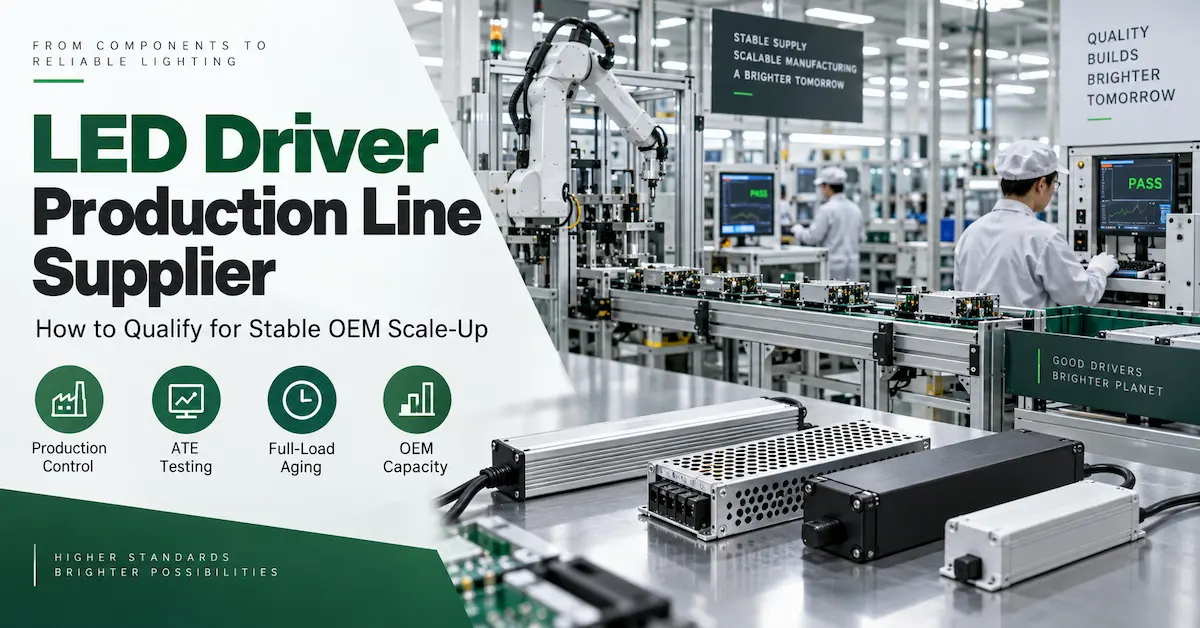
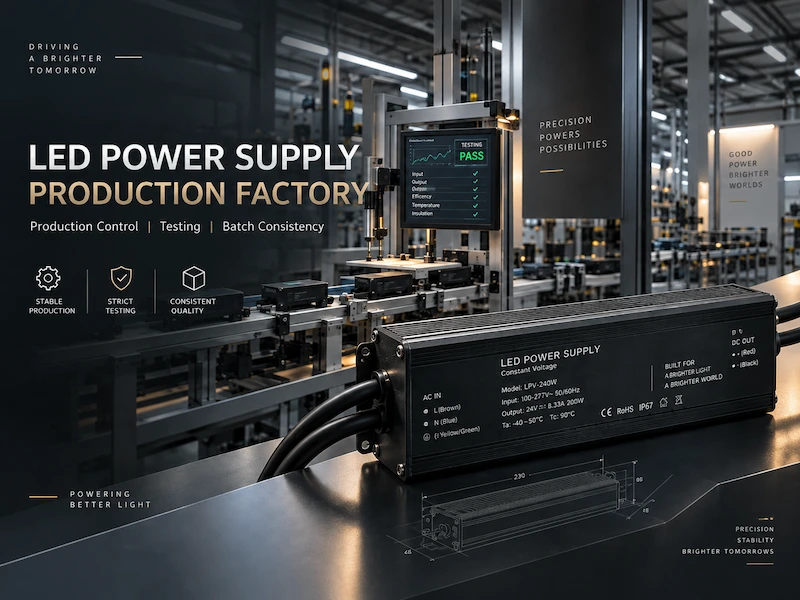
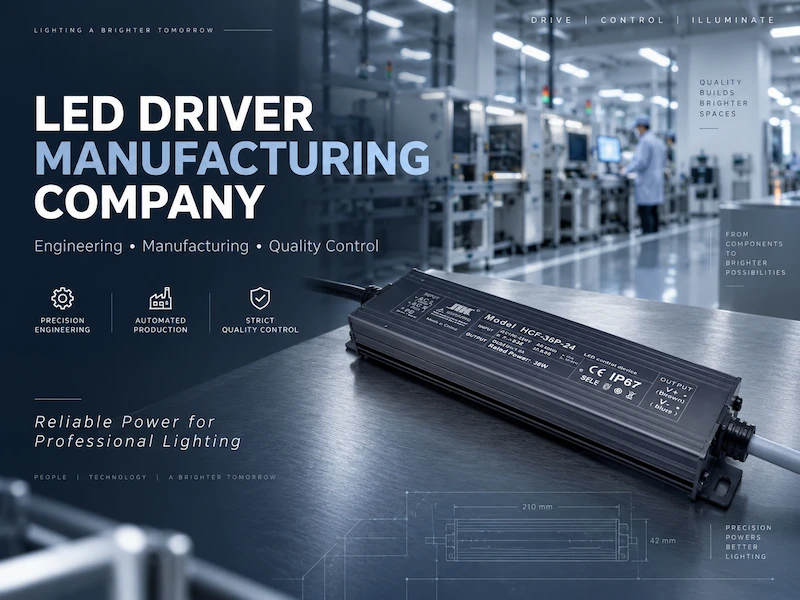
An LED power supply production line should deliver finished units that match the agreed specification and have completed the required manufacturing and inspection steps. For a buyer, the useful evidence is not just a conveyor, an assembly video, or one working sample. It is the connection between the order, components, assembly instructions, test results, and released shipment. This guide focuses on sourcing finished power supplies for lighting, signage, and repeat OEM programs—not buying turnkey production machinery. A practical evaluation starts with one question: Can the factory demonstrate how one identifiable batch moves from approved requirements to shipment release?
What JMHC Publishes About Its Manufacturing Capabilities
JMHC’s company and manufacturing overview describes integrated design, research and development, production, and sales of LED switching power supplies. The company reports a manufacturing area exceeding 5,000 square meters, annual capacity above five million power supplies, automatic vacuum glue-filling lines, automated test equipment, and 100% full-load aging. These company-level capabilities do not establish a particular order’s cycle time or delivery allocation. Confirm model-specific test limits, aging duration, and available production slots separately.
How Does an LED Power Supply Production Line Work?
JMHC’s bulk-production guide outlines a route covering order review, incoming inspection, production preparation, assembly, electrical checks, potting and curing where required, automated testing, full-load aging, and final inspection and packaging. Request the actual route for the chosen model, including manual operations. Have the quality team identify where approval is required and how failed units leave the normal production flow.
Convert the Product Specification Into Production Checkpoints
Before assessing equipment, agree on what the LED power supply production line must reproduce. Use a specification sheet that connects each requirement to an inspection method and an approval record. Avoid entries such as “standard cable” or “normal output” when several configurations are possible. Use the following buyer checklist to set model-specific requirements rather than applying one specification across the range.
| Specification Area | What to Define | Evidence to Request |
|---|---|---|
| Product identity | Factory model, customer item code, and revision | Order and production-document match |
| Input | Approved voltage range and frequency | Applicable datasheet and test conditions |
| Output | Constant-voltage or constant-current type, rating, and tolerance | Model-specific electrical limits |
| Load and power | Rated output and agreed loading conditions | Test setup and acceptance record |
| Circuit and materials | Board revision, bill of materials, and approved alternatives | Material-release and change records |
| Mechanical construction | Housing, dimensions, mounting, and assembly requirements | Drawing and first-article inspection |
| Wiring | Cable specification, length, polarity, and connector | Wiring drawing and inspection result |
| Environmental protection | Required construction and installation conditions | Applicable process and validation records |
| Control functions | Dimming interface and configuration, where required | Approved functional-test plan |
| Identification and packing | Label, carton, quantity, and included documents | Final inspection and packing record |
Six Checkpoints to Review on the Production Line
1. Incoming Materials and Circuit-Board Assemblies
Start with the materials actually assigned to the order. Ask the factory to connect a selected component or circuit-board batch to its purchasing reference, incoming inspection, and release status. Include housings, cables, connectors, and encapsulation materials where applicable, rather than reviewing only electronic components. Also establish the manufacturing boundary: which board-assembly operations happen in-house, which arrive as subassemblies, and who approves them? Do not infer a complete in-house surface-mount production system from photographs of final assembly. For repeat orders, request the procedure for handling unavailable components and evaluating proposed alternatives before they enter production.
2. First-Article Approval and Assembly Workmanship
At the start of a run or after a configuration change, ask to see the first completed unit checked against the production documents. Have qualified personnel explain how board identity, soldered connections, cable polarity, fixings, and housing assembly are verified. Then ask what happens when that first unit does not match. A useful audit exercise is to compare the instruction at the workstation with the approved drawing: are both the same revision, and can the operator identify the correct variant? JMHC’s batch-quality guidance includes first-article inspection, component control, and in-process checks among the areas buyers should review.
3. Vacuum Glue Filling, Sealing, and Curing
For products requiring encapsulation, extend the review beyond the filling machine. Ask which material reference and batch are used, what fill requirements apply, and what authorizes the product to move forward after curing. JMHC’s bulk-production guidance identifies potting material, filling quantity, coverage, cable-entry sealing, and curing as relevant controls for waterproof models. Request records for the selected construction rather than assuming that vacuum equipment proves every finished unit meets its environmental requirement. Confirm the applicable verification method separately.
4. Automated Electrical Testing
Automated test equipment, or ATE, needs a model-specific test program to be meaningful in a production review. Ask the quality team to demonstrate how the correct program is selected and how its limits relate to the approved input, output, load, and functional requirements. Request a representative result showing measured values where available, rather than relying only on a green “PASS” display. For an LED power supply production line handling several versions, also ask how an incorrect model selection is prevented or detected. Keep test coverage explicit: which checks apply to every unit, which are sampled, and which belong to separate engineering validation? JMHC discusses electrical testing and ATE in its reliability guidance.
5. Full-Load Aging and Failure Handling
JMHC reports 100% full-load aging, but that percentage does not specify the duration, ambient conditions, or monitoring method. Ask for those details for the selected model, together with the required loading and completion criteria. During the review, follow both a passing unit and the documented route for a failure: who records the issue, who authorizes repair or rejection, and what must be repeated before release? Do not turn an aging statement into a lifetime guarantee. The useful purchasing question is whether the agreed screening process was completed and whether exceptions remain visible in the batch record.
6. Final Inspection, Packaging, and Batch Identification
Finish the review at the shipping carton and work backward. Ask whether its product code and batch reference can be connected to the approved configuration, inspection status, and packing quantity. Check labels, output variants, cable arrangements, accessories, and included documents against the order. Agree whether traceability is batch-based or unit-based; do not assume individual serial-number tracking unless confirmed. As a practical control, request separate counts for accepted products, units awaiting review, repaired units, and rejected units. The packing total should reconcile with the quantity authorized for shipment, not simply the quantity that entered assembly.
Use Actual Product Models to Make the Review Specific
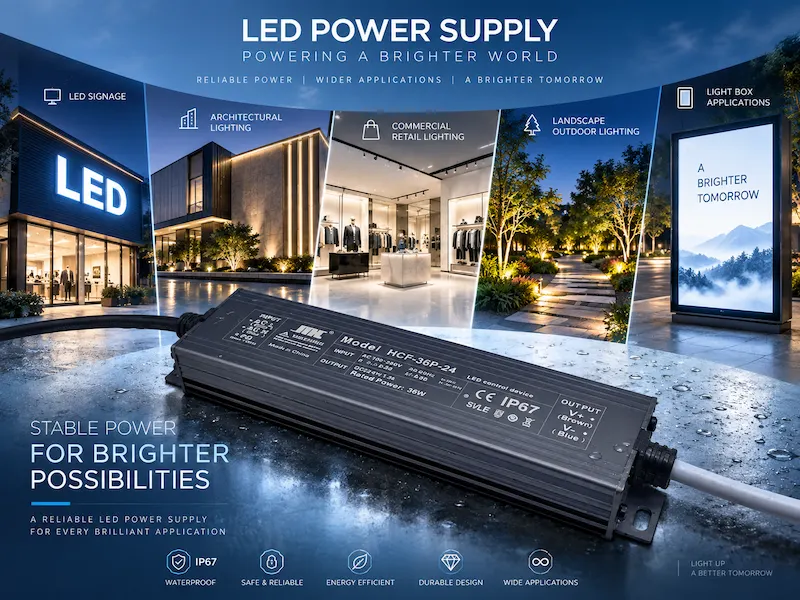
When reviewing an LED power supply production line, select a model close to the product you intend to buy. JMHC’s waterproof power supply range includes the three reference products below. Their published features help define the discussion, while the suggested production checks show what to investigate. They are not interchangeable solely because all three are listed as IP67, and the table does not establish a relative quality or price ranking. Confirm the exact output version and approved configuration before comparing quotations.
| JMHC Reference Model | Published Features | Application Direction to Assess | Production Review Focus |
|---|---|---|---|
| HCF-A Series 10W | Compact 10W, IP67 waterproof supply | Lower-power outdoor and commercial lighting | Correct version, cable arrangement, compact assembly, and specified load test |
| HCF-C Series 20W | Compact 20W, IP67 waterproof supply | Signage, light boxes, and decorative lighting | Material identity, sealing construction, wiring, and electrical acceptance |
| HCF-P Series 36W PFC | 36W, IP67, published power factor up to 0.95 | Projects with a defined power-factor requirement | Applicable input/load conditions, PFC-related checks, and correct test configuration |
These product descriptions come from JMHC’s model pages. In particular, the HCF-P figure of 0.95 refers to power factor; it is not a published 95% conversion-efficiency figure. Request the relevant operating conditions rather than treating the headline value as a result under every load.
Separate Production Testing From Qualification and Certification
Ask the quality manager to classify each requirement before approving the inspection plan: routine unit inspection, sampled batch check, design qualification, or supporting certification documentation. Do not treat these as substitutes. For example, request separate evidence for the model’s environmental qualification and the routine manufacturing controls intended to preserve that construction. Likewise, do not interpret an ATE pass as proof that every marketing claim has been tested. JMHC’s customization guidance emphasizes model-, modification-, and market-specific document review. Resolve differences between the production configuration and supporting documents before releasing artwork.
Evaluate Production Capacity Through Accepted Output
Check the Stages That Determine the Delivery Date
For delivery planning, evaluate LED power supply production line capacity by stage rather than dividing an annual factory figure into a daily promise. Ask about material readiness, assembly allocation, required curing time, testing availability, aging positions, and final inspection. Request the schedule for your actual product mix, including changeovers and other committed orders. A useful delivery plan states when a batch is expected to finish all release requirements—not merely when assembly begins. Where information is provisional, identify the dependency and the person responsible for confirming it.
Keep First-Pass Results Separate From Recovered Units
Use a simple hypothetical example—not JMHC production data. Suppose 1,000 units enter a run, 960 pass the agreed inspection sequence without rework, 25 additional units pass after approved repair and retesting, and 15 remain on hold. First-pass yield is 96%, while the accepted proportion at that point is 98.5%. Those numbers describe different outcomes; reporting only the latter hides the rework effort. When comparing suppliers, define the start and end points of the measurement and request the same calculation basis. For this example, only 985 units are accepted; the remaining 15 must not be counted as shipment-ready output.
Bring OEM and ODM Changes Into the Production Instructions
For an OEM or ODM order, ask how the LED power supply production line receives the final engineering release. Identify label, connector, output, and housing changes in the relevant production documents—not only in email. Request a changeover review covering materials, workstation instructions, test settings, and packaging. JMHC’s LED driver customization guide discusses linking custom requirements to samples and production approval. Apply that principle to the first production run: approve the complete configuration, retain its revision, and establish what requires renewed review before a repeat order is manufactured.
Compare the Cost of the Approved Manufacturing Scope
When comparing LED power supply production line capabilities, separate the product quotation from optional development and verification work. Ask what the unit price includes and which charges apply to samples, tooling, custom wiring, packaging, additional testing, or document review. Compare suppliers against the same configuration and inspection requirements. Also agree how an incomplete or nonconforming batch will be handled, including communication, rework approval, retesting, and delivery revisions. This is a more useful commercial comparison than choosing a lower price for an order whose manufacturing and acceptance conditions remain undefined. Do not assume that additional automation automatically produces either the lowest cost or the best fit for your order.
What to Request Before Approving a Production Order
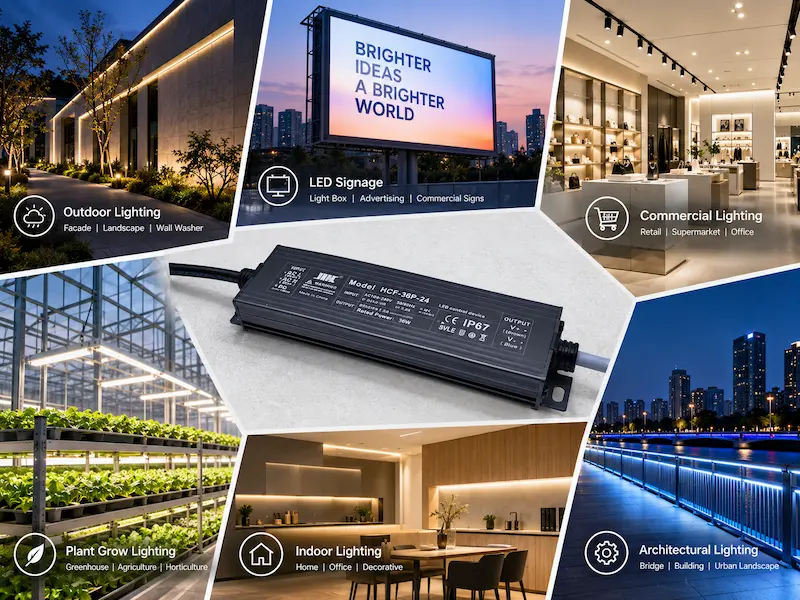
Prepare a focused review package: application, input and output requirements, load, installation conditions, drawings, quantity by model, target market, delivery expectations, and customization details. Ask the supplier to respond with a proposed product configuration, production route, inspection coverage, unresolved questions, and an order-specific schedule. JMHC’s application-based power supply solutions describe voltage and wattage matching, application customization, engineering support, and mass-production support. For a factory review, request permission to trace one representative batch and examine the records relevant to it; confirm access and confidentiality arrangements beforehand rather than assuming all internal records can be shared.
Frequently Asked Questions
1. What does an LED power supply production line include?
Use material preparation, assembly, electrical testing, relevant sealing or potting, aging, and final inspection as the initial process map. Request the exact route for your model, including inspection points and the records needed before shipment.
2. Does the production line need to be fully automated?
Evaluate how each operation meets the product requirements rather than using automation percentage as the main purchasing criterion. Ask which tasks are automated, which require manual work, and how both types are checked and documented.
3. Does a final-assembly line prove that all circuit boards are made in-house?
No. Ask the manufacturer to identify its own operations and any purchased subassemblies. Include supplier qualification, incoming acceptance, and engineering-change responsibilities in the review instead of inferring the entire manufacturing chain from an assembly photograph.
4. How long should full-load aging take?
Obtain a model-specific answer covering duration, load, conditions, monitoring, and completion criteria. JMHC’s published 100% coverage statement does not establish one universal duration. Confirm the aging time in the approved test plan.
5. Does vacuum glue filling alone prove an IP67 rating?
Do not accept the machine description as the full evidence package. Request the model’s relevant protection documentation and the production controls for materials, filling, curing, housing, and cable entries. Keep installation conditions within the confirmed product scope.
6. What should buyers check for dimmable driver production?
Include the approved control configuration in the production specification. Ask which functional states are checked routinely and which controller-and-load combinations were evaluated during qualification. Avoid treating basic output testing as a substitute for the agreed dimming checks.
7. How can I compare quality figures from different factories?
Ask what each figure counts. Confirm the batch size, inspection sequence, handling of reworked units, reporting period, and status of products on hold. Compare first-pass results separately from the final accepted quantity using equivalent definitions.
8. Can a standard line support a private-label order?
Ask which product, wiring, identification, and packaging changes are feasible on the selected platform. Before approval, confirm how those changes reach production instructions and final inspection. Do not assume branding approval also approves an electrical modification.
9. What determines production lead time?
Request a schedule covering material availability, production allocation, required processing and testing, approvals, and shipment release. Establish which milestone starts the quoted period and which buyer-dependent decisions can change it. Annual capacity alone is not an order commitment.
10. Which records should be agreed before shipment?
Agree on the approved configuration, relevant inspection and aging evidence, batch identification, final accepted quantity, and packing details. Identify any outstanding deviations and who can authorize release. Record availability and the required level of detail before ordering.
Conclusion
An LED power supply production line is best evaluated through the product and records it produces, not only the equipment visible during a tour. Start with one model, define its requirements, follow its materials and assembly route, review testing and aging, and reconcile the accepted batch with the shipment. Keep published factory capability separate from the capacity and inspection scope committed to your order. To discuss a production program, send JMHC your application, electrical requirements, quantity by model, customization needs, and delivery target, and request a product-specific manufacturing and quality review before bulk approval.