
What Does an LED Power Supply ODM Manufacturer Actually Do?
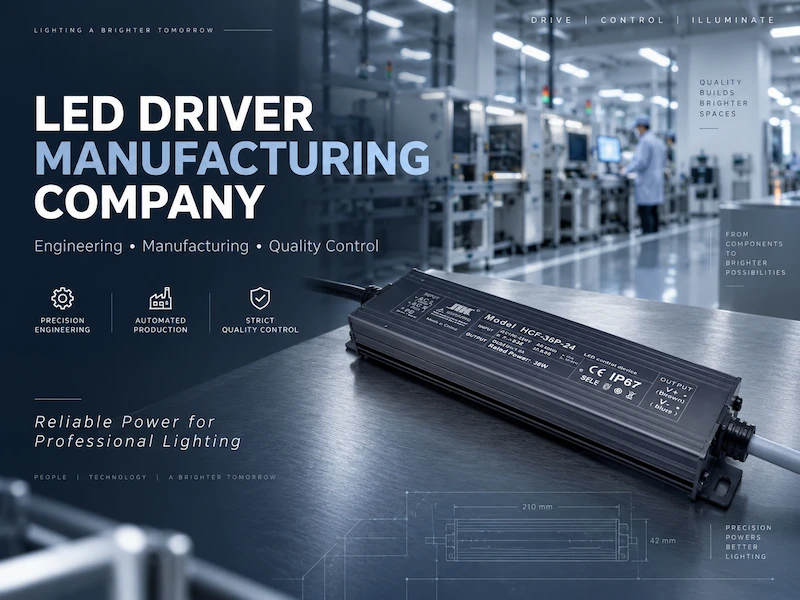
An LED power supply ODM manufacturer should do more than manufacture an existing power supply with a different label. In a true ODM project, the buyer starts with an application requirement, commercial target, product concept, or technical limitation, while the manufacturer contributes engineering work needed to turn those requirements into a manufacturable power solution. Depending on project depth, this can include requirement analysis, electrical design, thermal evaluation, mechanical integration, prototyping, application testing, production preparation, and mass-production control. JMHC describes its ODM approach around product definition, circuit design, prototyping, thermal optimization, and production integration, which makes ODM more suitable than a standard catalog purchase when a lighting brand needs a power supply adapted to a specific fixture, installation condition, control system, or differentiated product strategy.
The important distinction for buyers is responsibility. With a standard product, you select an existing platform. With OEM, much of the basic design is already defined and the manufacturer produces an agreed configuration, potentially with branding, cables, connectors, or packaging changes. With ODM, the manufacturer becomes more involved in product definition and engineering.Before choosing an ODM route, determine whether the project truly needs a new or substantially modified solution; if an existing product already satisfies the electrical, mechanical, environmental, and certification requirements, starting from JMHC's existing LED power supply product range may reduce unnecessary development work.
Who Should Work With an LED Power Supply ODM Manufacturer?
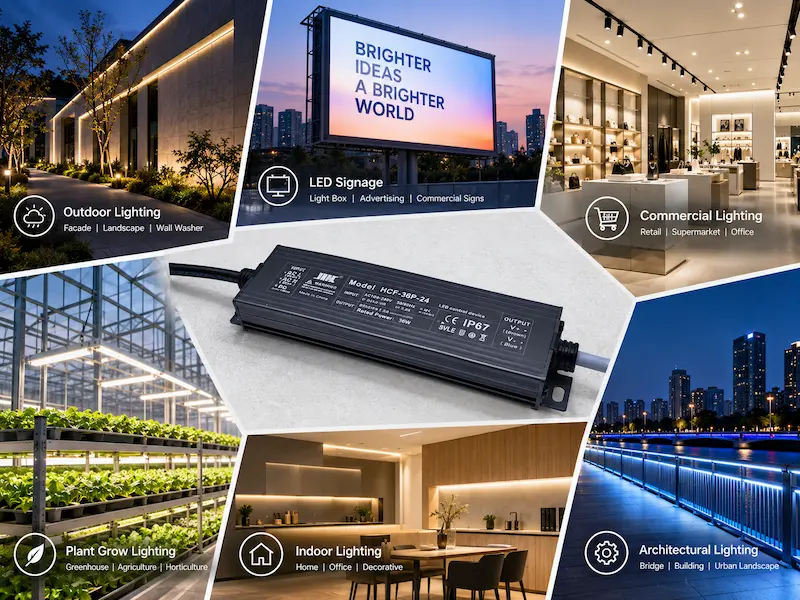
ODM is particularly relevant to lighting fixture manufacturers, LED signage brands, architectural-lighting suppliers, commercial-lighting companies, distributors developing differentiated product lines, and equipment manufacturers whose power supply must fit inside a defined mechanical or electrical system.A fixture manufacturer may need a specific form factor, cable layout, output configuration, thermal behavior, or dimming interface; an outdoor-lighting buyer may be more concerned with environmental protection and installation conditions; a distributor may need a family of related products that can be maintained consistently across repeated orders. These are different purchasing problems, so a capable LED power supply ODM manufacturer should not treat every inquiry as the same “custom power supply” request.
ODM is less useful when the buyer has not yet defined the application, target load, input requirement, output requirement, installation space, operating environment, market, or expected volume. It may also be unnecessary for a one-time purchase where a catalog model already meets the requirement. A practical first step is therefore to compare the project against JMHC's LED power supply solutions and available product platforms before deciding how much engineering customization is actually required.
Start With the Application, Not With a Wattage Number
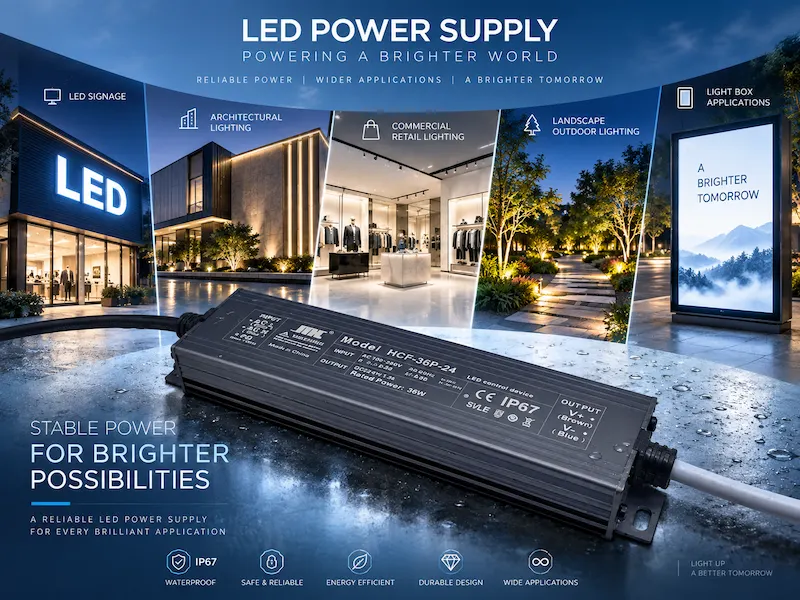
One of the most common sourcing mistakes is beginning an ODM discussion with only “we need a 100W power supply” or “we need an IP67 driver.” Wattage and an IP designation alone do not define the final application. An LED power supply may be installed inside a narrow light box, an enclosed commercial fixture, an exterior sign, architectural façade lighting, a landscape system, or another device with very different thermal, mechanical, wiring, and maintenance conditions. The engineering team therefore needs the final installation context before selecting or developing the power platform.
For indoor installations, buyers can first study JMHC's indoor power supply range; for exposed or protected outdoor applications, the waterproof power supply range provides a different starting point; projects involving lighting control should separately evaluate the dimmable LED driver category. These category pages are useful for platform selection, but the final ODM specification still needs to define the actual installation environment and model-specific conditions rather than assuming a category name alone guarantees application compatibility.
Build an ODM Requirement Specification Before Engineering Starts
A serious ODM project needs one controlled requirement document. This reduces misunderstandings between the buyer's purchasing team, lighting engineers, the LED power supply ODM manufacturer, and any certification or assembly partners. The document should distinguish between a buyer requirement, a supplier proposal, an approved value, and an unresolved item. That distinction becomes especially important after several engineering revisions, because information from an early quotation or prototype should not automatically become part of the final mass-production specification.
| Requirement Area | What the Buyer Should Define or Confirm | Why It Matters |
|---|---|---|
| Final application | Fixture, signage, light box,architectural or equipment use | Determines the engineering context |
| AC input | Required voltage range and frequency | Defines input design requirements |
| Output | Constant voltage/current requirement and required rating | Must match the LED load |
| Rated power | Required operating power and intended loading | Influences thermal and component design |
| Installation space | Maximum dimensions, mounting points and clearance | Controls mechanical feasibility |
| Environment | Indoor/outdoor location, temperature,moisture and installation conditions | Influences protection and thermal design |
| Dimming/control | Required interface and controller information | Determines compatibility validation |
| Wiring | Cable type, length, connector and exit direction | Affects fixture integration |
| Protection requirements | Required protection functions and expected behavior | Supports system-level risk management |
| Identification | Buyer code,supplier model and revision | Prevents version confusion |
| Target market | Destination country or sales market | Helps define documentation requirements |
| Quantity forecast | Prototype, pilot, initial order and annual estimate | Influences development and production planning |
This specification should remain the technical reference throughout development. If a requirement changes, record the revision and determine whether the change affects the circuit, thermal design, housing, materials, testing, certification, sample approval, or production process. That is more reliable than managing an ODM project through scattered emails and photographs.
How Should an ODM Manufacturer Approach Electrical and Thermal Design?
Electrical design should begin with the load rather than with a generic power rating.The ODM team needs to understand whether the application requires a constant-voltage or constant-current solution, the operating load range, input conditions, expected control behavior, and any relevant protection requirements. If dimming is involved, the driver and controller should be evaluated as a system; a statement such as “supports dimming” does not answer questions about controller compatibility, low-level behavior, audible noise, shutdown behavior, or operation with the actual fixture.
Thermal design is equally important because a power supply that operates correctly on an open laboratory bench may behave differently inside a compact luminaire, enclosed sign, or poorly ventilated cabinet. A useful ODM validation therefore reproduces the intended mounting arrangement and load conditions as closely as practical. Buyers should ask what temperature points are evaluated, under what ambient conditions, what load is used, whether derating applies, and whether a mechanical change requires renewed thermal evaluation. JMHC's existing ODM service information describes thermal optimization and prototype development as parts of its ODM process.
Components, Housing, Cables, and Potting Need Controlled Specifications
For a custom LED power supply, component selection should not be reduced to a request for a list of famous brands. The more useful question is which electrical and mechanical characteristics are controlled, which components are critical to performance, what substitutions are permitted, and which changes require approval. Capacitors, magnetic components, switching devices, protection devices, PCB layout, enclosure construction, cables, connectors, thermal interfaces, and potting materials can all influence the finished product, but the exact controlled items depend on the selected design.
Outdoor and waterproof products introduce additional process considerations. Potting quality, sealing, cable entries, housing construction, material preparation, and process repeatability become part of manufacturing control rather than cosmetic features. JMHC states that its manufacturing facility includes automatic vacuum glue-filling production lines for relevant products. Buyers evaluating an LED power supply ODM manufacturer should therefore go beyond asking whether the factory “uses potting” and instead confirm which process applies to their model, how the production version is defined, and how changes are controlled.JMHC's manufacturing information describes these factory capabilities in more detail.
Prototype Approval Should Test the Real Lighting System
An ODM prototype is not simply a sales sample. It represents a defined technical revision that should be evaluated against agreed requirements. Record the sample number or revision, the specification it represents, the fixture or load used, input conditions, operating duration, installation arrangement, observations, measured results, unresolved issues, and approval status. If a prototype is modified, do not continue referring to both versions as “the approved sample.” A controlled sample history makes later production verification much easier.
Application validation should also reflect the risks of the final lighting system. For a dimmable fixture, evaluate the intended dimmer and load behavior. For signage, confirm installation space, wiring arrangement, and continuous operation requirements. For a waterproof project, review the complete installation—including cables and connections—rather than treating the power-supply enclosure as the entire environmental-protection system.A successful bench test proves only what was tested under those conditions; it does not automatically validate every intended application.
How Manufacturing Capability Affects ODM Scale-Up
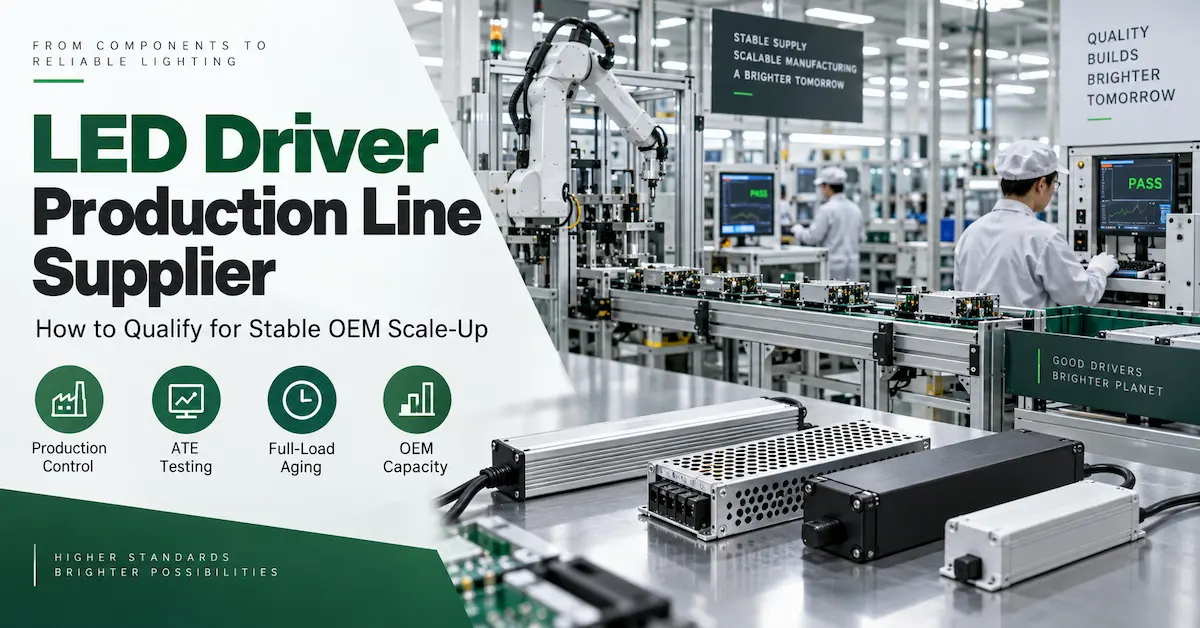
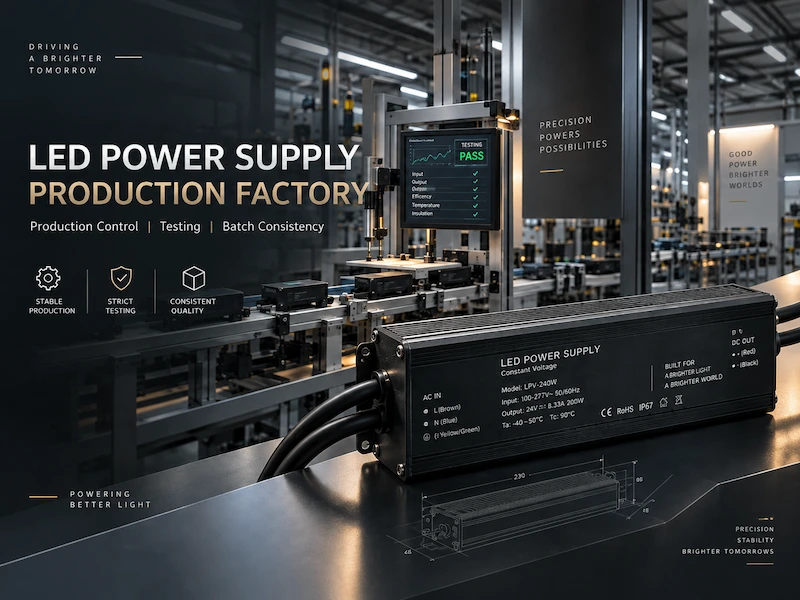
The development team can create a strong prototype, but B2B buyers ultimately need repeatable production. This is why manufacturing capability should be evaluated together with engineering capability. According to JMHC's published company information, the factory integrates design, R&D, production and sales, operates more than 5,000 m² of manufacturing space, uses automatic vacuum glue-filling lines and ATE testing equipment, reports annual production capacity above five million power supply units, and conducts 100% full-load aging. These are company-level capability statements rather than a guaranteed production allocation for an individual project, so order-specific capacity and timing still need separate confirmation.
The question buyers should ask is not simply “How large is your factory?” It is “How will my approved design be transferred into controlled production?” A good answer should address the production specification, work instructions, critical process points, approved components, testing criteria, golden sample or reference sample, labeling, packaging, revision control, and first-batch verification.This engineering-to-production transfer is one of the main differences between a credible LED power supply ODM manufacturer and a supplier that can only produce a few development samples.
ATE Testing and Full-Load Aging Should Be Defined, Not Just Mentioned
Automated test equipment can help standardize electrical checks, but buyers should ask which parameters are measured and what limits apply to the approved model. ATE ownership by itself does not prove that every relevant characteristic is evaluated. The product specification and production test criteria should agree on what is checked, how out-of-limit units are handled, and whether test records or batch traceability are available when required.
JMHC also states that its products undergo 100% full-load aging. Aging is useful as a production screening process, but it should not be presented as proof of unlimited product life. For an ODM buyer, the useful questions are the applicable aging conditions, duration, load level, monitoring method, and failure-handling procedure. Connecting these controls to the approved product specification provides more purchasing value than simply repeating the phrase “strict quality control.”
How Should Buyers Review Certifications and Compliance?
JMHC's company page lists relevant certifications and compliance items including CE (LVD and EMC), CCC, BIS, UKCA, and RoHS. However, a professional buyer should never assume that every mark or document shown on a manufacturer's website automatically applies to every product, output version, ODM modification, or destination market. The certification review should identify the exact product family or model covered, the document number or report, the applicable version, and whether a proposed design change affects coverage.
For an ODM project, certification should therefore be included early in the requirement document rather than discussed after the final prototype is complete. A change to circuit architecture, enclosure, critical components, wiring, or other controlled details can create additional review requirements. The buyer and manufacturer should agree who is responsible for documents, test samples, costs, schedules, labeling, and market-specific approvals before mass production.
Compare Existing Platforms Before Starting a Fully New Design
A fully new power supply is not always the most efficient ODM route.Existing production platforms can provide a technical reference for power range, construction style, environmental protection, and application direction. The comparison below is intended as a development starting point; the final ODM decision still requires model-specific engineering review.
| JMHC Platform | Published Direction | Potential ODM Starting Point | What Still Needs Confirmation |
|---|---|---|---|
| HCF-A Series 10W IP67 | Compact waterproof LED power supply | Small outdoor or compact lighting concepts | Output version, dimensions, wiring, environment and customization scope |
| HCF-C Series 20W IP67 | 20W waterproof platform | Signage or decorative lighting development | Actual load, installation and configuration requirements |
| HCF-P Series 36W PFC | 36W IP67 platform with published PFC feature | Commercial or project applications where power factor is part of the requirement | Required PF conditions, output, load and complete project specification |
| Indoor Power Supply Range | Compact, long-shape and indoor platforms | Fixtures, displays, light boxes and controlled indoor installations | Size, airflow, mounting and output requirements |
| Dimmable LED Driver Range | Controlled lighting platform | Commercial and architectural lighting requiring dimming | Control method, dimmer, load range and compatibility validation |
Starting from an existing platform can shorten some engineering tasks, but buyers should not assume that any requested modification is automatically simple. Even a cable, connector, housing, output, thermal, or control change may require new evaluation depending on its effect on the approved design.
Lead Time Should Be Divided Into Development Stages
There is no useful universal answer to “How long does ODM take?” because a label change, an output adjustment, a mechanical revision, and a new circuit architecture have very different engineering workloads. Instead of asking only for one delivery date, divide the project into requirement confirmation, engineering evaluation, prototype preparation, sample validation, design revision, pilot production, documentation or certification work where applicable, production preparation, and mass production.
This stage-based approach helps the buyer identify what is actually delaying the project.A late artwork approval should not be confused with a circuit-development delay; a certification test should not be reported as normal production lead time. When requesting an ODM quotation, ask the supplier to identify assumptions, buyer-dependent approvals, sample cycles, major decision points, and the event that starts the mass-production lead time.
ODM Cost Is More Than the Unit Price
A low unit quotation does not necessarily mean a lower ODM project cost. Compare engineering charges, prototype costs, tooling where applicable, certification or testing expenses, custom cables and connectors, packaging, minimum purchasing quantities, production price, logistics, incoming inspection effort, warranty exposure, and the cost of future engineering changes. Some are one-time costs and others repeat with every order, so they should not be mixed into one headline price.
The largest commercial risk is often an undefined configuration rather than a slightly higher initial price. If purchasing believes it ordered one design while production uses another revision, the consequences can include assembly delays, retesting, rework, field failures, warranty disputes, and difficult replacement management. A detailed specification, controlled sample, approved revision and documented change process therefore have direct commercial value.
A Practical LED Power Supply ODM Development Workflow
For lighting brands evaluating an LED power supply ODM manufacturer, a practical workflow is: define the application and buyer requirement first; compare existing product platforms; freeze the initial technical specification; allow engineering to assess electrical, thermal, mechanical and control requirements; manufacture a documented prototype; validate it in the actual lighting system; close technical issues; confirm certification and documentation scope; conduct pilot production when appropriate; approve the production configuration; and then release bulk manufacturing. JMHC's published ODM content similarly presents ODM as a structured development process rather than a simple customization request. Read more about JMHC LED power supply ODM development.
The final production release should identify the approved model, specification revision, relevant drawings, BOM or controlled component requirements where applicable, cables and connectors, label, packaging, testing criteria and approved sample.Future changes should follow a defined review process so a successful first order can become a repeatable product rather than a one-time development result.
What Should You Send an LED Power Supply ODM Manufacturer for Evaluation?
A useful ODM inquiry should include the final lighting or equipment application, input requirement, output requirement, power, actual load, size restrictions, mounting arrangement, indoor or outdoor environment, operating conditions, required control or dimming method, cable and connector requirements, destination market, required documentation or certifications, target cost if commercially necessary, prototype quantity, expected initial order, forecast volume and desired project schedule. Where possible, also provide mechanical drawings, photographs, existing samples, LED load information, controller information and known problems with the current solution.
JMHC provides product-selection and engineering support for application-based power-supply projects through its LED power supply solutions page.Buyers with a defined ODM requirement can then use the contact page to submit project details for technical evaluation instead of sending only a target wattage and asking for the lowest price.
Frequently Asked Questions
1. What is the difference between an LED power supply ODM manufacturer and an OEM manufacturer?
ODM generally involves greater manufacturer participation in product definition and engineering, while OEM more commonly manufactures or configures a product according to an already defined requirement. The boundary can vary by project, so the safest approach is to define exactly which design, testing, tooling, certification, production and documentation tasks each party is responsible for.
2. Do I need ODM if JMHC already has a suitable LED power supply?
Not necessarily.If an existing product meets the required electrical performance, dimensions, environment, documentation and commercial requirements, using a standard or OEM configuration may reduce development work. ODM is most useful when meaningful engineering changes or a differentiated solution are required.
3. What information should I prepare before requesting an ODM quotation?
Prepare the application, input and output requirements, load, dimensions, installation environment, control requirements, cables or connectors, destination market, expected quantity and required documentation. The more clearly these items are defined, the easier it is for the manufacturer to identify development scope and risk.
4. Can an ODM manufacturer change the power, voltage, housing and cables at the same time?
These requests can be evaluated, but they should not automatically be treated as independent cosmetic changes. Electrical, thermal and mechanical changes can interact, so the engineering team should determine whether a new prototype, validation or documentation review is necessary.
5.How should I validate an ODM LED power supply sample?
Evaluate the sample against the agreed specification and in the intended fixture or system whenever practical. Record input conditions, load, installation arrangement, thermal behavior, control compatibility, mechanical fit, wiring and any project-specific acceptance criteria.
6. Does IP67 mean the complete lighting installation is waterproof?
No. The rating of a power-supply enclosure does not automatically define the environmental protection of connectors, wiring joints, fixtures or the complete installation. Confirm the model's applicable conditions and design the complete system around the intended environment.
7. How should buyers evaluate ODM manufacturing quality?
Review how the approved design is transferred into production, including controlled specifications, components, process instructions, electrical testing, aging, waterproof processes where applicable, inspection, traceability and change management. Factory equipment is useful evidence of capability, but the buyer should understand how it is applied to the selected product.
8.Does JMHC offer testing for ODM production?
JMHC states that its manufacturing system includes ATE testing equipment and 100% full-load aging, with automatic vacuum glue filling used in relevant production processes. The exact test items, limits and process for an ODM model should still be confirmed during project approval.
9. How should certification requirements be handled in an ODM project?
Identify the destination market and required documents at the beginning of the project, then determine which existing reports or certifications apply to the proposed design and whether modifications require additional review or testing. Avoid assuming that a company-level certification list applies unchanged to every custom model.
10. What is the best way to reduce repeat-order risk after ODM development?
Create a controlled production specification linked to the approved sample, model number, drawings, key materials or components, cables, labels, packaging and test requirements. Require documented review before implementing relevant design or production changes so future orders remain tied to the same approved product definition.
Conclusion
Selecting an LED power supply ODM manufacturer is fundamentally a product-development and supply-chain decision. Lighting brands should evaluate whether the manufacturer can translate application requirements into a controlled electrical and mechanical design, validate prototypes under realistic conditions, manage materials and manufacturing processes, define meaningful quality tests, support required documentation, and reproduce the approved configuration during mass production. Existing products can provide a useful starting platform, but a successful ODM project still depends on clear requirements, revision control, application validation and transparent responsibility between buyer and manufacturer. JMHC combines existing indoor, waterproof and dimmable power-supply platforms with design, R&D, manufacturing, ATE testing, automatic vacuum glue filling and full-load aging capabilities described on its About Us page.For a project-specific assessment, submit your application, input/output requirements, load, installation environment, dimensions, control requirements, target market and estimated quantities through JMHC Contact Us so the appropriate existing platform or ODM development route can be evaluated.