What Does an LED Driver Factory Direct Supplier Mean for B2B Buyers?
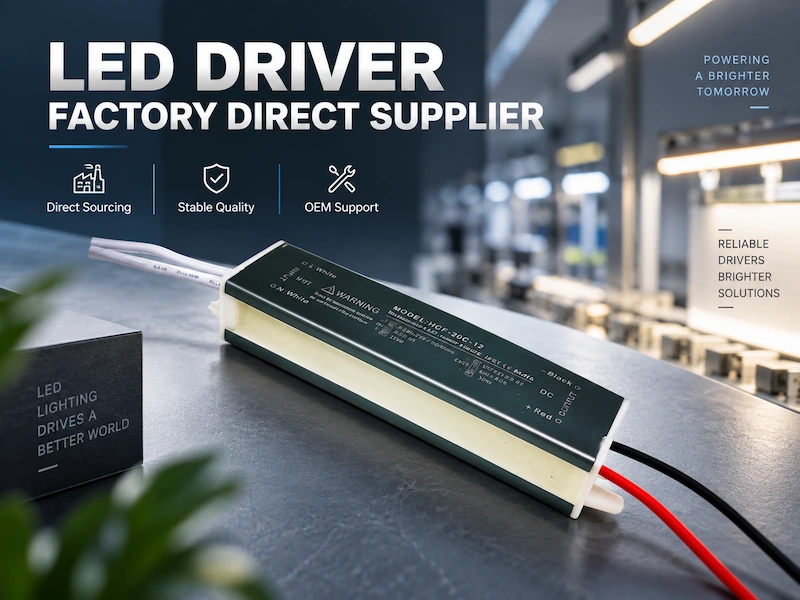
An LED driver factory direct supplier should provide a purchasing route in which the buyer communicates directly with the organization responsible for the relevant manufacturing, engineering, quality, and production decisions. For lighting distributors and OEM brands, the practical benefit is not simply the absence of another company in the transaction; it is the ability to connect an application requirement, approved model, quotation, production specification, test requirement, and repeat order through one controlled supply relationship. JMHC manufactures LED switching power supplies and maintains waterproof, indoor, dimmable, and other LED power supply product platforms, giving buyers a starting point for product selection before customization or bulk-production requirements are discussed. Direct sourcing is most valuable when that communication reduces ambiguity between what sales quotes, what engineering approves, and what production eventually manufactures.
Who Benefits Most From Factory-Direct LED Driver Sourcing?
Factory-direct sourcing is especially relevant to lighting distributors building a repeat product range, fixture manufacturers integrating a driver into their own luminaire, LED signage companies purchasing multiple power levels, private-label brands managing custom product identities, and engineering buyers who need model-specific documentation or technical coordination. These customers often need more than one shipment, so long-term consistency matters as much as the first price. A small buyer purchasing a few standard replacement units may not require the same depth of manufacturing involvement, while an OEM customer with custom cables, dimming requirements, packaging, or environmental conditions may need direct engineering support from the beginning. Buyers can first compare the requirement against JMHC's LED power supply solutions to decide whether a standard platform, OEM configuration, or deeper ODM route is appropriate.
Factory Direct Does Not Automatically Mean the Lowest Price
One of the most common misconceptions is that an LED driver factory direct supplier must always provide the lowest unit price. Direct sourcing can reduce some communication layers, but the final quotation still depends on product architecture, power level, materials, wiring, packaging, test scope, documentation, customization, order quantity, and delivery requirements. Two suppliers can quote “36W LED driver” while actually offering different construction, cables, environmental protection, quality-control scope, or commercial terms. Instead of asking only, “What is your factory price?”, ask, “What exact configuration does this price cover?” A meaningful direct quotation should identify the model, electrical version, cables or connectors, packaging, customization scope, test expectations, and order quantity so that competing offers describe comparable products.
Prepare a Factory-Direct RFQ Before Comparing Suppliers
A professional RFQ reduces assumptions before price negotiation begins. The buyer should distinguish required values from preferred values and leave unknown items open for engineering confirmation rather than guessing. This also helps the factory determine whether an existing production platform already fits the project.
| RFQ Item | What the Buyer Should Provide | What the Supplier Should Confirm |
|---|---|---|
| Application | Fixture, signage, architectural, retail or other use | Suitable product platform |
| Input | Required AC range and frequency | Supported input specification |
| Output | Constant voltage/current requirement and rating | Exact production version |
| Power/load | Actual LED load and target rated power | Suitable operating range |
| Installation | Available dimensions and mounting conditions | Mechanical compatibility |
| Environment | Indoor/outdoor conditions and exposure | Appropriate protection level |
| Wiring | Cable length, polarity and connector | Available or custom configuration |
| Control | Dimming/control method where required | Applicable driver platform |
| Market | Destination country or region | Relevant document scope |
| Branding | Label, SKU and packaging requirement | Customization feasibility |
| Quantity | Sample, first order and forecast | MOQ and capacity to be confirmed |
| Schedule | Required project milestones | Order-specific lead-time plan |
For complex projects, include fixture drawings, LED-module information, controller details, current product samples, installation photographs, and known technical problems. A complete RFQ gives an LED driver factory direct supplier enough information to recommend the correct platform instead of quoting a generic wattage.
Start With the Application Before Choosing the Product
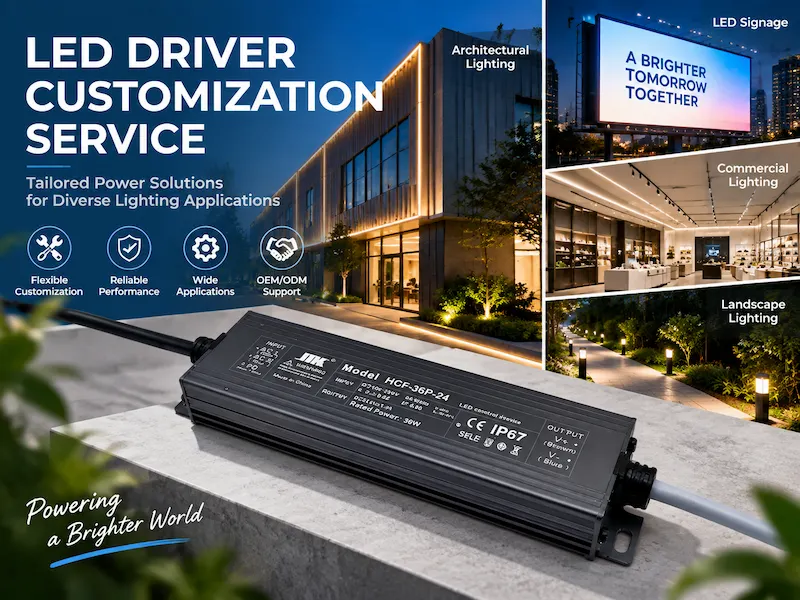
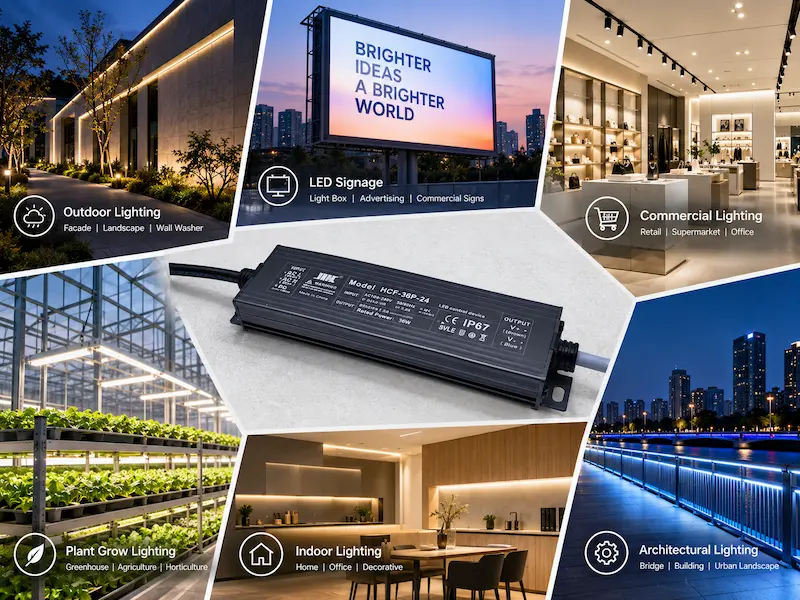
The selected driver should match the final lighting environment rather than merely the requested power rating. An indoor light box may prioritize compact dimensions and accessible wiring, while a landscape project may prioritize environmental protection; commercial lighting can introduce dimming and low-load behavior, and an LED signage project may require particular cable lengths or installation arrangements. JMHC separates its catalog into indoor power supplies, waterproof power supplies, and dimmable LED drivers, among other categories. These product families provide useful starting points, but a category name does not replace model-specific approval: actual voltage, load, size, control method, operating conditions, and installation still need to be confirmed before bulk purchase.
Use Existing Production Platforms Before Requesting Unnecessary Custom Design
Factory-direct cooperation does not mean every buyer needs a new circuit. Existing production models can often provide a lower-risk starting platform because their basic construction and manufacturing route are already defined. Buyers can then determine whether the real requirement is simply a suitable standard product, a private-label version, a cable or connector change, or deeper OEM/ODM development. JMHC currently presents several waterproof platforms that are useful for this initial comparison.
| JMHC Platform | Published Positioning | Potential Buyer Use | Key Question Before Ordering |
|---|---|---|---|
| HCF-A Series 10W IP67 | Compact waterproof platform | Lower-power outdoor or signage products | Does the output, size and wiring match the application? |
| HCF-C Series 20W IP67 | 20W waterproof platform | Signage and decorative lighting | Which electrical and cable version will be supplied? |
| HCF-P Series 36W PFC | 36W waterproof platform with PFC | Commercial and project requirements | Under which load and input conditions does the published PF apply? |
The HCF-P's published PF value should be understood as power factor, not conversion efficiency. This distinction illustrates why direct technical communication matters: procurement documents should preserve the meaning of each electrical parameter rather than reducing several performance indicators to a generic “high efficiency” claim.
How Do You Verify That a Supplier Is Actually Connected to Manufacturing?
A buyer should evaluate evidence rather than relying on the words “factory direct” in an advertisement. Ask who controls product engineering, who issues the production specification, where final assembly and relevant waterproof processes occur, who defines electrical test limits, who manages aging and inspection, and who handles an engineering change after a sample is approved. JMHC describes manufacturing capabilities including automatic vacuum glue filling for relevant products, ATE testing, and full-load aging on its About Us page. For sourcing purposes, the stronger question is how these capabilities apply to your selected model. A factory-tour photograph proves that equipment exists; a controlled model-specific process shows how it contributes to the product you are buying.
Quality Control Should Follow the Product From Sample to Shipment
A successful sample does not automatically guarantee a successful bulk order. Component batches can change, operators can assemble the wrong variant, wiring can differ from the approved sample, and packaging or labels can be mixed when several similar products are manufactured together. Buyers should therefore link the approved sample to a defined specification revision and require the bulk product to follow that reference. Quality review can cover incoming materials, first-article confirmation, process controls, electrical testing, aging, final inspection, and packing. For waterproof products, the review should also include relevant sealing or potting processes. The goal is not to ask for every possible factory record; it is to define which evidence confirms that the product shipped is the product originally approved.
ATE Testing Needs the Correct Program and Acceptance Limits
Automated test equipment can support consistent production inspection, but automation alone does not tell the buyer what has been verified. Ask which electrical characteristics are checked for the selected model, how the factory selects the correct program, and how different voltage or power variants are distinguished. A “PASS” result is meaningful only when the test limits correspond to the approved product specification. This is another advantage of dealing with an LED driver factory direct supplier: the buyer can connect engineering requirements to production testing instead of relying on a generic statement that “all products are tested.”
Full-Load Aging Should Be Treated as Production Screening
JMHC states that its manufacturing system includes 100% full-load aging. For a professional sourcing decision, buyers should understand what that statement does and does not establish. “100%” describes the stated coverage; it does not automatically define test duration, environmental conditions, monitoring, or field lifetime. Ask what conditions apply to the selected production model, how failed products are handled, and whether repaired units require additional testing. Aging should support production screening and shipment confidence without being converted into unsupported claims about unlimited lifetime or zero failure.
Review Certifications by Model, Version, and Target Market
A direct supplier relationship can make documentation communication easier, but buyers still need to verify scope. Company pages may list CE-related LVD/EMC, CCC, BIS, UKCA, RoHS, or other documentation, yet this does not mean every item automatically applies to every model, output version, customized construction, or destination market. Before printing compliance statements on private-label packaging, connect the document to the actual production configuration. If an OEM modification changes the circuit, critical component, housing, wiring, or another controlled detail, confirm whether additional review is required. Direct access to the factory should help resolve these questions earlier, not encourage buyers to skip them.
How Can Factory-Direct Supply Support OEM and Private Label Projects?
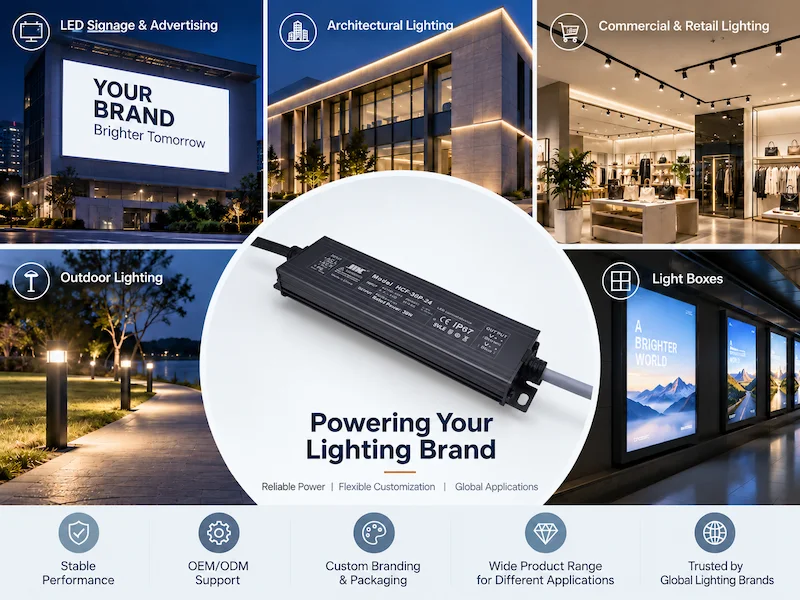
An LED driver factory direct supplier can be particularly useful when a lighting brand needs its own product identity or assembly configuration. Potential project requirements can include labels, SKU references, packaging, cables, connectors, and other approved changes, while deeper ODM work may involve electrical, thermal, mechanical, or control-system development. Buyers should define each requested change independently because a custom label and an electrical redesign do not carry the same engineering risk. JMHC's OEM supplier guide explains the value of starting from an established production platform when it already meets most requirements. Before mass production, the final approval should connect the factory model, customer SKU, output version, relevant drawings, wiring, label, packaging, test criteria, and approved sample.
Direct Supply Should Improve Change Communication on Repeat Orders
Repeat orders are where a direct manufacturing relationship can provide significant operational value. A buyer should not need to rediscover the product specification every time a purchase order is placed. Establish a configuration record and define which changes require notification or renewed approval. If a cable supplier changes, a connector is replaced, a component becomes unavailable, or packaging artwork is revised, the impact should be evaluated before the new version enters production. A controlled change process helps purchasing, engineering, quality, warehouse, and after-sales teams continue referring to the same product definition. This is more valuable than simply receiving the same model name on an invoice.
How Should Distributors Evaluate MOQ, Capacity, and Lead Time?
Factory-direct sourcing does not eliminate production planning. A manufacturer still needs materials, line allocation, process capacity, testing, aging, inspection, and packaging time. JMHC reports manufacturing capabilities at company level, but buyers should request an order-specific answer for MOQ and lead time because model mix, customization, packaging, materials, and quantity can change the production plan. Ask whether MOQ applies per model, per electrical version, or per customized package; ask what milestone starts the quoted lead time; and distinguish sample preparation from mass-production timing. For distributors carrying several wattages, also ask whether mixed-model orders can be planned together or whether each SKU follows separate minimum quantities.
Compare Total Sourcing Cost, Not Just Factory Unit Price
A direct factory quotation should be evaluated as part of total sourcing cost. Include samples, product customization, special wiring, packaging, tooling where applicable, certification or testing work, shipping, incoming inspection, warranty exposure, and the operational cost of maintaining several SKUs. A slightly lower unit price can lose its advantage if product identification is inconsistent, the wrong version arrives, documentation is incomplete, or repeated engineering questions delay fixture production. Conversely, buyers should not assume a direct supplier deserves a higher price simply because it owns manufacturing equipment. Compare the complete agreed scope and the risks each supplier is prepared to control.
A Practical LED Driver Factory Direct Supplier Audit Workflow
When evaluating an LED driver factory direct supplier, start with a real purchasing requirement and follow it through the supplier's system. Confirm the application and target specification, identify a suitable existing platform, obtain the correct datasheet and quotation, approve a sample, confirm the production revision, review manufacturing and testing controls, verify the document scope, agree packaging and identification, establish MOQ and delivery milestones, and define how future changes will be managed. JMHC's existing factory-direct sourcing article provides additional context on the relationship between manufacturing control and project stability, while its production factory guide focuses more specifically on factory audit and batch-production controls. Using these topics together gives buyers a clearer path from supplier qualification to repeat ordering.
What Should You Send JMHC for a Factory-Direct Quote?
To obtain a useful quotation, send the final application, required input and output, actual LED load, wattage, available dimensions, mounting conditions, indoor or outdoor environment, required control method, cable and connector details, target market, documentation needs, branding or packaging requirements, sample quantity, expected first order, forecast demand, and required schedule. Where available, add fixture drawings, photographs, LED module data, or the current driver you intend to replace. Submit the project through JMHC Contact Us so the team can evaluate whether an existing product, OEM configuration, or ODM development route matches the requirement instead of quoting only from a wattage number.
Frequently Asked Questions
1. What is an LED driver factory direct supplier?
An LED driver factory direct supplier provides LED drivers through a manufacturer-connected supply relationship in which product selection, manufacturing, technical requirements, and production issues can be coordinated directly with the responsible organization. Buyers should still verify the manufacturer's actual operations rather than relying only on the phrase “factory direct.”
2. Is buying factory direct always cheaper?
No. Price depends on configuration, materials, quantity, customization, packaging, testing, documentation, and delivery terms. Factory-direct sourcing can reduce communication layers, but buyers should compare the complete product and commercial scope rather than assume an automatic price advantage.
3. How do I verify that a supplier is a real factory?
Review its manufacturing operations and ask who controls engineering, production specifications, assembly, testing, quality inspection, and engineering changes. During an audit, trace one actual model from approved specification through production and shipment rather than evaluating workshop photographs alone.
4. What information should I provide for an accurate LED driver quotation?
Provide the application, input and output requirements, load, wattage, dimensions, environment, control method, cables, connector, destination market, documentation, customization, quantity, and required schedule. Complete information reduces quotation assumptions.
5. Can I order private-label LED drivers directly from a factory?
Private-label projects can be evaluated using an existing production platform where appropriate. Buyers should define branding, labels, packaging, electrical configuration, cables, and any additional modifications separately and obtain approval for the final production version.
6. Can factory-direct suppliers support custom cables and connectors?
Suitable projects can be evaluated for cable or connector changes, but the buyer should provide clear specifications including cable type, length, connector reference, pin arrangement, and installation requirements. The factory should confirm feasibility for the selected model before production.
7. How should I compare waterproof LED driver suppliers?
Compare the exact model, electrical requirement, construction, cables, applicable protection documentation, production process, testing, and intended installation. Do not compare products only by wattage and the word “waterproof.”
8. Does factory-direct sourcing guarantee faster lead time?
No. Lead time still depends on material availability, production allocation, customization, testing, aging, packaging, quantity, and buyer approvals. Ask for an order-specific schedule and clarify which milestone starts the quoted lead time.
9. How can a distributor reduce repeat-order inconsistency?
Use a controlled configuration containing the manufacturer model, customer SKU, electrical version, approved cables, label, packaging, relevant documents, and revision. Agree which changes require notification or renewed approval before a later batch is produced.
10. What is the difference between factory direct, OEM, and ODM?
Factory direct describes the sourcing relationship. OEM describes manufacturing an agreed product or customized configuration for the buyer, while ODM generally involves deeper product-definition and engineering participation by the manufacturer. A single project can therefore be factory-direct and also involve OEM or ODM services.
Conclusion
Choosing an LED driver factory direct supplier should be treated as a long-term sourcing and supplier-qualification decision rather than simply a search for a lower factory price. B2B buyers should verify that product recommendations match the final application, quotations describe the same approved configuration, manufacturing and testing processes support repeatable production, documentation applies to the selected model, and OEM/ODM changes remain controlled across future orders. JMHC provides indoor, waterproof, and dimmable LED power-supply platforms together with manufacturing, ATE testing, relevant vacuum glue-filling processes, full-load aging, and application-based customization capabilities described across its website. Buyers planning distribution, private-label, fixture-manufacturing, or project orders can review the JMHC product range and submit detailed requirements through JMHC Contact Us for a product-specific factory-direct sourcing evaluation.