Why Private Label LED Drivers Are Becoming Popular Among Lighting Brands
Launching a lighting product line requires more than selecting a good LED driver.
For many companies, building an internal power supply manufacturing system is unrealistic. It requires electrical engineers, production equipment, testing systems, compliance management, inventory control, and long-term supplier management.
This is why many lighting brands choose a LED driver private label supplier.
A private label supplier allows companies to sell LED drivers or complete lighting products under their own brand while relying on an experienced manufacturer for production.
The business model is attractive because it helps buyers:
- enter the market faster;
- reduce manufacturing investment;
- create branded product lines;
- maintain repeat supply;
- focus resources on sales and distribution.
However, private label does not mean simply adding a logo to a standard product.
A reliable supplier should provide a controlled process from product selection to packaging, testing, and future reorders.
For B2B buyers, the important question is:
Can this supplier help build a reliable branded product instead of only providing a customized label?
JMHC provides LED switching power supply design, manufacturing, testing, and OEM/ODM services. The company states that it operates a 5,000+ m² manufacturing facility with annual production capacity exceeding five million units, automatic vacuum glue-filling lines, ATE testing equipment, and 100% full-load aging. (jmhce.com)

Private Label LED Driver vs OEM LED Driver: What Is the Difference?
Many buyers use private label and OEM interchangeably, but there are differences.
| Model | Main Feature | Suitable Buyer |
|---|---|---|
| Standard product | Existing product without branding changes | Buyers needing immediate supply |
| Private label | Existing product with customer brand, label, packaging | Brands and distributors |
| OEM | Product manufactured according to customer requirements | Lighting manufacturers |
| ODM | Supplier participates in product development | Companies creating new products |
A private label LED driver project usually starts with an existing product platform.
The buyer may customize:
- brand logo;
- model number;
- product label;
- packaging;
- instruction documents;
- carton design.
OEM projects may involve deeper changes such as:
- output requirements;
- cable configuration;
- connectors;
- mechanical design;
- application optimization.
Understanding this difference helps buyers choose the right cooperation model.
Who Should Work With a LED Driver Private Label Supplier?
Private labeling is especially suitable for companies that already understand their market but do not want to manufacture internally.
Lighting Brands
Lighting brands often need:
- consistent product appearance;
- branded packaging;
- reliable production;
- repeat ordering capability.
A private label supplier allows them to build product recognition without investing in factories.
Lighting Distributors
Distributors may use private label products to:
- differentiate from competitors;
- improve customer loyalty;
- create exclusive product lines.
Online Lighting Sellers
E-commerce sellers often need:
- attractive branding;
- stable inventory;
- controlled product quality;
- supplier support.
Project Lighting Companies
Project suppliers may require:
- customized specifications;
- documentation;
- stable replacement supply.
Private labeling can help them provide a more complete solution.
What Should a Private Label LED Driver Supplier Provide?
A professional supplier should support more than branding.
The complete private label process usually includes:
| Service Area | Buyer Requirement |
|---|---|
| Product selection | Choose suitable driver platform |
| Engineering support | Confirm compatibility |
| Label customization | Brand identification |
| Packaging | Retail or project packaging |
| Testing | Verify product performance |
| Production | Maintain batch consistency |
| Documentation | Support market sales |
| Reorder management | Maintain supply stability |
A supplier that only provides stickers or packaging changes may not be enough for long-term cooperation.
Start With the Right LED Driver Platform
One common mistake is selecting a product based only on price.
The correct driver should match the final application.
Important factors include:
- input voltage;
- output voltage;
- wattage;
- installation environment;
- IP protection;
- available space;
- operating temperature;
- expected lifetime.
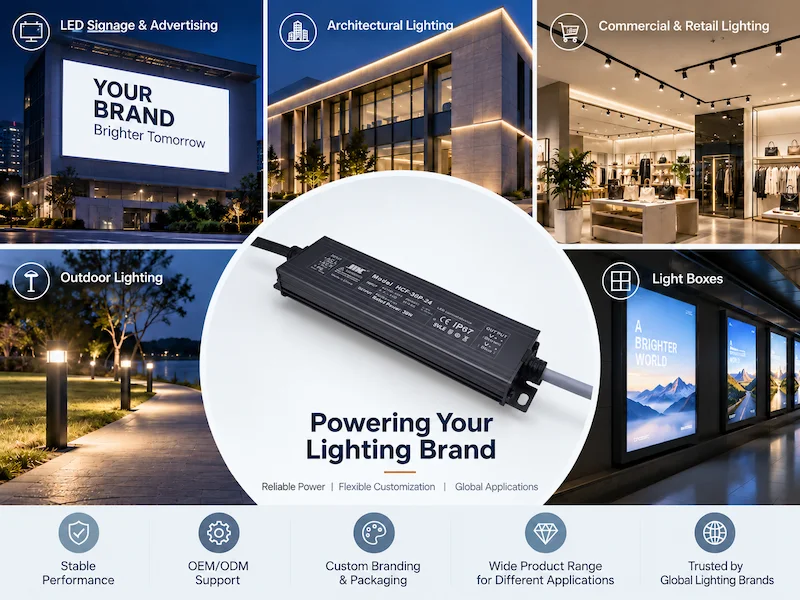
JMHC offers different LED power supply platforms suitable for various applications.
| Product | Application Direction |
|---|---|
| HCF-A Series 10W IP67 | Compact outdoor lighting |
| HCF-C Series 20W IP67 | Signage and decorative lighting |
| HCF-P Series 36W PFC | Commercial lighting projects |
| HCA Series 18W Mini | Compact indoor applications |
| HCC-L Series 120W | Narrow installation spaces |
| HCF-PE Series 380W IP67 | High-power outdoor systems |
Explore JMHC LED power supply products:
https://www.jmhce.com/products
Starting with an existing production platform can reduce development time and make private label projects easier to manage.
What Can Be Customized in a Private Label LED Driver Project?
Brand Label and Identification
The most common customization is product identification.
This may include:
- brand logo;
- model name;
- electrical information;
- product marking;
- traceability information.
The final label should be reviewed carefully because electrical information and compliance markings must remain accurate.
Packaging Design
For distributors and retail-focused brands, packaging affects customer perception.
Private label packaging may include:
- branded cartons;
- product stickers;
- manuals;
- installation documents.
Packaging should match the target market and sales channel.
Cable and Connector Options
For lighting manufacturers, cable configuration can influence installation efficiency.
Possible requirements include:
- cable length;
- wire type;
- connector selection;
- input/output cable arrangement.
These changes can reduce assembly work for downstream customers.
Why Product Consistency Matters More Than First Order Price
Many companies evaluate suppliers during the first purchase.
However, the real challenge appears during repeat orders.
A private label LED driver supplier should maintain:
- approved specifications;
- production records;
- testing standards;
- packaging consistency;
- engineering revision control.
A product that performs well in the first shipment but changes during later production can create serious problems.
For branded products, consistency directly affects customer trust.
Quality Control Checklist for Private Label LED Drivers
Before selecting a supplier, buyers should ask:
| Quality Area | Question |
|---|---|
| Incoming materials | Are components controlled? |
| Production process | Are manufacturing steps standardized? |
| Electrical testing | Is every batch tested? |
| Aging testing | Are products tested under load? |
| Waterproof products | Is sealing controlled? |
| Change management | Are modifications communicated? |
| Traceability | Can production batches be identified? |
JMHC states that its manufacturing process includes ATE testing and 100% full-load aging.
These processes help identify abnormal performance before products reach customers.
Why Sample Approval Is Critical Before Private Label Production
A branded product should never move directly from discussion to mass production.
The recommended process is:
- Confirm product requirements.
- Select suitable platform.
- Approve label and packaging.
- Produce samples.
- Test samples in real applications.
- Confirm final specification.
- Start production.
Testing should include:
- electrical performance;
- installation compatibility;
- temperature behavior;
- cable arrangement;
- packaging accuracy.
The purpose of sample approval is not only checking whether the product works.
It confirms whether the supplier can deliver the exact product the brand wants to sell.
How to Evaluate a LED Driver Private Label Supplier
A reliable supplier evaluation should include:
Manufacturing Capability
Check:
- factory size;
- production equipment;
- annual capacity;
- testing capability.
Engineering Support
Ask:
- Can the supplier recommend suitable products?
- Can they evaluate application requirements?
- Can they support technical questions?
Supply Stability
Confirm:
- production capacity;
- lead time;
- component management;
- repeat order process.
Communication Ability
Private label projects involve many details.
A good supplier should communicate clearly about:
- specifications;
- samples;
- packaging;
- changes;
- production schedules.
MOQ and Lead Time Considerations
Private label requirements vary significantly.
MOQ and lead time depend on:
- product model;
- label requirements;
- packaging changes;
- customization level;
- production quantity.
A supplier should evaluate the complete project before confirming commercial terms.
A simple logo change and a complete product modification should not have the same MOQ expectation.
Why Brands Choose JMHC as a Private Label Partner
JMHC combines product platforms with manufacturing capability for customers who need branded LED power supply solutions.
The company's published capabilities include:
- LED power supply design;
- OEM/ODM support;
- automatic vacuum glue filling;
- ATE testing;
- full-load aging;
- scalable production.
JMHC product platforms cover:
- waterproof LED power supplies;
- compact indoor models;
- PFC solutions;
- high-power applications.
For brands looking for a private label LED power supply solution, working from proven platforms can reduce development risk while maintaining product flexibility.
Contact JMHC for private label cooperation:
https://www.jmhce.com/contact-us
FAQ
What is a LED driver private label supplier?
A LED driver private label supplier manufactures products that customers can sell under their own brand through customized labeling, packaging, and related services.
Can private label LED drivers use my own brand name?
Yes. Private label programs commonly include customer branding, labels, packaging, and product identification after approval.
What is the difference between private label and OEM?
Private label usually focuses on branding an existing product platform, while OEM may involve deeper product customization based on customer requirements.
Can JMHC customize LED driver labels and packaging?
JMHC supports OEM/ODM-related customization including product identification and packaging requirements for suitable projects.
Do private label LED drivers require large order quantities?
MOQ depends on customization level, product model, packaging requirements, and production planning.
How do I choose the right private label supplier?
Evaluate manufacturing capability, engineering support, testing process, quality control, communication, and long-term supply stability.
Can I customize cables and connectors?
For suitable product platforms, cable and connector requirements can be evaluated according to application needs.
Should I test private label samples before ordering?
Yes. Sample approval helps confirm electrical performance, installation compatibility, branding accuracy, and production requirements.
Conclusion
Choosing the right LED driver private label supplier is about creating a reliable branded product, not simply adding a company logo to an existing item.
The best supplier should combine product knowledge, manufacturing control, testing capability, customization support, and long-term supply reliability.
For lighting brands, distributors, and project suppliers, a strong private label partner can reduce development costs while helping create competitive products under their own brand.
JMHC provides LED power supply manufacturing, OEM/ODM support, quality testing, and production capabilities for customers seeking stable LED driver solutions.
Start your private label LED driver project with JMHC:
https://www.jmhce.com/contact-us