Why the Right LED Power Supply OEM Supplier Matters
A reliable LED power supply OEM supplier should do more than place your logo on an existing product.
For lighting brands and manufacturers, the power supply becomes part of the finished product that customers judge. If voltage matching, thermal behavior, waterproofing, wiring, certification, or production consistency is wrong, the problem can appear as flicker, overheating, field failure, warranty claims, delayed projects, or damaged brand reputation.
This is why an OEM program should begin with the final application rather than with a price request.
A professional supplier should help convert your commercial requirements into a controlled product specification, validate the configuration before mass production, and maintain that specification across repeat orders.
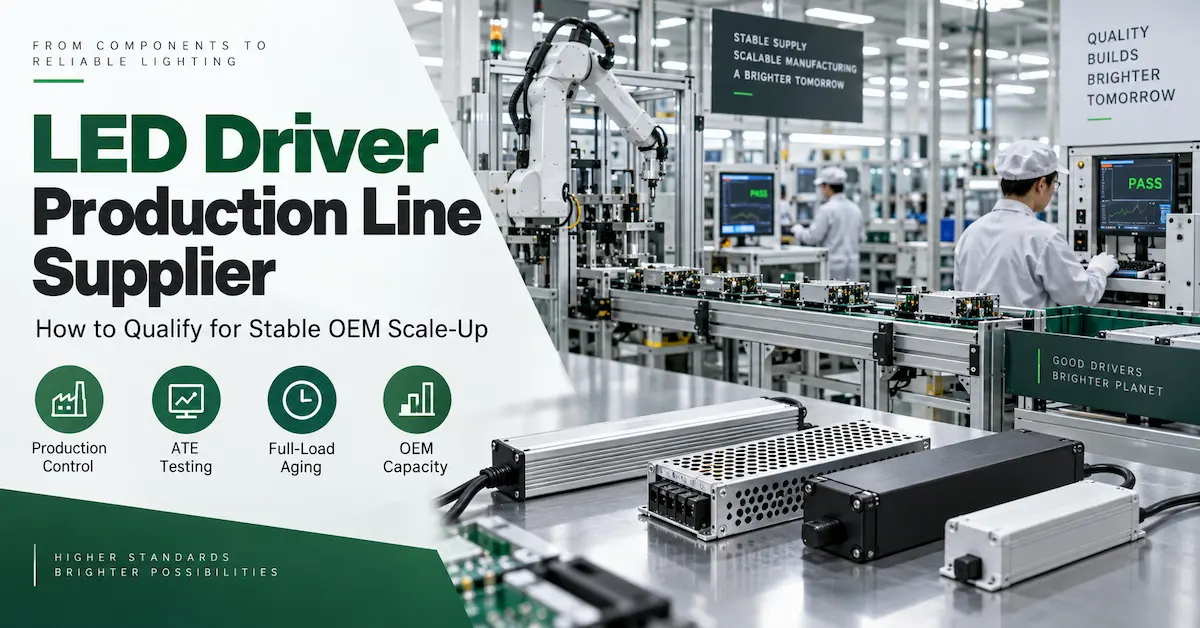
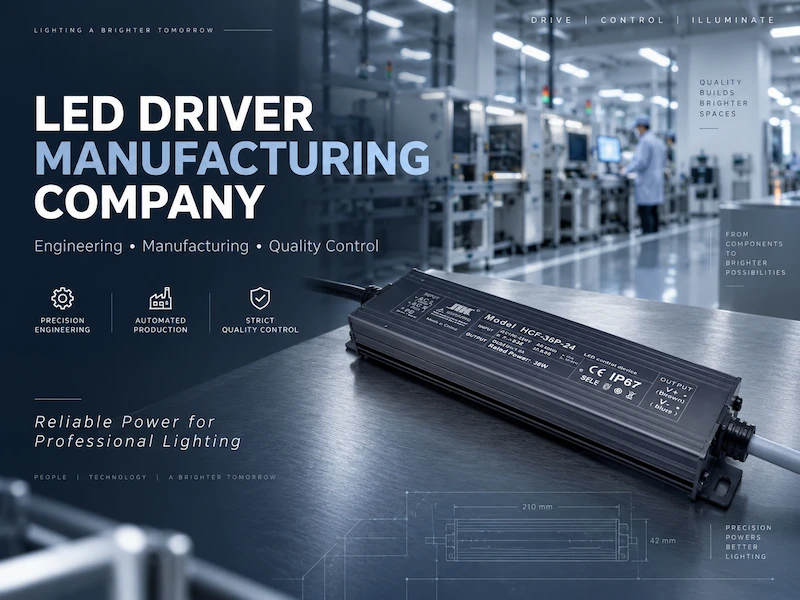
JMHC integrates LED switching power supply design, R&D, manufacturing, testing, and sales. Its published manufacturing information states that the company operates a 5,000+ m² facility with annual production capacity above five million units, automatic vacuum glue-filling lines, ATE testing equipment, and 100% full-load aging.
Buyers can review JMHC's manufacturing background and factory capabilities.

OEM, ODM, or Standard Product: Which Supply Model Do You Need?
OEM and ODM are often used interchangeably, but they involve different levels of supplier responsibility.
| Supply Model | Buyer Provides | Supplier Role | Best For |
|---|---|---|---|
| Standard product | Basic application and quantity | Supplies an existing catalog model | Buyers needing quick standard sourcing |
| OEM | Approved requirements, branding, product configuration | Manufactures and customizes according to agreed specifications | Lighting brands, distributors,fixture manufacturers |
| ODM | Product concept and commercial requirements | Supports product definition, engineering, prototyping and production development | Brands needing deeper product development |
JMHC already publishes structured ODM capabilities covering requirement analysis, circuit design, prototyping, thermal optimization, and production integration.
For many buyers searching for an LED power supply OEM supplier, OEM is the right choice when the basic product architecture already exists but the buyer needs a controlled branded configuration.
If your project requires new electrical architecture or substantial product development, ODM may be more appropriate.
Who Benefits Most From an OEM LED Power Supply Program?
An OEM program is particularly relevant when the customer will repeatedly purchase the same approved configuration.
| Buyer Type | Typical OEM Requirement | Main Business Risk |
|---|---|---|
| Lighting brand | Private label, packaging, specifications | Brand complaints and warranty cost |
| LED fixture manufacturer | Electrical and mechanical matching | Fixture incompatibility |
| Signage manufacturer | Voltage, cables, size,waterproofing | Installation and field failure |
| Distributor | Private label, repeat supply | Batch changes and stock inconsistency |
| Architectural lighting supplier | IP protection, PFC, project specifications | High maintenance cost |
| Industrial equipment manufacturer | Stable output and long-term availability | Production interruption |
For a buyer who only needs a few standard units and does not require branding, engineering changes, or repeat production control, a normal catalog purchase may be more efficient than a full OEM project.
Start OEM Development With the Application, Not the Logo
One of the most common OEM mistakes is discussing branding before confirming electrical and environmental requirements.
The product should first match the LED system.
An OEM supplier should understand at least the following project variables:
| Requirement | Why It Matters |
|---|---|
| Final application | Determines the overall product direction |
| Input voltage | Must match the target electrical system |
| Output voltage | Must match the LED load |
| Required wattage | Determines power capacity |
| Load behavior | Affects thermal and operating requirements |
| Installation space | Influences housing and form factor |
| Indoor or outdoor use | Influences enclosure protection |
| Operating hours | Important for thermal and reliability assessment |
| Dimming requirement | May require a different product architecture |
| Target market | Affects certification planning |
| Expected volume | Affects production planning |
| OEM requirements | Defines label, cable,connector and packaging needs |
A technically complete RFQ allows the supplier to recommend or develop the correct configuration much faster.
Use Existing Proven Models as an OEM Starting Point
OEM does not always mean designing a completely new power supply.
For many buyers, the lowest-risk approach is to begin with a proven production platform and customize only the elements needed for the finished product.
JMHC's current product center lists several existing LED power supply platforms:
| JMHC Model | Current Product Positioning | Possible OEM Starting Point |
|---|---|---|
| HCF-A Series 10W | IP67 waterproof | Compact outdoor LED products |
| HCF-C Series 20W | IP67 waterproof | Signage and outdoor lighting |
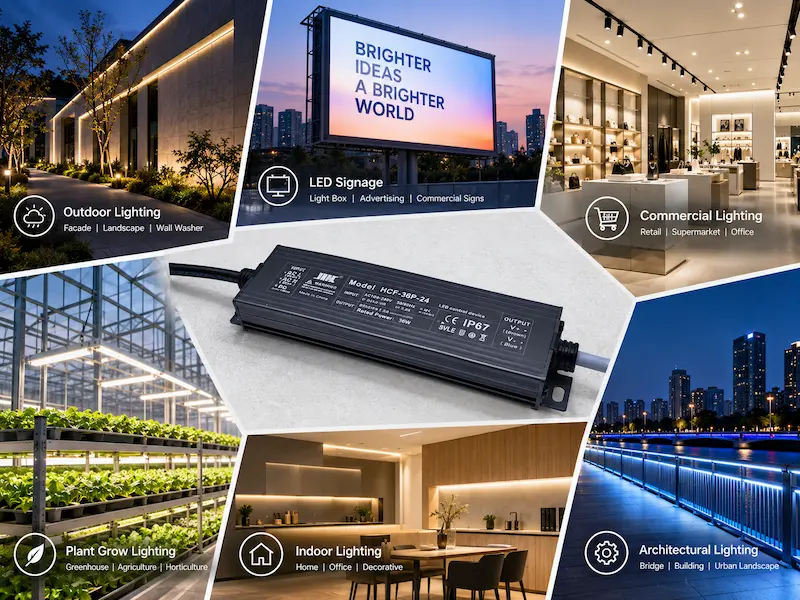
| HCF-P Series 36W | IP67, PFC 0.95 | Commercial/project applications |
| HCA Series 18W Mini | IP20 mini format | Light boxes and compact indoor designs |
| HCC-L Series 120W | IP20 long-shape format | Narrow indoor installations |
| HCF-PE Series 380W | IP67 high power | Large outdoor and engineering systems |
These six products are currently listed in the JMHC product center.
Explore the current JMHC LED power supply range before requesting a custom development.
Starting from an existing production platform can reduce unnecessary engineering changes and make sample validation, cost control, and future repeat production easier.
What Can Be Customized in an OEM LED Power Supply?
The real question is not simply, "Can you customize?"
Buyers should ask exactly which variables can be controlled for their project.
JMHC's existing OEM/ODM content describes customization directions including output voltage and wattage, private labeling, packaging, cable configuration, connectors, product structure matching, application selection, and certification support.
Electrical Configuration
Depending on the product platform and technical feasibility, OEM projects may involve output voltage, wattage, application matching, or other electrical configuration requirements.
The approved electrical specification should be frozen before pilot production.
Cable and Connector Configuration
Cable length and connector selection can significantly affect fixture assembly.
For an OEM fixture manufacturer, the correct connector can reduce assembly labor and wiring errors.For signage or project applications, cable configuration may also affect installation convenience.
Private Label and Product Identification
OEM branding may include brand name, model number, rated electrical information, required compliance markings, and other approved label information.
The final artwork should be approved before bulk production.
Packaging
Private-label buyers may require branded cartons, model identification, packing quantities, instruction documents, or market-specific labeling.
Packaging should be treated as part of the OEM specification rather than a last-minute change.
What Should an OEM Sample Prove?
A sample should not simply prove that the power supply turns on.
It should prove that the proposed configuration is suitable for the real product.
An OEM sample evaluation should examine electrical compatibility, physical fit, cable configuration, operating temperature, installation environment, output stability, protection requirements, waterproof requirements where applicable, label accuracy, and integration with the final LED system.
For a lighting manufacturer, sample testing should preferably use the actual fixture or representative load rather than an unrelated laboratory load alone.
The goal is to answer:
Can this approved configuration operate correctly inside the customer's real system?
Only after that question is answered should the buyer move toward pilot or mass production.
Why a Pilot Order Can Reduce OEM Risk
There is a large difference between approving several hand-selected samples and manufacturing thousands of units.
A pilot order introduces real production variables such as component lots, assembly processes, wiring, labeling, potting, inspection, packaging, and production documentation.
JMHC's own bulk-production guidance recommends pilot production when projects involve new housings, cables, output specifications, labels, packaging, or application requirements.
A useful OEM sequence is therefore:
| Stage | Buyer Decision |
|---|---|
| Requirement confirmation | Is the specification complete? |
| Product/platform selection | Is an existing model suitable? |
| Engineering review | Are modifications technically feasible? |
| Sample production | Does the design meet the requirement? |
| Application testing | Does it work in the real system? |
| Label/packaging approval | Is the commercial configuration correct? |
| Pilot production | Can the factory reproduce it consistently? |
| Bulk production | Is the process ready to scale? |
| Final QC and aging | Does production meet approved criteria? |
| Repeat-order control | Will future batches remain consistent? |
This process reduces the risk of discovering specification problems after a large order has already entered production.
Quality Control Is Critical for OEM Repeat Orders
OEM buyers often use the same power supply inside a product line for several years.
That makes repeatability more important than a single successful shipment.
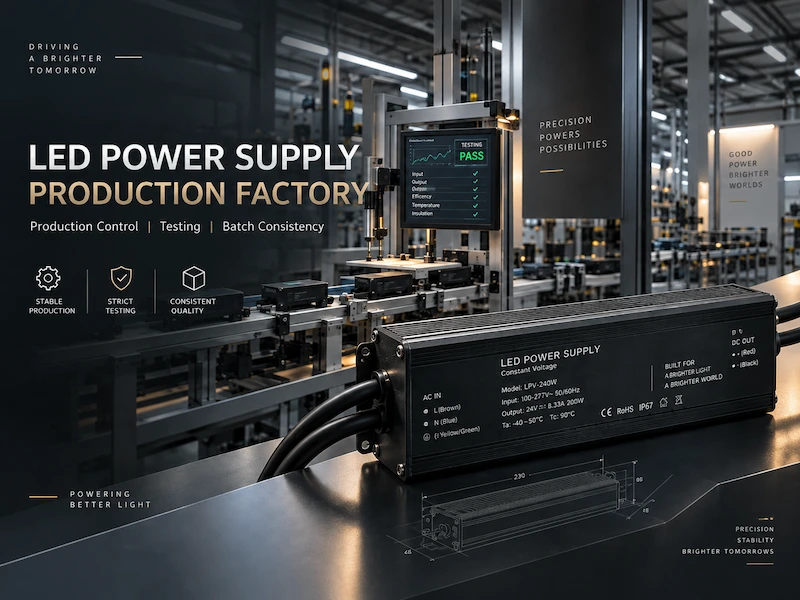
JMHC states that its manufacturing system includes ATE testing and 100% full-load aging, while its waterproof production capability includes automatic vacuum glue filling.
ATE Testing
Automated test equipment can help standardize electrical checks across larger production quantities.
For OEM buyers, standardized testing supports batch consistency and makes it easier to identify units outside defined criteria.
Full-Load Aging
A short functional test cannot expose every early-life problem.
JMHC reports conducting 100% full-load aging before delivery. Aging can help identify abnormal temperature behavior, unstable operation, assembly problems, and early component failures before products reach the customer's assembly line.
Waterproof Production Control
For IP67 OEM products, consistency in sealing and potting becomes part of the manufacturing risk.
IEC 60529 defines the classification system for degrees of protection provided by electrical enclosures—the IP Code.
Buyers developing an outdoor product should therefore verify that any OEM change does not unintentionally affect the enclosure or protection configuration.
Review IEC 60529 IP Code information
Certification Must Be Verified After OEM Changes
Certification is another area where buyers should avoid assumptions.
IEC 61347-2-13:2024 specifies particular safety requirements for electronic controlgear for LED light sources and includes requirements related to rated output characteristics and marking.
JMHC states that relevant products have certifications including CE (LVD & EMC), CCC, BIS, UKCA, and RoHS.
However, an OEM buyer should verify certification against the exact model and final customized configuration.
A change in electrical parameters, construction, housing, labeling, or other controlled elements may require technical review.
Do not assume that a company-level certification list automatically applies to every customized product.
How to Evaluate an LED Power Supply OEM Supplier
A useful supplier audit should focus on evidence rather than phrases such as "professional factory" or "best quality."
| Evaluation Area | What Buyers Should Verify |
|---|---|
| Engineering capability | Can the supplier understand the application and specification? |
| Product platform | Is there a suitable existing model to reduce development risk? |
| Sampling | Can the supplier provide a controlled sample for validation? |
| Quality system | Are incoming,in-process and final controls defined? |
| Testing | Are electrical testing and aging performed? |
| Waterproof manufacturing | Is the potting/sealing process controlled where applicable? |
| Certification | Can the supplier identify applicable model-level documentation? |
| Production capacity | Can volume scale after approval? |
| Change control | Will BOM or specification changes be communicated? |
| Repeat-order control | Can the same approved configuration be reproduced later? |
JMHC reports more than 5,000 m² of manufacturing space and annual capacity above five million power supplies,providing a production base for both standard and customized programs.
OEM Price Should Be Evaluated as Total Project Cost
The lowest quotation is not always the lowest-cost OEM solution.
For a lighting brand, total cost can include the purchase price plus sample iterations, incoming inspection, assembly problems, field replacements, freight, warranty handling, certification delays, and customer complaints.
A slightly cheaper power supply can become expensive if it causes repeated failures across a finished lighting product.
OEM buyers should therefore compare suppliers across four commercial variables:
| Cost Area | Buyer Question |
|---|---|
| Unit cost | Is the production price competitive? |
| Development cost | How many iterations are required before approval? |
| Quality risk | What happens if batch performance changes? |
| Lifecycle cost | Can the same configuration be supplied reliably for future orders? |
MOQ,sample charges, tooling requirements, and lead time should be confirmed for each project because they depend on the level of customization rather than following one universal number.
What Makes JMHC Relevant for OEM Buyers?
JMHC combines existing LED power supply platforms with manufacturing and engineering capabilities that can support customized projects.
Its published capabilities include integrated design and R&D, automatic vacuum glue filling, ATE testing, 100% full-load aging, OEM/ODM support, and production capacity above five million units annually.
Its current product range provides starting platforms for indoor, compact, long-shape, waterproof, PFC, and higher-power applications.
For buyers who require deeper product development rather than configuration-based OEM, JMHC also publishes an ODM workflow covering concept definition through scalable production.
Explore JMHC's application-based LED power supply solutions.
What Should You Include in an OEM RFQ?
A high-quality RFQ reduces back-and-forth communication and helps the supplier quote the correct configuration.
Before contacting an LED power supply OEM supplier, prepare the application, target input voltage, output voltage, required wattage, total load, indoor/outdoor environment, installation dimensions, IP requirement, operating hours, cable/connector requirements, private-label requirements, packaging requirements, target market, certification needs, sample quantity, expected production volume, annual forecast if available, and required delivery schedule.
This gives the supplier enough information to decide whether an existing platform can be used or whether additional engineering is required.
FAQ
What is an LED power supply OEM supplier?
An LED power supply OEM supplier manufactures power supplies according to an agreed buyer specification and may support private labeling, packaging, cables, connectors, electrical configuration, and application matching.
What is the difference between OEM and ODM LED power supplies?
OEM normally starts from an existing or buyer-defined specification, while ODM involves deeper supplier participation in product definition, engineering, prototyping, and development.
Can I put my own brand on an LED power supply?
Private labeling is a common OEM requirement. The final label should be reviewed for electrical information, model identification, applicable markings, and brand requirements before production.
Can JMHC customize output voltage and wattage?
JMHC states that it supports custom output voltage and wattage requirements for applicable OEM/ODM projects. Feasibility should be confirmed against the selected product platform and application.
Should I start with a standard JMHC model or develop a new one?
If an existing product already matches the main electrical, environmental, and mechanical requirements, using it as an OEM base can reduce risk and development time. New development is more appropriate when the standard platform cannot meet the application.
What should I test before approving an OEM sample?
Test the sample with the actual or representative LED load and verify voltage, power, physical fit, cable configuration, operating temperature, environment, protection requirements, and any customized labeling or packaging.
Why is pilot production useful before a bulk OEM order?
Pilot production tests whether the approved specification can be reproduced under real production conditions before the financial and quality exposure of a large order.
Does a customized LED power supply keep the original certification?
Not automatically. Buyers should confirm whether the exact customized configuration remains within the applicable certification scope.
How can I reduce quality variation between repeat OEM orders?
Use an approved specification, controlled BOM, sample reference, engineering revision, label artwork, packaging standard, testing criteria, and formal change-control process.
How do I request an OEM quotation from JMHC?
Provide the application, input/output requirements, wattage, environment, installation space, IP rating, cable or connector needs, target market, certification requirements, customization details, expected order quantity, and delivery schedule.
Conclusion
Choosing an LED power supply OEM supplier is ultimately a supply-chain and product-risk decision, not simply a sourcing exercise.
A strong OEM partner should help you define the correct configuration, validate samples, manage customization, control quality during mass production, protect repeat-order consistency, and support future product growth.
JMHC combines existing indoor and waterproof LED power supply platforms with design, R&D, manufacturing, ATE testing, automatic vacuum glue filling, full-load aging, and OEM/ODM capabilities.
For a faster technical evaluation and more accurate quotation, send JMHC your application + voltage + wattage + environment + installation size + IP requirement + cable/connector + branding + packaging + target market + certification + estimated quantity.