What Should You Expect From an LED Driver OEM Manufacturer?
A professional LED driver OEM manufacturer should do more than manufacture a standard driver with a different label.
For lighting brands and OEM buyers, the manufacturer should be able to understand the final application, match the electrical and mechanical requirements, validate samples, control production changes, perform repeatable testing, and reproduce the approved configuration across future orders.
That distinction matters because a successful sample does not automatically guarantee successful mass production.
A driver may work correctly during initial testing but still create problems later if component sourcing, thermal behavior, sealing, wiring, testing procedures, or engineering revisions are not properly controlled.
For buyers, the real question is therefore:
Can this manufacturer reproduce the approved LED driver reliably at scale?
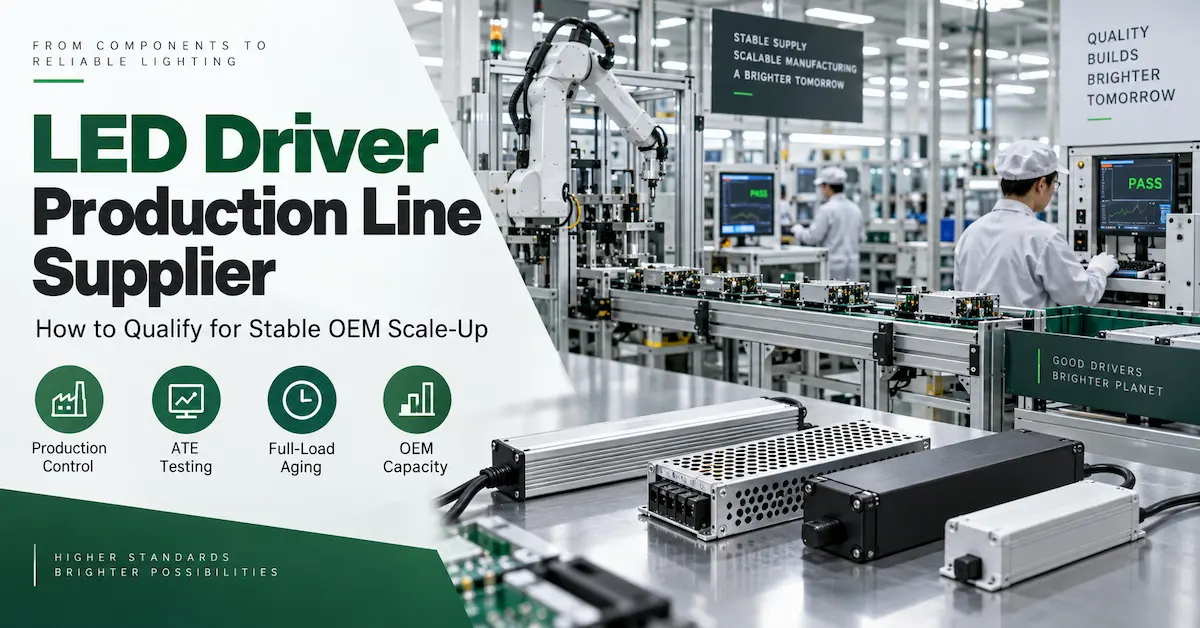
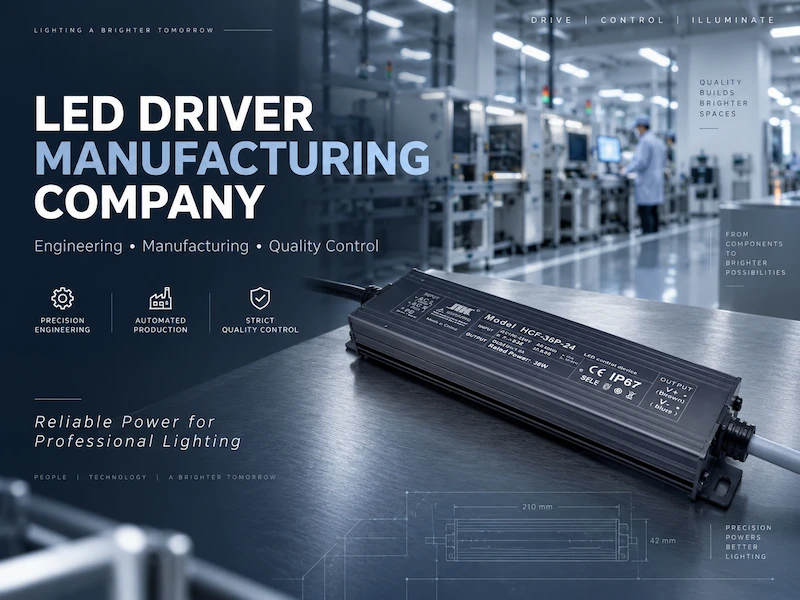
JMHC integrates LED switching power supply design, R&D, manufacturing, testing, and sales.Its current company information states that it operates more than 5,000 m² of production space, has annual capacity above five million power supply units, uses automatic vacuum glue-filling lines and ATE testing equipment, and conducts 100% full-load aging.
Review JMHC manufacturing capabilities

Who Should Work With an OEM Manufacturer Instead of Buying Standard Drivers?
OEM manufacturing is most valuable when the LED driver becomes an integrated part of another commercial product.
| Buyer Type | Typical Requirement | Main Procurement Risk |
|---|---|---|
| Lighting brand | Private label and repeat production | Brand complaints and warranty claims |
| Fixture manufacturer | Electrical and mechanical integration | Driver-fixture incompatibility |
| Signage manufacturer | Voltage, housing,cable and waterproofing | Field installation failures |
| Distributor | Private label and stable reorder supply | Batch inconsistency |
| Architectural lighting supplier | IP protection, PFC and project matching | High maintenance cost |
| Industrial OEM | Stable specification and long lifecycle | Production interruption |
If the project only requires a small quantity of standard products, a catalog purchase may be more efficient.
If the buyer requires repeat orders, branding, modified wiring, packaging, application-specific configuration, or controlled production specifications, working directly with an OEM manufacturer provides more value.
OEM Manufacturer vs Trading Supplier: What Is the Difference?
Not every company selling LED drivers controls the manufacturing process.
For OEM projects, buyers should distinguish between a factory that manufactures and validates the product and a trading supplier that primarily sources existing products.
| Evaluation Area | Trading Supplier | OEM Manufacturer |
|---|---|---|
| Product customization | Usually limited | Higher flexibility |
| Engineering access | Indirect | Direct engineering communication |
| BOM control | Limited visibility | Can be formally controlled |
| Production process | Third-party dependent | Directly managed |
| Testing | Depends on source factory | Can be integrated into production |
| Pilot production | Less controllable | Easier to implement |
| Repeat-order consistency | Supplier dependent | Can follow approved specification |
| Root-cause investigation | Slower | Direct factory analysis |
This does not mean every manufacturer is automatically better.
The advantage only exists when the factory has real engineering, production, testing, and change-control capability.
Start With Application Requirements Before Discussing OEM Price
One of the biggest mistakes in LED driver sourcing is asking:
“What is your price for a 100W driver?”
before defining how the driver will actually be used.
A technically useful OEM RFQ should identify the final application first.
Electrical Requirements
The manufacturer should understand:
- Input voltage
- Required output voltage
- Rated wattage
- Total LED load
- Continuous operating conditions
- Power factor requirements where applicable
- Dimming requirements if needed
Installation Requirements
The project should also define:
- Available housing space
- Cable direction and length
- Connector requirements
- Indoor or outdoor installation
- Ventilation
- Expected ambient conditions
- Required enclosure protection
Commercial Requirements
OEM buyers should communicate:
- Branding
- Product label
- Packaging
- Order quantity
- Annual forecast
- Target sales market
- Required certification
- Delivery schedule
When these requirements are defined early, quotation quality improves and sample revisions are reduced.
Use Existing LED Driver Platforms to Reduce OEM Development Risk
OEM does not necessarily mean developing a completely new driver.
For many lighting brands, the safest and fastest approach is to start with a proven production platform and customize only what the application genuinely requires.
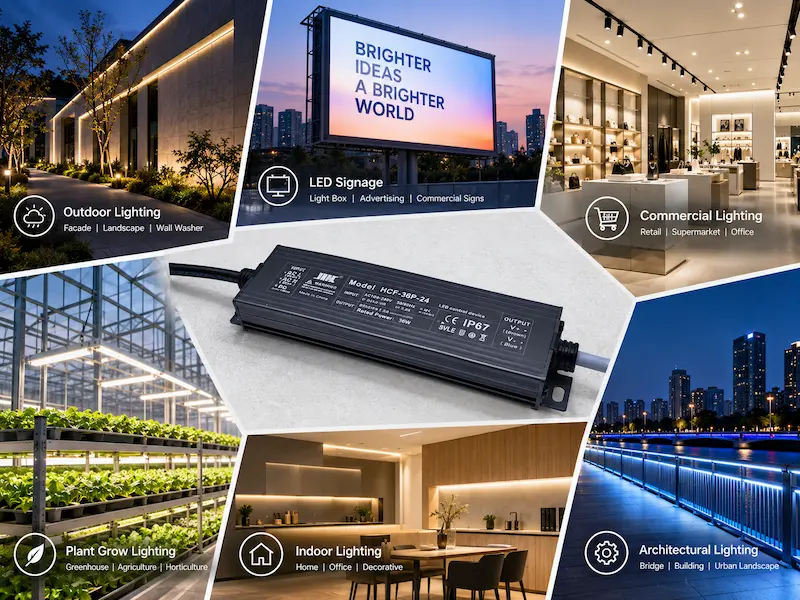
JMHC's current product center lists several existing models that can act as reference platforms:
| JMHC Product | Current Positioning | Potential OEM Application |
|---|---|---|
| HCF-A 10W | IP67 waterproof | Compact outdoor LED systems |
| HCF-C 20W | IP67 waterproof | Signage and landscape lighting |
| HCF-P 36W | IP67, PFC 0.95 | Commercial outdoor projects |
| HCA 18W Mini | IP20 compact format | Indoor light boxes |
| HCC-L 120W | IP20 long-shape format | Narrow indoor installations |
| HCF-PE 380W | IP67 high-power | Large outdoor lighting projects |
These six models are currently displayed in the JMHC product center.
Explore JMHC LED driver and power supply products
Using an established platform can reduce:
- Engineering uncertainty
- Prototype cycles
- Tooling risk
- Testing complexity
- Production ramp-up time
The manufacturer can then focus customization on the areas that create real commercial value.
What Can an LED Driver OEM Manufacturer Customize?
The exact customization scope depends on the selected platform, order volume, certification implications, and engineering feasibility.
Typical OEM requirements may include electrical configuration, wiring, identification, and packaging.
Electrical Configuration
Applicable projects may require changes to output voltage, wattage, or application matching.
These changes should always be validated rather than assumed to be compatible with an existing design.
Cables and Connectors
For fixture manufacturers, cable configuration directly affects assembly efficiency.
Potential requirements may include:
- Cable length
- Cable type
- Connector selection
- Input/output lead configuration
A suitable cable design can reduce secondary assembly work and wiring mistakes.
Private Labeling
OEM labeling may include:
- Brand name
- Custom model number
- Electrical rating
- Compliance information
- Traceability information
Label artwork should be frozen and approved before production.
Packaging
For distributors and lighting brands, packaging may be part of the commercial product.
OEM packaging can involve cartons, product identification, internal packaging, documentation, and private-label presentation.
JMHC's existing OEM content states that customization can include voltage, wattage, cables, connectors, labels, packaging, and application matching.
Why Engineering Validation Matters Before Mass Production
The most important OEM milestone is not sample completion.
It is sample validation under realistic operating conditions.
An approved LED driver sample should be evaluated with the actual fixture or a representative load whenever possible.
Important validation areas include:
| Validation Area | What Buyers Should Confirm |
|---|---|
| Output performance | Correct voltage and load behavior |
| Thermal performance | Acceptable temperature under real use |
| Physical integration | Fits the available installation space |
| Wiring | Correct cable and connector configuration |
| Protection | Appropriate response under abnormal conditions |
| Environment | Suitable indoor/outdoor configuration |
| Waterproofing | Appropriate enclosure and sealing where required |
| Label | Accurate final information |
| Packaging | Matches OEM approval |
IEC 62384:2020 defines performance requirements for electronic controlgear associated with LED modules, including constant-voltage and constant-current controlgear. It provides a useful industry reference when discussing driver performance requirements.
Review IEC 62384 LED controlgear performance requirements
Why Pilot Production Should Come Before a Large OEM Order
A few approved samples are produced under controlled conditions.
Mass production introduces more variables:
- Larger component lots
- More operators
- Longer production periods
- Multiple process stages
- Potting and curing variation
- Label and packaging integration
- Equipment calibration
- Production scheduling
Pilot production bridges the gap between sample approval and full-scale manufacturing.
A useful OEM workflow is:
Requirement confirmation → Product platform selection → Engineering review → Sample development → Application validation → Label/packaging approval → Pilot production → Mass production → Aging and final inspection → Repeat-order control
JMHC's published LED driver manufacturing guidance also emphasizes engineering validation, pilot production, standardized mass production, electrical testing, and full-load aging.
How to Audit LED Driver Manufacturing Quality
OEM buyers should evaluate the factory's quality process before discussing long-term cooperation.
Incoming Material Control
Driver performance depends heavily on component consistency.
Important components may include:
- Capacitors
- Switching devices
- Transformers
- ICs
- Rectifiers
- Wiring
- Potting materials
- Housing components
Buyers should ask how substitutions are approved when the original component is unavailable.
First-Article Inspection
The first production units should confirm that manufacturing matches the approved sample and specification.
This step is particularly important after:
- New OEM labels
- Cable changes
- Housing changes
- Electrical revisions
- Packaging changes
Electrical Testing
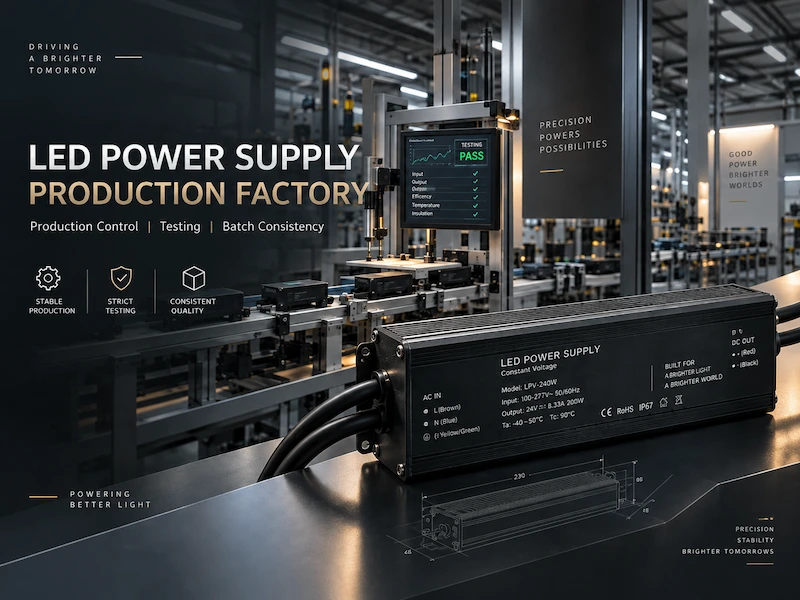
JMHC states that it uses ATE equipment as part of its manufacturing system. Automated testing can improve repeatability by checking products against standardized criteria.
Depending on the product specification, buyers may discuss tests such as input/output performance, load operation, protection functions, ripple, efficiency, and insulation.
Full-Load Aging
A driver may pass a short electrical test but still show problems after extended operation.
Potential early-life problems include:
- Abnormal temperature rise
- Output instability
- Internal connection defects
- Component weakness
- Intermittent operation
JMHC states that its LED power supplies undergo 100% full-load aging.
For OEM buyers, one useful factory-audit question is:
Is every production unit aged, or only a statistical sample?
Waterproof OEM Drivers Need Additional Process Control
Outdoor drivers introduce another manufacturing variable: enclosure protection.
JMHC's current waterproof range includes the HCF-A 10W, HCF-C 20W, HCF-P 36W PFC, and HCF-PE 380W IP67 series.
View JMHC waterproof LED driver models
For these products, OEM buyers should pay attention to:
- Potting completeness
- Cable entry sealing
- Housing integrity
- Potting material consistency
- Curing process
- Mechanical modifications
JMHC reports using automatic vacuum glue-filling production lines for waterproof products.
IEC 60529 defines the IP Code used to classify degrees of protection provided by electrical enclosures. Any OEM change that affects the housing, cable entry, sealing, or enclosure construction should therefore be reviewed carefully.
Certification Should Be Checked Against the Final OEM Configuration
Certification is another area where sourcing teams frequently make incorrect assumptions.
IEC 61347-2-13:2024 specifies safety requirements for electronic controlgear for LED light sources and includes requirements covering areas such as marking and rated output characteristics.
JMHC currently states that relevant products have certifications including CE (LVD & EMC), CCC, BIS, UKCA, and RoHS.
However, buyers should verify:
- Exact model
- Electrical rating
- Product construction
- Certificate scope
- Target country
- OEM modifications
Do not assume that changing the housing, electrical configuration, or labeling automatically preserves the original certification status.
How to Compare LED Driver OEM Manufacturers
A useful factory comparison should go beyond unit price.
| Evaluation Factor | Weak Supplier Signal | Strong Manufacturer Signal |
|---|---|---|
| Application understanding | Requests only wattage | Reviews full operating conditions |
| Engineering | Limited technical response | Engineering validation available |
| Sample process | Sample only | Defined approval process |
| Production | Outsourced/unclear | Controlled manufacturing |
| Testing | Basic functional check | Structured electrical testing |
| Aging | Not defined | Defined full-load aging process |
| Waterproofing | Generic IP claim | Controlled sealing/potting process |
| Change control | Unclear | BOM and engineering revision control |
| OEM support | Logo only | Electrical, cable, label and packaging options |
| Repeat production | No reference standard | Approved specification maintained |
For high-volume lighting programs, these operational differences are often more important than a small unit-price difference.
What Creates the Real Cost in an OEM LED Driver Project?
OEM purchasing cost should not be measured only by factory quotation.
A more realistic calculation is:
Total OEM cost = unit price + development cost + quality risk + assembly cost + certification risk + warranty cost + replacement cost + supply interruption risk
For example, saving a small amount per driver may have little value if the design later causes:
- Fixture rework
- Customer returns
- Contractor call-outs
- Field replacement
- Delayed certification
- Brand warranty claims
This is why experienced buyers evaluate total lifecycle cost, not only FOB price.
MOQ and Lead Time Depend on the Level of Customization
There is no responsible universal MOQ or lead-time number for every OEM project.
Requirements change depending on whether the buyer needs:
- Standard product with private label
- Cable modification
- Custom packaging
- Electrical modification
- New housing
- Certification-related changes
- Full ODM development
A serious LED driver OEM manufacturer should first review the specification, then confirm sample timing, MOQ, pilot quantity, mass-production lead time, and pricing.
This is more reliable than publishing one generic number for every project.
What Information Should You Send for an Accurate OEM Quotation?
To shorten the quotation cycle, provide the manufacturer with a complete project brief.
Include:
- Final lighting application
- Input voltage
- Output voltage
- Required wattage
- Actual load
- Expected operating hours
- Indoor or outdoor environment
- Installation dimensions
- Required IP rating
- Dimming requirements
- Cable and connector requirements
- Target market
- Certification requirements
- Brand and label requirements
- Packaging requirements
- Sample quantity
- Estimated order quantity
- Annual forecast
- Target delivery date
If your RFQ only says “Need 24V LED driver, please quote”, the manufacturer does not have enough information to recommend the most reliable solution.
Why Lighting Brands Consider JMHC for OEM Manufacturing
JMHC's manufacturing position is built around integrated R&D, production, testing, and scalable LED power supply manufacturing.
The company's published capabilities include:
- 5,000+ m² manufacturing base
- Annual capacity above 5 million units
- Automatic vacuum glue filling
- ATE testing
- 100% full-load aging
- OEM/ODM support
- Indoor and IP67 waterproof platforms
Its current product portfolio also allows OEM buyers to begin with existing compact, long-shape, waterproof, PFC, and high-power platforms rather than automatically developing everything from zero.
Explore JMHC application solutions
For buyers needing deeper product development rather than standard OEM customization, JMHC also publishes a separate LED driver ODM workflow covering engineering development and scalable manufacturing.
FAQ
What is an LED driver OEM manufacturer?
An LED driver OEM manufacturer produces drivers according to an agreed product specification and can support controlled customization such as electrical configuration, cables, connectors, private labels, packaging, and application matching.
How is an OEM manufacturer different from a normal supplier?
A manufacturer directly controls engineering, production, testing, and quality processes. A normal supplier may only source or resell finished products.
Can I use an existing LED driver as the base for OEM customization?
Yes. Starting from a proven platform can reduce engineering risk, development time, and validation complexity when the base design already matches the application.
What should I test before approving an OEM LED driver?
Verify electrical performance, thermal behavior, fixture compatibility, cables, installation fit, environmental protection, labeling, and packaging using the actual application whenever possible.
Why is pilot production important?
Pilot production confirms that the approved design can be reproduced consistently under real manufacturing conditions before the buyer commits to a large order.
Does JMHC support private-label LED drivers?
JMHC states that OEM/ODM customization can include labels, packaging, cables, connectors, voltage, wattage, and application-specific requirements for applicable projects.
Can JMHC manufacture waterproof OEM LED drivers?
JMHC currently manufactures IP67 waterproof HCF-A, HCF-C, HCF-P, and HCF-PE products and uses automatic vacuum glue-filling production lines.
Does certification automatically remain valid after OEM customization?
Not necessarily. The final configuration should be reviewed against the applicable certification scope, especially if electrical ratings, construction, housing, or other controlled elements change.
How can buyers maintain consistency across repeat OEM orders?
Maintain an approved specification, BOM, sample reference, engineering revision, cable requirements, artwork, packaging specification, inspection criteria, and formal change-control procedure.
How can I get an OEM quote from JMHC?
Send the application, voltage, wattage, operating environment, dimensions, IP requirement, cables, connectors, certification requirements, branding, packaging, quantity, and delivery target so the engineering and production teams can evaluate the project accurately.
Conclusion
Choosing an LED driver OEM manufacturer is ultimately about controlling product and supply-chain risk before mass production begins.
The strongest manufacturing partner should be able to understand the final application, recommend or adapt a suitable driver platform, validate samples, control production variables, perform structured testing, support pilot production, and maintain the approved specification across future orders.
For lighting brands, fixture manufacturers, distributors, signage companies, and project suppliers, this approach can reduce design revisions, warranty risk, inconsistent batches, and costly field failures.
JMHC combines LED power supply engineering, manufacturing, ATE testing, automatic vacuum glue filling, 100% full-load aging, and OEM/ODM support for indoor and outdoor LED applications.
For a more accurate OEM evaluation, prepare your application + input/output voltage + wattage + load + installation space + environment + IP rating + cable/connector + certification + branding + packaging + quantity + delivery target before requesting a quotation.