
What Is a Commercial LED Power Supply?
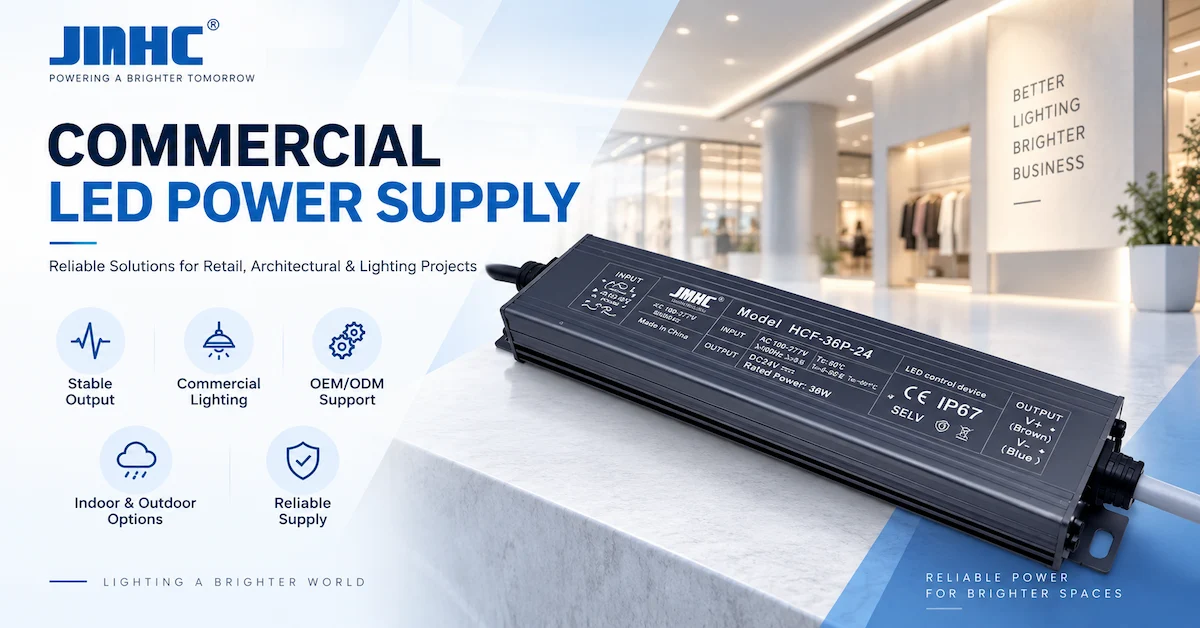
A commercial LED power supply is designed to provide stable electrical power for professional lighting systems used in retail spaces, office buildings, hotels, architectural projects, signage applications, and other commercial environments.
Compared with residential lighting projects, commercial lighting systems usually operate for longer periods and involve more complex requirements. Buyers need to consider not only output voltage and power rating, but also installation conditions, thermal management, control compatibility, maintenance requirements, and long-term product consistency.
For lighting brands, distributors, contractors, and fixture manufacturers, the right power supply selection can directly influence system reliability, installation efficiency, and future maintenance costs.
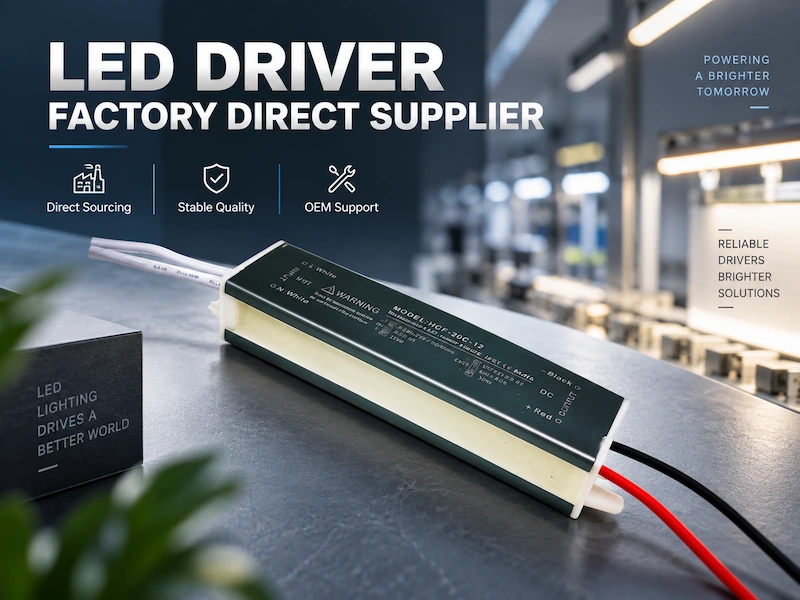
JMHC provides LED power supply solutions for different lighting applications, including indoor, waterproof, and dimmable product categories. Buyers can review the LED power supply product range to understand available platforms before selecting a project-specific solution.
Why Commercial Lighting Projects Need Dedicated Power Solutions
Commercial lighting projects often have different expectations from standard consumer applications. A retail store, hotel, office building, or architectural lighting project may require stable operation, consistent brightness, flexible installation, and reliable long-term supply.
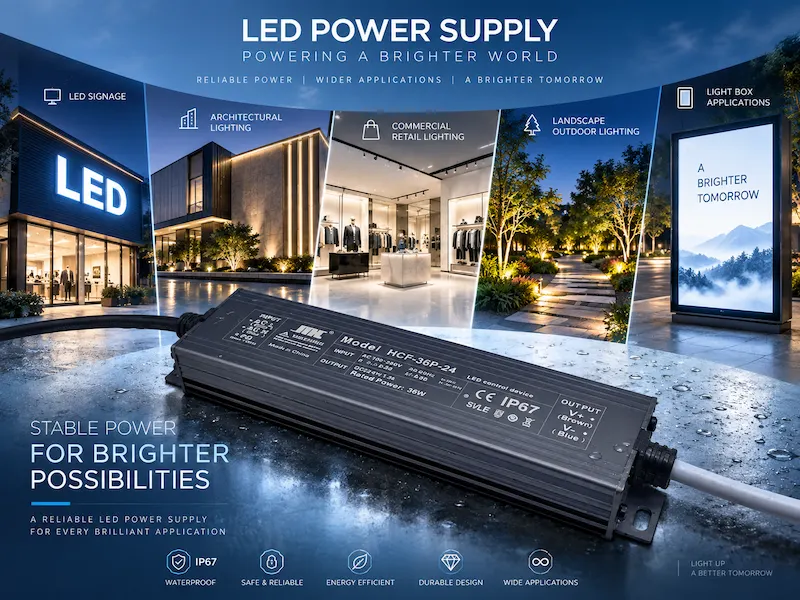
Common Commercial Lighting Applications
Commercial LED power supplies are commonly used in:
- Retail lighting systems
- Shopping center lighting
- Office lighting
- Hotel and hospitality lighting
- Architectural façade lighting
- LED signage
- Display and showcase lighting
- Landscape lighting projects
Each application creates different selection considerations.
For example:
Retail Lighting
Retail environments often focus on visual presentation and continuous operation. The power supply should match the lighting fixture design while supporting stable performance during extended working hours.
Important considerations include:
- Compact installation space
- Stable output
- Easy maintenance
- Compatibility with lighting controls
Architectural Lighting
Architectural lighting projects often require power solutions that can integrate with exterior or decorative lighting systems.
Buyers should evaluate:
- Installation environment
- Outdoor exposure
- Wiring requirements
- Project maintenance access
- Long-term operating stability
LED Signage Applications
LED signage requires consistent power delivery because uneven output can affect the appearance of illuminated letters, displays, and advertising structures.
Important factors include:
- Correct voltage matching
- Appropriate power calculation
- Cable arrangement
- Installation conditions
How Should Buyers Select a Commercial LED Power Supply?
Choosing a commercial LED power supply requires understanding the complete lighting system instead of selecting a product only by wattage.
A professional selection process should include electrical requirements, environmental conditions, installation limitations, and future maintenance considerations.
Confirm the LED Load Requirements First
The first step is identifying the actual LED load.
Buyers should confirm:
- LED operating voltage
- Required current
- Total power consumption
- Number of lighting units
- Operating hours
- Expected load variation
A common purchasing mistake is selecting a power supply only according to the nominal wattage of the lighting product.
For example, two lighting systems may both require a 100W power supply but have completely different requirements due to:
- Different installation environments
- Different cable distances
- Different thermal conditions
- Different control systems
A reliable supplier should help evaluate whether the selected product matches the complete application.
Choose the Correct Product Structure for the Environment
Commercial projects may require different product structures depending on where the power supply will be installed.
JMHC provides different product categories according to application requirements.
For indoor projects, buyers can review the indoor LED power supply range.
For outdoor or exposed applications, buyers can evaluate the waterproof LED power supply range.
For lighting systems requiring adjustable control, buyers can review the dimmable LED driver category.
Indoor Commercial Lighting Considerations
Indoor applications usually focus on:
- Installation size
- Heat dissipation
- Wiring convenience
- Product integration
Typical applications include:
- Display cabinets
- Retail lighting
- Office lighting
- Interior decorative lighting
Outdoor Commercial Lighting Considerations
Outdoor applications require additional attention to:
- Environmental exposure
- Protection requirements
- Cable connections
- Installation methods
A waterproof power supply should always be evaluated together with the complete installation system. The power supply enclosure is only one part of environmental protection; cables, connectors, and installation conditions also influence final performance.
Key Specifications Buyers Should Review Before Ordering
A professional purchasing process should define the important specifications before requesting quotations.
| Specification | Why It Matters |
|---|---|
| Input voltage | Ensures compatibility with electrical systems |
| Output voltage/current | Matches LED requirements |
| Rated power | Supports correct load selection |
| Dimensions | Determines installation feasibility |
| Protection features | Supports application requirements |
| Dimming compatibility | Important for controlled lighting |
| Wiring configuration | Influences installation efficiency |
| Documentation | Supports project approval |
Specifications should always be connected to the exact model. Similar-looking products may have different electrical characteristics or installation requirements.
How Does Dimming Affect Commercial LED Power Supply Selection?
Many commercial lighting projects require flexible lighting control.
Examples include:
- Hotels
- Restaurants
- Retail stores
- Exhibition spaces
- Smart lighting systems
A dimmable LED driver should be selected based on the actual control system.
Buyers should confirm:
- Required dimming method
- Controller compatibility
- Lighting load range
- Expected dimming performance
A product described as dimmable does not automatically mean it works with every dimming controller.
The driver, controller, LED load, and installation environment should be evaluated together.
How Should Buyers Evaluate a Commercial LED Power Supply Supplier?
Selecting the right product is only part of the purchasing decision. For commercial lighting projects, the supplier's engineering capability, production control, and long-term support also influence the final project result.
A reliable commercial LED power supply supplier should be able to support buyers through:
- Product selection
- Technical communication
- Sample evaluation
- Production confirmation
- Quality inspection
- Repeat ordering
A supplier that only provides a price list may not be enough for complex commercial projects.
Evaluate Manufacturing Capability Before Bulk Orders
Commercial lighting buyers should understand how a supplier converts an approved product specification into a repeatable production process.
Important evaluation areas include:
| Evaluation Area | Buyer Questions |
|---|---|
| Product development | Can the supplier understand the application requirements? |
| Production process | How is the product manufactured and controlled? |
| Testing | What inspections are performed before shipment? |
| Product consistency | How are repeat orders managed? |
| Customization | Can project-specific requirements be evaluated? |
| Documentation | Are technical documents available? |
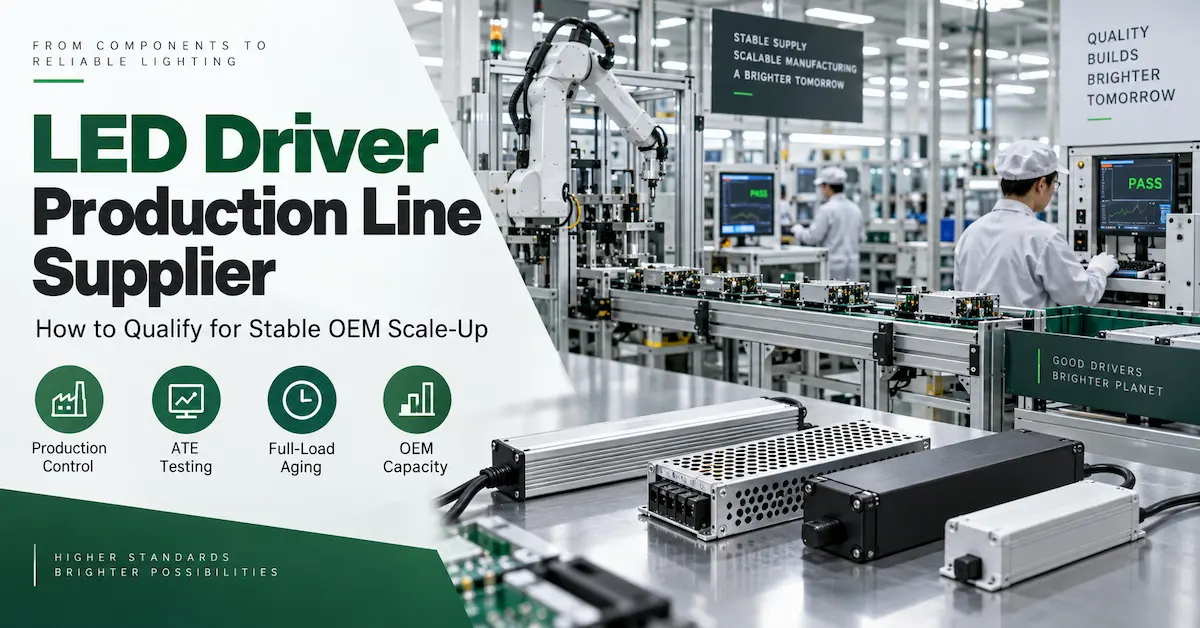
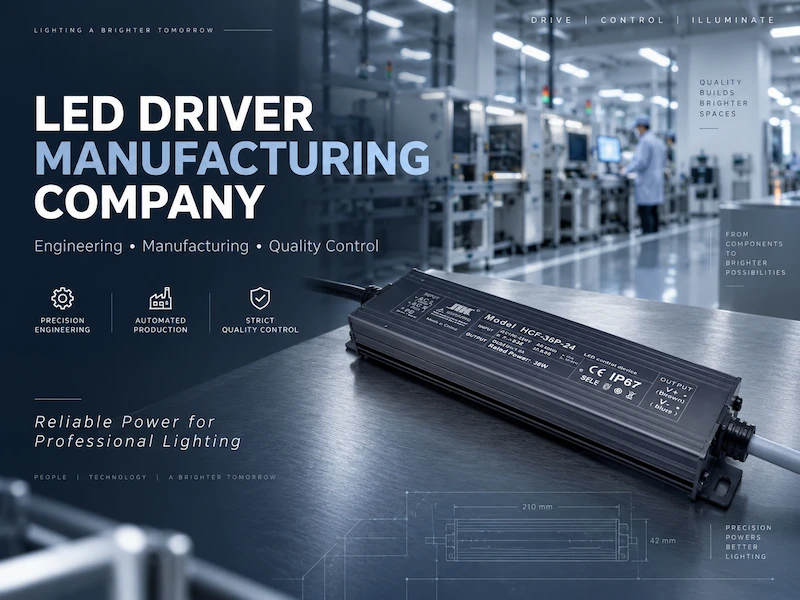
JMHC states that its manufacturing system integrates LED power supply design, research and development, production, and sales. The company also publishes manufacturing capabilities including automatic vacuum glue-filling production lines, automated testing equipment, and full-load aging processes. These are company-level capabilities, and buyers should confirm the specific process requirements for their selected product model. Buyers can review the JMHC manufacturing information for more details.
Why Quality Control Matters for Commercial LED Power Supplies
Commercial projects usually involve multiple lighting fixtures and longer operating periods. A small inconsistency between batches can create installation problems, replacement difficulties, or additional inspection work.
A professional quality-control process should consider several stages.
Incoming Material Control
Before production starts, suppliers should control incoming materials such as:
- Electronic components
- PCB assemblies
- Housing materials
- Wires
- Connectors
- Packaging materials
The purpose is to ensure that approved materials are consistently used during production.
Production Process Control
During manufacturing, buyers should understand how the supplier controls:
- Assembly operations
- Product identification
- Wiring accuracy
- Component matching
- Process instructions
For OEM and repeat-order projects, process control is especially important because the buyer expects the same approved product configuration in future shipments.
Electrical Testing
Electrical testing should be connected with the actual product specification.
Buyers should confirm:
- Which electrical parameters are tested
- Whether testing is performed on every unit or by sampling
- How failed products are handled
- Whether test records are maintained
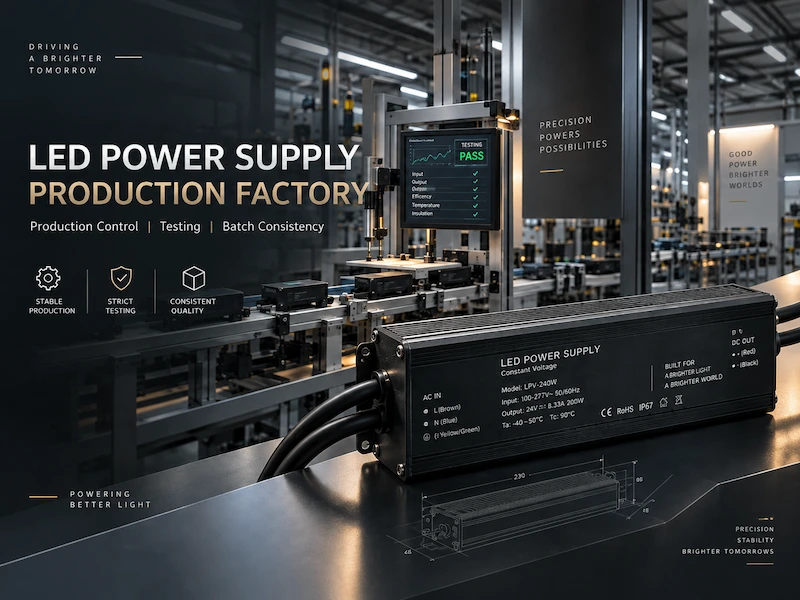
JMHC states that automated test equipment is used within its manufacturing system. Buyers should confirm the exact test items and acceptance criteria for the selected commercial LED power supply model.
How Should Buyers Compare Commercial LED Power Supply Options?
Different commercial projects require different product characteristics. Instead of selecting a power supply only by price or wattage, buyers should compare products based on application suitability.
| Product Direction | Suitable Applications | Main Evaluation Points |
|---|---|---|
| Indoor LED power supply | Retail, office, display lighting | Size, installation, thermal conditions |
| Waterproof LED power supply | Outdoor signage, landscape lighting | Environmental conditions, installation method |
| Dimmable LED driver | Commercial controlled lighting | Control compatibility, system matching |
JMHC provides different product categories to support these applications, including indoor power supply, waterproof power supply, and dimmable LED driver solutions.
How Can OEM Buyers Use Commercial LED Power Supply Solutions?
Many commercial lighting brands require more than standard products. OEM buyers may need:
- Customized product identification
- Specific packaging
- Different cable configurations
- Connector requirements
- Application-specific adjustments
Before starting an OEM project, buyers should define:
- Required product changes
- Approval process
- Sample requirements
- Final production specification
- Documentation requirements
A supplier should clearly distinguish between:
- Standard product supply
- Product customization
- Deeper ODM development
This prevents misunderstandings during production.
JMHC provides application-based power supply support through its LED power supply solutions, helping buyers evaluate suitable product platforms according to project requirements.
How Should Buyers Manage Commercial LED Power Supply Costs?
The lowest unit price does not always represent the lowest total project cost.
A complete cost evaluation should include:
- Product price
- Product consistency
- Installation efficiency
- Documentation support
- Quality inspection requirements
- Replacement risk
- Long-term supply stability
For example, a lower-priced product may create additional costs if:
- The specifications are unclear
- Different batches are inconsistent
- Documentation is incomplete
- Installation requires extra modification
A better purchasing approach is comparing suppliers based on the complete product value rather than only the initial quotation.
What Information Should Buyers Provide for a Commercial LED Power Supply Quote?
A complete project inquiry helps suppliers provide more accurate recommendations.
Buyers should prepare:
| Information | Example |
|---|---|
| Application | Retail, hotel, office, signage, architectural lighting |
| Input requirement | Local electrical standard |
| Output requirement | Voltage and current |
| Power requirement | Total LED load |
| Installation environment | Indoor or outdoor |
| Dimensions | Available installation space |
| Control requirement | Dimming or lighting control system |
| Quantity | Sample and bulk order volume |
| Market | Destination region |
Providing these details allows the supplier to evaluate whether an existing product platform is suitable or whether customization should be considered.
How Does a Commercial LED Power Supply Project Move From Inquiry to Production?
A professional purchasing workflow usually includes several stages.
Stage 1: Requirement Review
The buyer provides:
- Application details
- Electrical requirements
- Installation conditions
- Quantity expectations
The supplier evaluates suitable product options.
Stage 2: Product Selection
The supplier and buyer confirm:
- Product model
- Electrical specification
- Mechanical requirements
- Documentation needs
Stage 3: Sample Evaluation
The buyer verifies:
- Product fit
- Electrical performance
- Installation compatibility
- Appearance and packaging
Stage 4: Production Approval
Before bulk production, both parties confirm:
- Final specification
- Approved sample
- Product identification
- Quality requirements
Stage 5: Bulk Supply
The supplier manufactures according to the approved configuration and manages production inspection before shipment.
This process reduces the risk of differences between the first sample and future orders.
Frequently Asked Questions
1. What is a commercial LED power supply used for?
A commercial LED power supply is used for professional lighting applications such as retail lighting, office lighting, signage, architectural lighting, and other project-based lighting systems.
2. How do I choose a commercial LED power supply?
Start with the LED load, required voltage, power rating, installation environment, dimensions, and control requirements. The selected model should match the complete lighting system.
3. Are commercial LED power supplies suitable for outdoor lighting?
Some products are designed for outdoor-related applications, but buyers should confirm the specific product protection requirements, installation conditions, and system design.
4. What is the difference between indoor and waterproof LED power supplies?
Indoor products are generally designed for protected environments, while waterproof products are developed for applications requiring additional environmental protection considerations.
5. Can commercial LED power supplies support dimming?
Some models support dimming functions, but buyers should verify compatibility between the driver, controller, and lighting system.
6. Why is supplier reliability important for commercial projects?
Commercial projects often require stable performance and repeat orders. A reliable supplier helps maintain product consistency and reduce purchasing risks.
7. Can commercial LED power supplies be customized?
Customization depends on the selected product platform and project requirements. Possible areas may include identification, packaging, cables, connectors, and application-related adjustments.
8. What should I check before bulk purchasing?
Confirm the final model, specification, sample approval, quality requirements, packaging, documentation, and production arrangements.
9. How can I evaluate an LED power supply manufacturer?
Review product capability, manufacturing process, testing methods, quality control, engineering support, and experience with similar applications.
10. How can I contact JMHC for a commercial lighting project?
Prepare your application details, electrical requirements, quantity, and customization requirements, then contact JMHC for project evaluation.
Conclusion
Selecting a commercial LED power supply requires a complete understanding of the lighting application, electrical requirements, installation environment, and supplier capability. Commercial buyers should evaluate not only product specifications but also manufacturing consistency, quality control, customization support, and long-term supply stability.
A suitable power solution should help reduce installation risks, simplify project management, and support future replacement or expansion needs.
JMHC provides LED power supply platforms for indoor, waterproof, and dimmable lighting applications, supported by manufacturing and quality-control processes described on its website. Buyers can review the JMHC product range and submit project requirements through JMHC Contact Us to discuss suitable commercial lighting power solutions.