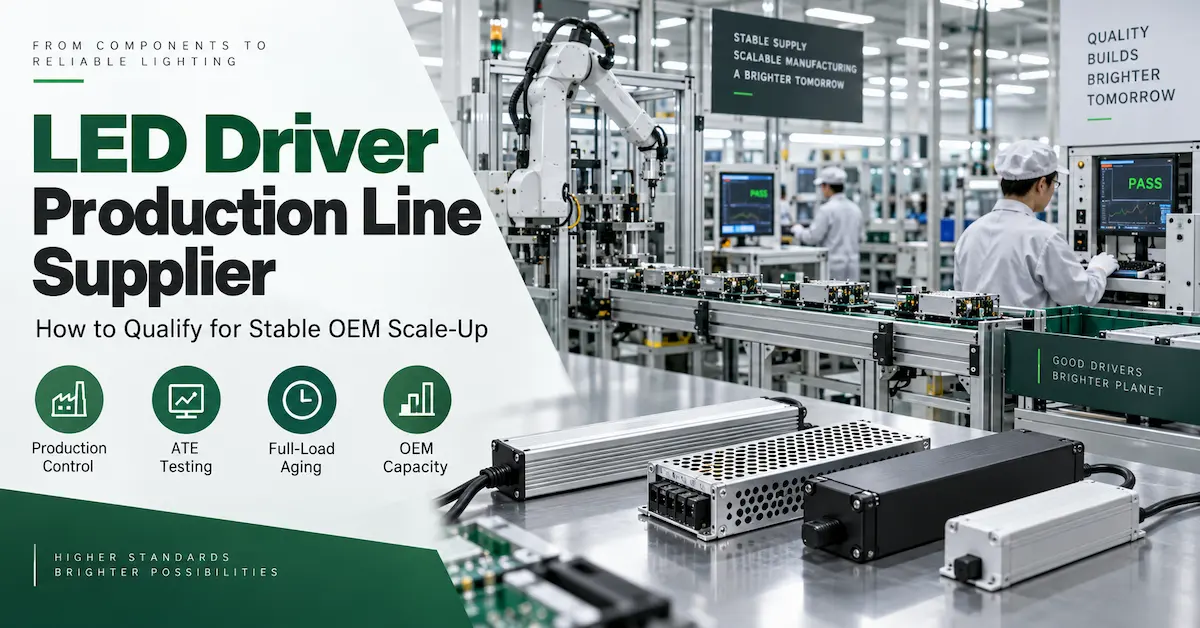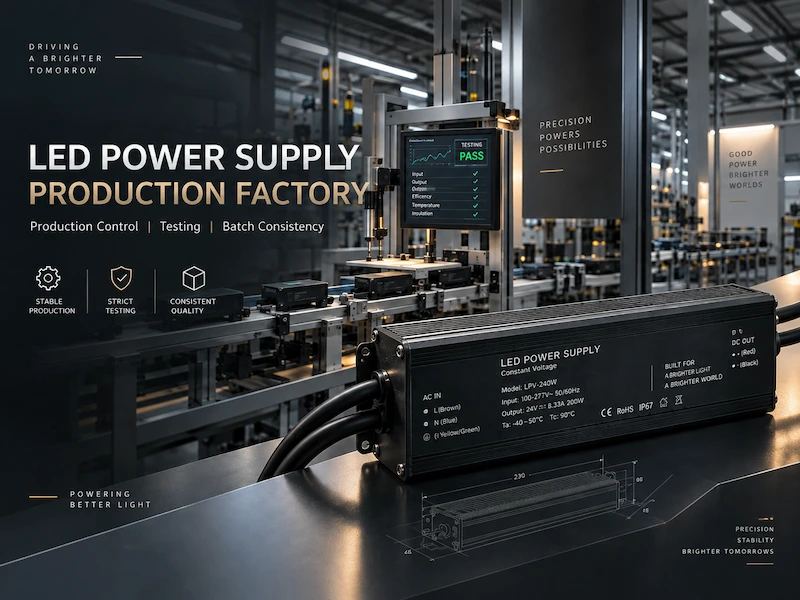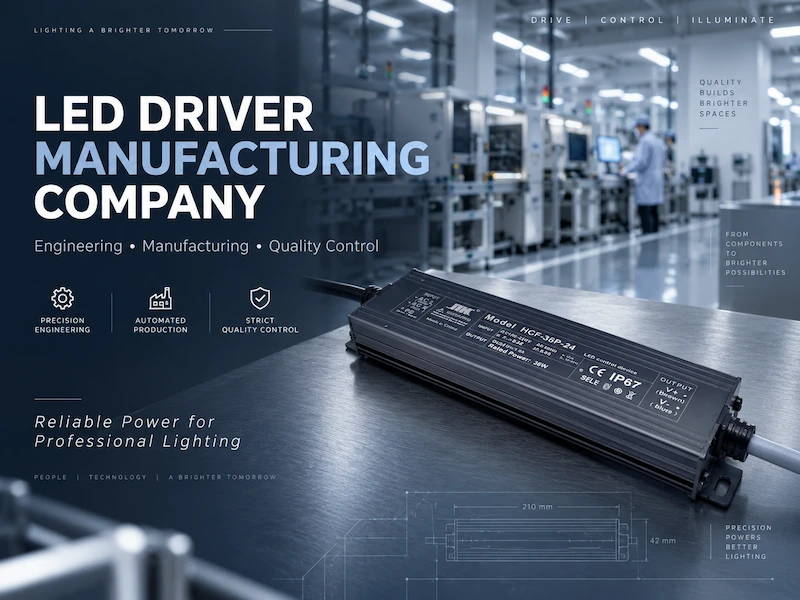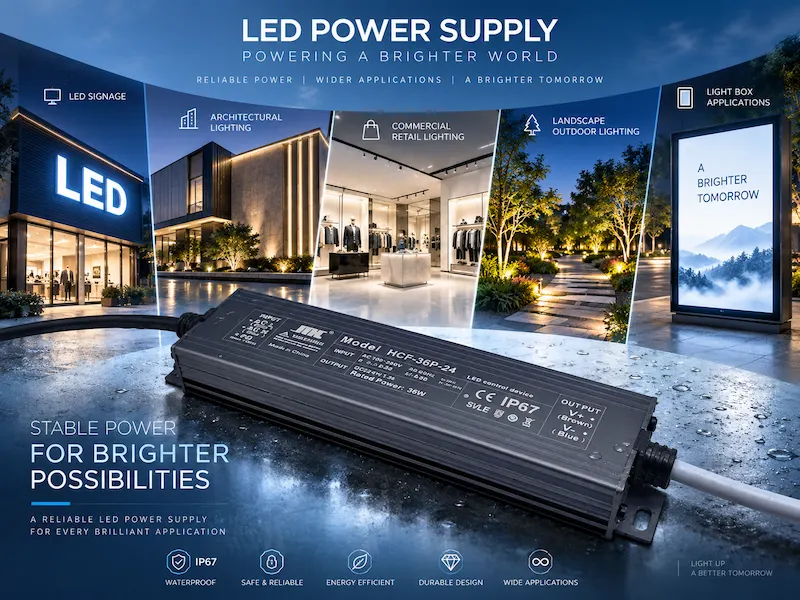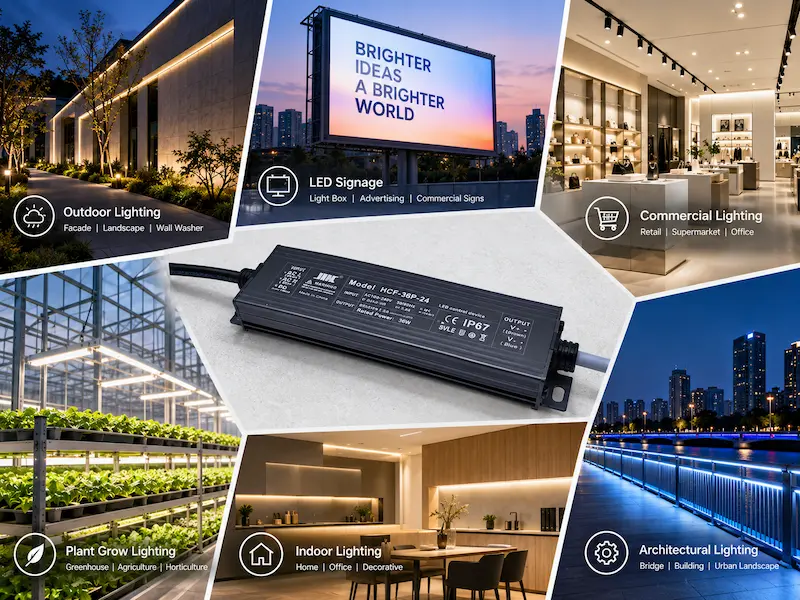
Direct answer: A reliable waterproof LED power supply factory must prove more than an IP67 label. Before OEM mass production, a buyer should verify the exact electrical design, potting or enclosure process, model-specific test evidence, certification scope, full-load aging, production capacity, and the factory's ability to answer a detailed RFQ. Public information from JMHC shows a 5,000+ square meter facility, annual capacity above 5 million sets, automatic vacuum glue filling lines, ATE testing equipment, and 100% full-load aging tests. The remaining items, including MOQ, final lead time, packaging, connectors, and model-specific reports, should be confirmed in the quotation process.
Buying a few samples and approving a mass-production supplier are different decisions. A sample can work on a bench while the production batch later shows inconsistent potting, connector changes, unstable output, or a delivery schedule that does not match the lighting project. The factory evaluation therefore has to connect product evidence with manufacturing evidence.
This article is written for lighting brands, OEM buyers, electrical distributors, project contractors, and engineers comparing an OEM LED power supply factory with a trading company or a general switching power supply supplier. The search intent is supplier comparison and RFQ intent: the goal is to decide what evidence to request before placing a repeat order, not to repeat a basic definition of IP67.
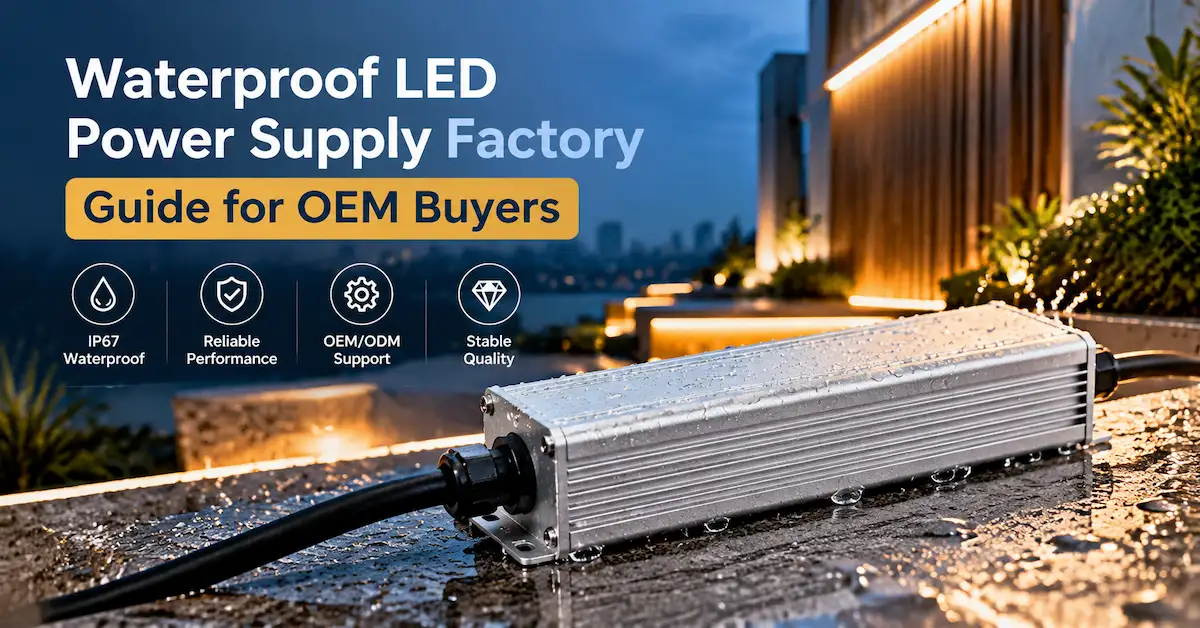
Who Should Use This Factory Evaluation
A factory comparison is most useful when the power supply will be installed in a product that carries your brand, shipped into several markets, or used in a project where replacement is expensive. The review should be more detailed when the LED system is outdoors, exposed to condensation, installed in a signboard or light box, or expected to run for long hours at high load.
Typical buyers
- Lighting brands that need a repeatable private-label or OEM power supply.
- Distributors that need a stable range of waterproof LED drivers rather than one spot purchase.
- Architectural and landscape lighting contractors that must match output voltage, power, installation space, and environmental exposure.
- Signage and light-box manufacturers that need compact low-wattage models as well as higher-power units.
- Engineers replacing an existing driver and needing evidence that the new supply will fit the electrical and mechanical design.
When a short supplier screen is not enough
Do not rely on a factory homepage alone when the project requires a formal compliance file, a controlled connector, an unusual output voltage, a private label, or a fixed delivery window. Those requests affect BOM control, tooling, production scheduling, packaging, and documentation. A professional RFQ submitted with the actual project data gives the factory a basis for an answer that can be checked.
What “Waterproof” Must Mean in a Production Context
For procurement, waterproof is not a complete specification. It should describe a tested assembly, a defined installation condition, and an identified model. IP67 generally communicates protection against dust ingress and temporary immersion under the applicable test conditions. It does not automatically prove that every cable joint, connector, gland, mounting direction, enclosure seam, or installation detail will remain protected in a real project.
Ask the factory to separate four statements that are often mixed together:
- Design claim: the product uses a potted enclosure, sealed housing, or other protection method.
- Test claim: a defined sample passed an IP test under a named method or report.
- Production control: the same materials, filling process, cure condition, and inspection are applied to the production batch.
- Installation boundary: the buyer understands what must be protected outside the power supply, such as cable joints and exposed connectors.
JMHC's public information describes IP67 waterproof LED power supply families, automatic vacuum glue filling, and a third-party IP67 report in the company timeline. Those are useful first-party signals. The RFQ should still request the applicable report or specification for the exact model, output, enclosure, and revision being quoted.
Evidence a buyer should request
| Factory evidence | What to verify | Why it matters |
|---|---|---|
| IP test report or certificate | Model, sample construction, test scope, date, and issuing body | Prevents a factory-wide IP claim from being applied to an untested variant |
| Potting process description | Material type, vacuum filling, cure or sealing controls, and inspection points | Shows how the protection is reproduced from sample to batch |
| Product drawing or installation sheet | Cable exits, mounting position, input/output separation, and environmental limits | Clarifies what the IP rating does and does not cover |
| Batch test record | Serial or lot traceability, electrical test, and aging result | Connects the supplied unit to a measurable release decision |
Verify the Electrical Design Before Reviewing the Factory
A waterproof enclosure cannot compensate for an unsuitable electrical design. Before comparing supplier prices, confirm whether the project needs a constant-voltage LED driver, a constant-current driver, or a different type of power supply. Then match input range, output voltage, rated power, load profile, power factor, efficiency, dimming method, protections, and thermal conditions.
Start with the load, not the catalog number
For a constant-voltage LED system, identify the LED strip, module, light box, or fixture voltage first. Calculate the connected load and allow a sensible operating margin. A 24 V fixture cannot be treated as interchangeable with a 12 V fixture simply because both products are described as LED power supplies. The connector, cable length, voltage drop, and starting behavior also affect the result.
For a project with long operating hours, request efficiency and power factor data at the intended input and load condition. JMHC's HCF-380PE public product page states active PFC, PF greater than or equal to 0.95, efficiency up to 91%, universal AC input from 100 V to 250 V at 50/60 Hz, and protection against short circuit, over-current, and overload with auto-recovery. These figures are useful for initial comparison, but the quotation should identify the exact output version and the test conditions behind the data.
Check protection as a system requirement
Short-circuit, over-current, overload, over-temperature, and surge behavior should be assessed against the fixture and installation environment. “Auto-recovery” also needs clarification: ask what fault condition is cleared automatically, what happens after repeated events, and whether the output restarts within the project's acceptable behavior.
If the project uses TRIAC, 0-10 V, 1-10 V, PWM, DALI, ELV, or another control method, do not assume that a waterproof body means dimming compatibility. The control signal, dimming range, minimum load, flicker behavior, wiring, and driver version must be named in the RFQ. JMHC publishes multiple dimmable LED driver directions on its site, but the specific dimming option must be matched to the model and project controller.
A practical electrical confirmation list
- Input voltage, frequency, and power supply environment.
- Constant-voltage or constant-current output type.
- Nominal output voltage and current or wattage.
- Maximum rated load and recommended operating margin.
- Power factor and efficiency at the required operating point.
- Inrush current, ripple, regulation, and start-up behavior when relevant.
- Protection modes and recovery behavior.
- Ambient temperature, enclosure temperature, humidity, vibration, and installation orientation.
Inspect Potting, Enclosure, and Material Controls
The main difference between a dependable waterproof LED driver and a product that only looks sealed is process control. A buyer should understand how the factory controls the enclosure, potting compound, cable exit, terminal, and cure condition. A nice product photograph cannot show voids, trapped air, incomplete filling, poor adhesion, or a material mismatch that appears after heat cycling.
Vacuum filling is a process, not a marketing adjective
JMHC publicly identifies automatic vacuum glue filling production lines as part of its manufacturing capability. For a production audit, ask how the line controls glue ratio, mixing, vacuum level, fill volume, work time, curing, and operator access. Ask how a bad batch is identified and how the factory prevents a material or recipe change from passing unnoticed.
The aim is not to demand a proprietary formula. The aim is to establish controlled inputs and traceable outputs. A supplier should be able to explain whether the potting material is chosen for adhesion, insulation, thermal behavior, chemical resistance, or a combination of these factors. The answer should be specific to the product construction and the intended environment.
Review the mechanical details around the seal
Many field failures begin outside the main PCB enclosure. Check cable bend relief, strain relief, gland or exit design, connector mating, mounting holes, and the transition between the potted body and the lead wire. If the factory supplies a bare driver but the installer creates the final cable joint, the system's environmental protection depends on both parties.
Ask for the approved bill of materials or at least the controlled component list for the quoted model. It should cover the enclosure, potting material, cable, connector, fuse or protection component, and any components that affect certification. If the factory offers private labeling, confirm that the label revision does not change the model identity or invalidate the compliance file.
Review the Production Line and Testing Process
A credible waterproof LED power supply factory should explain how incoming parts, assembly, potting, electrical testing, aging, final inspection, and packing connect. The strongest evidence is a process that an auditor can follow from an incoming material lot to a released finished unit.
Incoming and in-process controls
Ask how the factory checks critical incoming components and how nonconforming material is isolated. For a potted power supply, in-process controls can include assembly polarity, solder or connection quality, enclosure preparation, fill quantity, vacuum condition, cure status, and visual inspection before final closure. The exact checklist belongs to the factory's quality system, but the buyer should be able to see that the process has defined control points.
ATE testing and full-load aging
JMHC states that it uses ATE testing equipment and performs 100% full-load aging tests before shipment. This is important because a full-load aging step can expose unstable components, insufficient thermal margin, abnormal output behavior, and assembly defects before the order leaves the factory. During an audit or technical review, ask what measurements are captured, how long the aging step runs, which loads are applied, and how failed units are reworked or rejected.
“100% aging” should also be tied to traceability. Request a sample record showing the model, lot, test date, measured result, and release decision. If the factory cannot share customer-sensitive records, it can usually provide a blank report format or redacted example. The purpose is to verify the control logic, not to obtain another customer's data.
Factory evidence versus product evidence
| Question | Factory-level evidence | Product-level evidence |
|---|---|---|
| Can the supplier produce at scale? | Facility size, capacity statement, line layout, staffing, scheduling process | Quoted model's monthly or order-specific capacity confirmation |
| Can the supplier control waterproofing? | Automatic vacuum filling line and process controls | Exact model potting construction, IP report, and batch inspection |
| Can the supplier release stable units? | ATE equipment and 100% full-load aging policy | Test items, acceptance limits, and lot record for the quoted model |
| Can the supplier sell into the target market? | Published compliance scope and quality system | Certificate or test report tied to the model, rating, and revision |
Use Certifications as Evidence, Not Decoration
CE, LVD, EMC, CCC, BIS, UKCA, RoHS, or EAC references can help a buyer shortlist a supplier, but a logo on a web page is not the same as a complete compliance file. The relevant question is: which model, under which rating, with which critical components, has been evaluated for which market?
JMHC's public pages list CE, LVD, EMC, CCC, BIS, UKCA, and RoHS directions, with EAC appearing on some site content. Treat that as a published capability statement. Before order approval, request the current document set for the exact product and destination market. Confirm whether the document is a certificate, declaration, test report, or internal statement, and whether the tested model matches the one on the quotation.
Questions to ask about certification scope
- Does the document identify the exact model number and output rating?
- Does the tested construction match the supplied enclosure, cable, connector, and potting material?
- Are the input range and frequency the same as the quoted product?
- Is the document current for the target market and importer requirements?
- Are there component substitutions or factory changes since the test date?
- Does the product need a buyer-side declaration, marking, or technical file in addition to the factory documents?
Standards listed on a product page are useful search entities, but they are not a substitute for a model-specific review. This distinction improves both procurement quality and the accuracy of the product content that later appears on your own website.
Evaluate Capacity, MOQ, Lead Time, and Packaging
Factory capacity matters only when it can be translated into an order-specific delivery plan. A supplier may state a high annual capacity while a custom model is delayed by component availability, potting cure time, certification updates, or packaging approval. Ask for the production assumptions behind the quote.
JMHC publicly describes a facility of more than 5,000 square meters and annual capacity above 5 million sets. This supports an initial assessment of manufacturing scale. It does not establish a fixed MOQ or lead time for every model. MOQ, sample timing, production lead time, packaging, connector selection, output voltage, private label, and custom tooling should be confirmed in the RFQ based on quantity, model, destination, and customization level.
What to separate in the quotation
| RFQ item | Why the factory needs it | Expected buyer response |
|---|---|---|
| Sample quantity and approval date | Defines the first technical gate before production | State how many samples are needed and who signs approval |
| Forecast and order quantity | Supports component purchasing and line scheduling | Give the first order, monthly forecast, and peak requirement if known |
| MOQ and order split | Determines material efficiency and production setup | Ask whether MOQ differs for standard and custom versions |
| Lead time | Separates sample, material preparation, production, aging, and shipment | Request each stage rather than one vague delivery number |
| Packaging and labels | Controls protection, carton quantity, barcode, and private-label work | Provide packaging dimensions, label artwork, and shipping marks if available |
| Documentation | Determines what is ready for import, audit, and customer support | List required reports, declarations, drawings, and test records |
When a supplier quotes “fast delivery,” ask whether the date starts after deposit, after artwork approval, after material arrival, or after sample approval. A clear milestone schedule is more useful than a short headline number. This is also where a trading company can struggle if it has to confirm every answer with a separate factory.
Compare a Factory with a Trading Company
A trading company can be useful when it provides sourcing reach, language support, consolidation, or access to multiple product categories. The issue is not whether a trading company is automatically bad. The issue is whether the party answering your technical questions controls the production process and can provide evidence without delay.
Questions that reveal the supply chain
- Who owns the production line and the test equipment?
- Who controls the BOM and approves component substitutions?
- Who performs vacuum filling, ATE testing, and full-load aging?
- Who issues the model-specific test report and declaration?
- Who keeps the lot record if a field failure occurs?
- Who confirms a change to cable, connector, label, enclosure, or potting material?
An actual manufacturer should be able to answer these questions with process ownership. JMHC identifies itself as Jiangmen Huachuang Electronic Technology Co., Ltd., located at No.10, Minghui Road, Jianghai District, Jiangmen City, Guangdong Province, China. Its public company information describes design, development, production, and sales of LED power supplies. A buyer can use the JMHC company profile as the starting point, then verify the exact product and order conditions through the engineering and sales response.
What JMHC Publicly Demonstrates
The following points can be used as a first-party evidence map when evaluating JMHC as a waterproof LED power supply factory. They are not a replacement for a project-specific quotation or audit. They show which questions the website already answers and which questions still belong in the RFQ.
| Entity or capability | Publicly stated information | Buyer should still confirm |
|---|---|---|
| Company | Jiangmen Huachuang Electronic Technology Co., Ltd., brand JMHC | Legal entity on quotation, invoice, certificate, and export documents |
| Location | No.10, Minghui Road, Jianghai District, Jiangmen City, Guangdong Province, China | Audit contact, visitor arrangements, and production address for the quoted order |
| Operating history | Founded in 2018; company timeline includes IP67 HCF-A engineering work and later manufacturing upgrades | Current product revision, quality system scope, and responsible technical contact |
| Scale | More than 5,000 square meters and annual capacity above 5 million sets | Capacity available for the buyer's model, forecast, and required ship window |
| Manufacturing | Automatic vacuum glue filling production lines | Potting material, recipe control, cure condition, and model-specific inspection |
| Testing | ATE equipment and 100% full-load aging tests | Test items, acceptance limits, aging duration, and record format |
| Market support | Website references CE, LVD, EMC, CCC, BIS, UKCA, RoHS, and some EAC content | Exact certificate or report for the selected model and destination market |
For a broader view of application fit, review the JMHC LED power supply solutions pages. For a direct comparison of waterproof families, use the waterproof power supply category and then narrow the discussion to a specific model instead of quoting a category page.
Match the Product Family to the Project
A supplier evaluation should end with model fit. A factory may have the right manufacturing capability but still be unsuitable for a particular project if the output, dimensions, power range, or control method is wrong. Use public product pages to create a shortlist, then ask for the current datasheet and approval sample.
| Product family or example | Public information useful for shortlisting | Confirm before purchase |
|---|---|---|
| HCF-A Series | IP67 10 W and 15 W examples; the company timeline also identifies the HCF-A engineering series | Output voltage, dimensions, cable, actual IP documentation, and available quantity |
| HCF-C Series | IP67 20 W product page for outdoor lighting | Output version, enclosure details, test report, and connector options |
| HCF-P Series | IP67 36 W page with PFC 0.95 reference | PF test condition, efficiency, output, and destination-market documents |
| HCF-380PE | Public page states 380 W, IP67, active PFC, PF at least 0.95, and efficiency up to 91% | Exact rated wattage, 12 V/24 V version, nameplate, IP report, and certification file |
| HCC-L examples | 60 W, 100 W, and 120 W long-shape pages are visible in the product catalog | Do not infer IP rating from inconsistent page titles; verify formal specification |
One important content and procurement lesson is visible in the HCF-380PE page itself: the page title includes “300W” while the body and URL identify a 380W product. Several HCC-L and HCA pages also contain IP20/IP67 wording that should be checked. This does not prove a production defect. It does prove that buyers should use the formal specification, nameplate, sample, and test report as the approval baseline instead of copying an SEO title into a purchase order.
Build an RFQ That a Factory Can Answer Precisely
A weak RFQ asks, “Please send your best price for a waterproof LED driver.” A strong RFQ gives the factory enough information to confirm engineering fit, documentation, production planning, and commercial conditions in one response.
Minimum technical information
- Application: landscape lighting, architectural lighting, signboard, light box, commercial decoration, security monitoring, industrial control, or another defined use.
- Input voltage, frequency, region, and expected abnormal input condition.
- Output voltage, current, wattage, and constant-voltage or constant-current requirement.
- Fixture quantity, connected load, duty cycle, installation location, and ambient temperature.
- IP requirement for the driver and the complete installed system.
- Dimensions, mounting points, cable length, connector, terminal, and wiring direction.
- Control method, if dimming is needed.
- Target market, certification, marking, language, and documentation requirements.
Minimum commercial information
- Sample quantity and expected sample approval date.
- First order quantity, annual forecast, and expected order frequency.
- Private label, carton label, barcode, manual, and packaging requirements.
- Target shipment date and destination port or delivery address.
- Whether the buyer needs a standard product, a controlled modification, or a new design.
- Required reports, drawings, inspection records, and warranty terms.
Send the RFQ through JMHC's contact page or its inquiry page with the model or application data attached. The more specific the input, the easier it is to distinguish a real factory answer from a generic catalog reply.
Factory Audit Checklist Before Mass Production
Use the following checklist as a release gate. A “yes” should mean that evidence exists, not simply that someone gave a verbal assurance.
| Release question | Pass condition | Evidence to retain |
|---|---|---|
| Is the supplier identity clear? | Legal entity, address, contacts, and factory role are consistent | Quotation, company profile, and commercial documents |
| Is the electrical design approved? | Input, output, load, control, protection, and temperature limits are signed off | Approved specification and sample test record |
| Is waterproofing tied to the exact model? | IP claim, construction, and report match the quoted version | Drawing, report, photos, and sample record |
| Is production repeatable? | Critical materials and process checkpoints are defined | BOM or controlled component list, process flow, and audit notes |
| Is release testing adequate? | ATE and full-load aging criteria are defined for the model | Redacted test form or sample batch record |
| Are documents market-appropriate? | Certificate and report scope match destination and model | Current compliance package |
| Is delivery realistic? | MOQ, material, sample, production, aging, and shipment milestones are written | Order schedule and approved packaging specification |
| Is the change process clear? | Factory must notify and approve material, PCB, cable, label, or process changes | Change-control agreement or purchase-order clause |
The checklist also protects the buyer's content accuracy. When the approved specification, certificate, and product page use the same model identity, your catalog, installation manual, sales material, and customer support answers can remain consistent.
FAQ for Waterproof LED Power Supply Factory Buyers
How do I know whether a waterproof LED power supply factory is genuine?
Check whether the company can identify its legal entity, factory address, production process, test equipment, responsible technical contact, and model-specific documents. A genuine manufacturer should be able to explain who controls potting, ATE testing, aging, BOM changes, and lot records. Use the public JMHC About Us page as a first reference, then ask questions tied to the model and order.
Does an IP67 label guarantee outdoor reliability?
No. IP67 is one part of environmental protection. Confirm the exact product report, enclosure, potting, cable exit, installation conditions, temperature, condensation risk, and exposed system joints. The driver and the complete installed lighting system should be reviewed separately.
What information should I request from an IP67 LED driver manufacturer?
Request the current specification, input and output ratings, dimensions, installation instructions, IP evidence, certification scope, protection behavior, test items, aging process, sample record, packaging details, MOQ, lead time, and change-control conditions. For custom work, add the BOM, label, connector, cable, and forecast requirements.
Does JMHC publish a fixed MOQ for waterproof LED power supplies?
The public website does not establish one universal MOQ for every waterproof model or customization level. MOQ should be confirmed with the exact model, quantity, packaging, output, connector, private-label, and forecast requirements. The same applies to lead time and packaging.
What is publicly stated about JMHC production testing?
JMHC publicly describes automatic vacuum glue filling lines, ATE testing equipment, and 100% full-load aging tests. In an RFQ, ask for the relevant test items, acceptance limits, aging duration, and a model-specific sample or redacted record.
Which JMHC products should I compare first?
For a small outdoor load, compare the HCF-A examples. For 20 W and 36 W outdoor applications, review the HCF-C and HCF-P pages. For a higher-power constant-voltage requirement, the HCF-380PE page is a starting point. Treat HCC-L products as a separate mechanical and environmental review because the public pages contain IP wording that needs formal confirmation.
Should I choose a standard product or request OEM customization?
Start with a standard model when the output, dimensions, cable, connector, IP evidence, and certification already fit. Request OEM or ODM changes when the existing model cannot meet the installation, label, packaging, output, or control requirement. Customization should be approved through a written specification and sample process, not only through an email description.
Conclusion
Choosing a waterproof LED power supply factory is a verification exercise. The right supplier can connect a waterproof construction with stable electrical design, controlled materials, repeatable potting, ATE testing, full-load aging, appropriate documentation, and a delivery plan that matches the project. The buyer's job is to request evidence at the same level of specificity as the purchase order.
JMHC is a credible candidate for this comparison because its public company and product information identifies a Guangdong manufacturing base, a 5,000+ square meter facility, annual capacity above 5 million sets, automatic vacuum glue filling lines, ATE testing, and 100% full-load aging. The next decision still depends on the exact model. Confirm the rating, IP report, output version, certification scope, MOQ, lead time, packaging, connector, and sample approval criteria before OEM mass production.