
What Should a Private Label LED Power Supply Project Deliver?
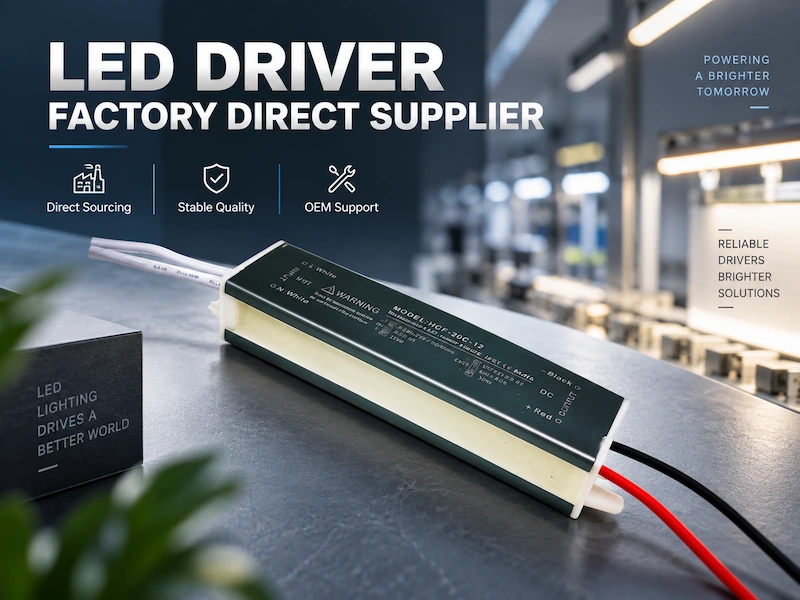
A private label LED power supply is a manufacturer-produced power supply sold under your own brand, with agreed product identification and packaging. JMHC describes private-label cooperation as including branding and packaging for suitable products, while cable, connector, or electrical changes require a separately defined scope. For a distributor, the practical goal should be more precise than “put our logo on this unit”: approve a product your sales team can describe accurately, your warehouse can identify correctly, and your supplier can reproduce against an agreed specification. The approval framework below connects those tasks so that a successful sample does not become disconnected from the product eventually ordered in volume.
Decide Whether Private Label Fits Your Business
Consider this sourcing route when you are building a branded lighting-accessory range, supplying repeat signage projects, or supporting customers who need recognizable products and consistent replacement references. Start by identifying who will approve the electrical specification, who will manage artwork, and who will handle product questions after delivery. A small company can assign several responsibilities to one person, but none should be left undefined. For a one-time replacement purchase, evaluate whether a standard catalog product would meet the need without a branding program. When the load, installation conditions, or required product behavior remain unresolved, complete the technical evaluation before committing to a private label LED power supply launch.
Match the Product Family to the Installation
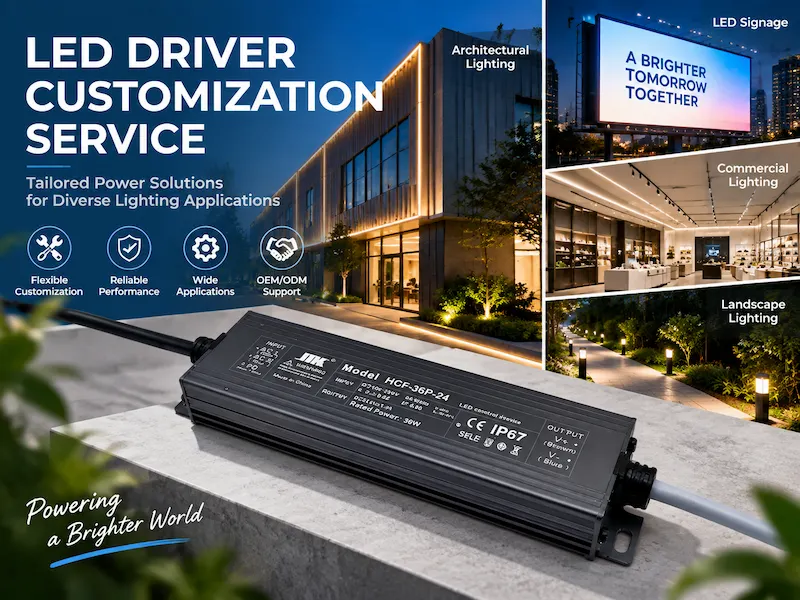
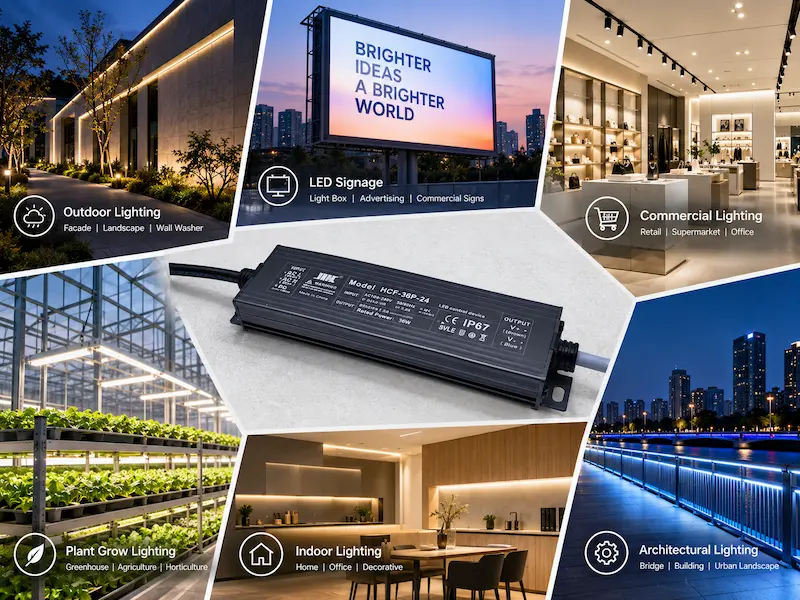
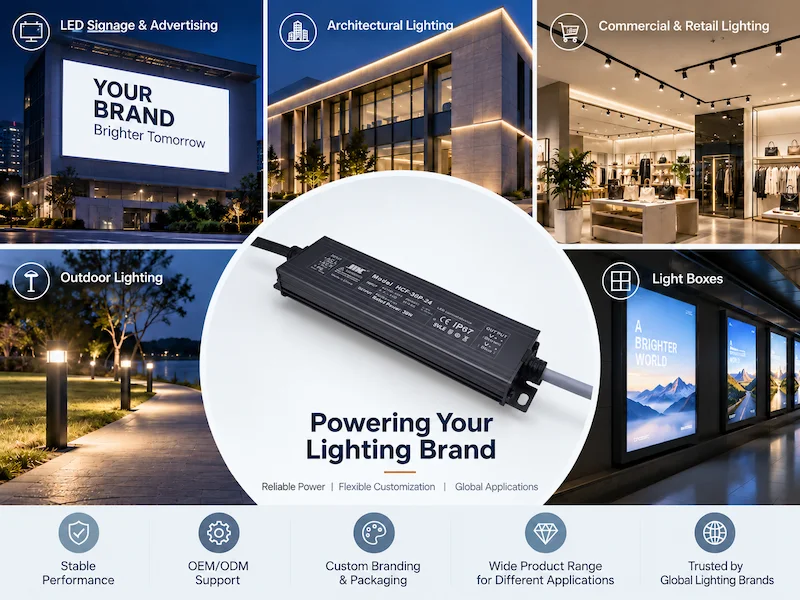
JMHC’s published application areas include LED lighting, advertising signboards, light boxes, architectural lighting, and commercial decoration. Its catalog separates indoor power supplies from waterproof power supplies, providing useful starting points for a product-range discussion. For your own portfolio, give each proposed model a defined installation role rather than grouping everything under “LED lighting.” A retail-display product brief should describe its available mounting space and access requirements; a signage brief should identify exposure, connection arrangements, and operating conditions. For controlled lighting, also specify the intended dimming system. Treat these as separate approval questions, even when two products have similar advertised wattages.
Create a Technical Specification Before Approving Artwork
Before requesting branded samples, create one specification record for each proposed inventory item. Separate the application requirement from the supplier’s confirmed product value: “required output” and “approved output” should not remain interchangeable descriptions. Mark unresolved fields as open questions and assign someone to close them. This is particularly useful when purchasing, engineering, and marketing work from different documents. JMHC’s custom-manufacturing and OEM guidance emphasizes defining electrical, mechanical, environmental, and production requirements before approval; the following specification checklist turns those areas into an approval record rather than presenting unverified values as a shared datasheet.
| Specification Item | What to Confirm | Approval Record |
|---|---|---|
| Application | Lighting product, installation location, and intended operating conditions | Application brief |
| Input supply | Required AC input range and frequency | Approved model datasheet |
| Output type | Constant voltage or constant current, as required by the load | Electrical specification |
| Output rating | Voltage or current requirement, rated power, and permitted load range | Confirmed rating sheet |
| Thermal conditions | Ambient conditions, mounting arrangement, and applicable derating | Model-specific thermal information |
| Dimensions | Overall size, fixing positions, and installation clearance | Approved mechanical drawing |
| Materials | Enclosure material, cable specification, and relevant controlled components | Construction specification |
| Connections | Cable length, conductor identification, connector, and connection arrangement | Wiring drawing |
| Dimming | Required interface, controller model, and validation conditions | Compatibility record |
| Environmental protection | Required protection and documented installation limits | Applicable model documentation |
| Protection functions | Required fault responses and recovery behavior | Agreed test criteria |
| Identification | Your product code, factory model, and document revision | Product-reference record |
Compare JMHC Models by Their Role in Your Range
For the waterproof portion of a private label LED power supply range, JMHC publishes the following reference products. Use the table to shortlist candidates for discussion, not to approve an application from wattage alone. The published features are product-page information; the portfolio roles are suggested evaluation directions. Confirm the exact output version, dimensions, installation limits, documentation, and customization feasibility before assigning your own product code. Prices also need a configuration-specific quotation rather than an assumed “economy,” “standard,” or “premium” ranking.
| JMHC Reference Product | Published Features | Potential Portfolio Role | Main Approval Questions |
|---|---|---|---|
| HCF-A Series 10W | 10W, IP67, compact construction | Candidate for lower-power outdoor lighting requirements | Does the confirmed output and mechanical size match the intended load and installation? |
| HCF-C Series 20W | 20W, IP67; lighting and signage positioning | Candidate for a separately defined signage or decorative-lighting requirement | Which output version, connection arrangement, and installation conditions will be approved? |
| HCF-P Series 36W PFC | 36W, IP67, published power factor up to 0.95 | Candidate where the project specifies a power-factor requirement | Under which input and load conditions is the stated power factor applicable? |
Review Materials and Workmanship Before Cosmetic Changes
Do not use exterior appearance as your construction specification. Ask which enclosure, wiring, connectors, and other relevant materials belong to the selected version, and identify which changes require approval. Where potting is part of the construction, discuss the associated process controls rather than treating “filled with compound” as a complete quality description. JMHC publishes automatic vacuum glue-filling capability in its manufacturing information. For your project, request the applicable construction details and agree how substitutions will be reviewed. The useful distinction is between an allowed production adjustment and a change that needs renewed confirmation—not between two products that happen to look identical in a photograph.
Approve the Label, Carton, and Product Record Together
For a private label LED power supply, treat artwork approval as a product-identification task as well as a design task. Create a simple relationship between your inventory code, the factory model, the output version, the specification revision, and the artwork revision. Then check the physical label, individual packaging, outer-carton identification, datasheet, and sales listing against that relationship. For example, two approved variants may share a housing but have different output requirements; give your warehouse an unambiguous way to distinguish them without opening every carton. Have the technical reviewer approve ratings and descriptions, the commercial reviewer approve branding and packaging, and one named person confirm that both reviews apply to the same version. Avoid releasing several loosely named files such as “final label” and “final label new.”
Match Documentation to the Branded Configuration
Build a document index for every private label LED power supply model rather than collecting an undifferentiated folder of certificates. Record the document name, covered model, relevant version, and the person responsible for reviewing its suitability for your intended market and product claims. Ask which documents support the underlying factory model and whether your proposed naming or construction changes require further review. Keep unverified certification marks and performance statements off approved artwork until the question is resolved. As a practical cross-check, place the sample, label, datasheet, and document index together during sign-off: any rating or product identity that cannot be reconciled should remain an open approval item, not become a marketing assumption.
Validate the Sample as a Complete Branded Product
Give sample approval two separate outcomes: application approval and commercial-presentation approval. For the first, have qualified personnel evaluate the agreed electrical behavior, installation fit, thermal conditions, connections, and any required control compatibility. For the second, inspect identification, label readability, packaging contents, and the match between the product and its documentation. Record which sample was evaluated, what configuration it represented, and any unresolved findings. Keep an approved reference sample together with the corresponding records, but do not let that sample replace a written specification. Before a larger commitment, agree whether a pilot quantity is needed to check receiving, assembly, packing, and identification under normal production conditions. JMHC’s OEM guidance discusses application validation and pilot production as distinct steps before scaling.
Ask What Production Testing Actually Covers
JMHC’s manufacturing overview describes automated test equipment, commonly abbreviated as ATE, and 100% full-load aging. Use those stated capabilities as the beginning of a quality discussion. Ask which tests apply to your selected model, what acceptance limits are used, how aging conditions are defined, and how failed units are handled. Also agree which records will accompany or identify the production batch. For your receiving process, distinguish evidence of electrical testing from evidence that the correct label, cable, connector, and carton were supplied. Both matter to the approved product, but one record should not be treated as proof of the other.
Confirm MOQ and Lead Time After Defining the Order
JMHC states that its manufacturing facility exceeds 5,000 square meters and its annual production capacity exceeds five million power supplies; those figures describe overall capability, not an allocated delivery slot for your order. Its private-label guidance also identifies model, packaging, customization scope, and quantity as factors in minimum order quantity and lead time. Request separate confirmation of the minimum quantity per model or version, any packaging-related minimums, sample timing, and bulk-production timing. For a private label LED power supply launch, also agree what starts the delivery clock: order confirmation, material availability, artwork approval, or completion of another milestone. Put the agreed sequence in the order record instead of relying on a single number of days without a defined starting point.
Compare the Cost of the Approved Configuration
Use the same approved specification when comparing quotations. Ask each supplier to identify what is included in the recurring unit price and what is charged separately for samples, artwork preparation, packaging, tooling, or additional evaluation. Add the delivery and receiving costs relevant to your own purchasing arrangement, while avoiding double-counting items already included in the quote. Then compare the first order and a repeat order separately: one-time setup costs should not be confused with ongoing product cost. Also agree how shortages, incorrect configurations, and reported defects will be reviewed. A meaningful private label LED power supply quotation should make these boundaries visible; a lower headline price is not directly comparable when it describes different cables, packaging, documentation, or inspection scope.
Set Reorder Rules Before the First Shipment
Make future purchase orders refer to the approved configuration, not just a product nickname or photograph. Establish a simple change-request record containing the proposed change, the reason, affected inventory codes, required review, approval status, and the first affected batch. Ask the supplier to agree which electrical, material, mechanical, and identification changes require notification before implementation. Internally, keep old and new revisions distinguishable during any transition. Consider a hypothetical distributor changing only its carton design: purchasing may approve the new packaging while technical specifications remain unchanged, but the warehouse still needs to know which carton revision to expect. This small example illustrates the wider rule—every change needs an identifiable scope, even when it does not change the electrical product.
Prepare a Private Label LED Power Supply Inquiry for JMHC
JMHC’s application-based power supply solutions describe voltage and wattage matching, application customization, and engineering support. To start a useful discussion, submit your target application and market, input and output requirements, actual load, installation dimensions, environmental conditions, and any dimming requirements. Add the proposed branding scope, cable or connector requests, packaging format, sample quantity, first-order quantity, and expected reorder pattern. Identify which requirements are fixed and which are open to a standard-product alternative. Ask for three clear outputs: a recommended product basis, a list of items requiring evaluation, and a quotation scope tied to the agreed configuration. This gives a private label LED power supply project a practical starting point before artwork or delivery expectations are finalized.
Frequently Asked Questions
1. What is the minimum order quantity for a private label LED power supply?
Request a project-specific MOQ covering the selected model, output version, branding, and packaging. JMHC’s published guidance does not establish one universal quantity; it identifies the product and customization scope as factors to confirm before ordering.
2. Can JMHC put my brand on the product and packaging?
JMHC states that suitable projects can include customized product identification and packaging. Submit your artwork requirements with the technical brief, then obtain confirmation of the available format and approval process for the selected product.
3. How should I distinguish private labeling from a deeper OEM project?
Define the requested changes individually instead of relying on the project name. Separate branding and packaging requests from changes to electrical output, construction, wiring, or installation requirements, and ask which items need engineering evaluation.
4. Can I request a different cable or connector?
Include the exact request in the specification, including length, connector identification, and connection arrangement. Ask JMHC to evaluate feasibility on the selected product rather than assuming that a visually small modification can be accepted without review.
5. Can several wattages use the same packaging design?
A shared visual design can be part of your proposed packaging plan, but require clear variant identification. Check that product codes, ratings, quantity markings, and packing instructions prevent different approved models from being confused.
6. Should I approve artwork before the electrical sample?
You can develop artwork early, but keep technical fields provisional until the configuration is confirmed. Final release should connect the approved ratings, product identity, physical sample, and artwork revision in one record.
7. How should certification information appear in my approval process?
Require a documented review of the exact model and proposed claims. Keep a record of which supporting documents were checked and who approved the wording or markings; unresolved claims should remain outside released artwork.
8. What should a sample approval record contain?
Include the sample identifier, specification revision, evaluation conditions, results, outstanding issues, and approvers. Record commercial-presentation checks separately from application checks so that “approved packaging” cannot be mistaken for “approved electrical performance.”
9. What should I ask when a component or construction change is proposed?
Ask which models and batches are affected, whether performance or documentation needs review, and what evidence is required before acceptance. Record the decision and transition plan before treating the revised product as interchangeable.
10. What information makes repeat ordering easier?
Use the agreed inventory code, factory model, output version, specification revision, artwork revision, and packaging reference. Confirm that the purchase-order acknowledgment matches those details rather than assuming a previous order number fully defines the new shipment.
Conclusion
A private label LED power supply program should leave you with more than a recognizable box. It should give you an approved product definition, a tested sample, consistent identification, a clear quotation scope, and a controlled way to place repeat orders. Begin with the application, select suitable product candidates, and close technical and commercial questions before authorizing bulk production. To discuss a branded range for lighting, signage, or related applications, contact JMHC with your technical requirements, branding brief, and expected quantities so the proposed configuration and next evaluation steps can be reviewed together.