What Should Buyers Expect From an LED Driver Manufacturing Company?
An LED driver manufacturing company should do more than supply a driver with the required wattage printed on the label. For professional B2B buyers, the real question is whether the company can translate a lighting requirement into a controlled product specification, manufacture that configuration consistently, test it against defined limits, and reproduce the same approved version on future orders. This matters to lighting brands, luminaire manufacturers, LED signage companies, distributors, and engineering buyers because a driver becomes part of a larger electrical and mechanical system. JMHC positions its business around LED switching power supplies and provides different product platforms for indoor, waterproof, and dimmable applications through its LED power supply product range.
A useful supplier review should therefore connect four areas: engineering capability, manufacturing control, quality evidence, and commercial repeatability. A factory may have modern equipment but weak revision management; another may produce acceptable samples but lack a clear process for transferring those samples into mass production. The purpose of supplier qualification is to identify those gaps before they become purchasing problems.
Which Buyers Need a Manufacturing Partner Rather Than a Trading-Only Supplier?
A manufacturing relationship is particularly valuable when the driver affects fixture design, installation, regulatory documentation, assembly efficiency, or repeat-order consistency. Lighting fixture manufacturers may need mechanical integration and thermal review; signage producers may require waterproof construction, cable arrangements, and stable batch supply; commercial-lighting brands may need dimming compatibility; distributors may need several product families under one sourcing program; and OEM/ODM customers may require controlled customization, labels, packaging, or engineering changes.
Not every order requires deep manufacturing involvement. If a buyer needs a small quantity of an existing standard product and no engineering, labeling, documentation, or long-term supply control is required, a standard purchasing route may be sufficient. Before developing a custom program, compare the requirement with JMHC's LED power supply solutions and existing product platforms to determine whether a standard configuration already fits the project.
Start the Factory Audit With the Application
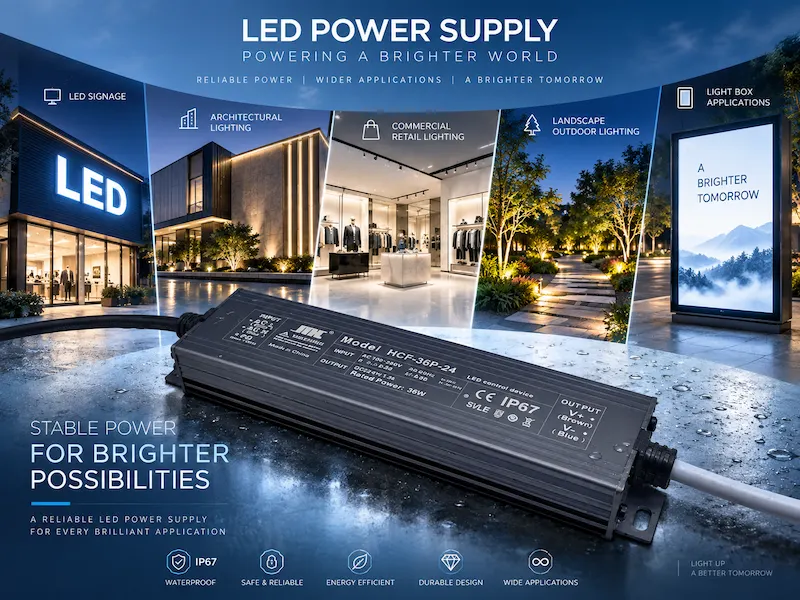
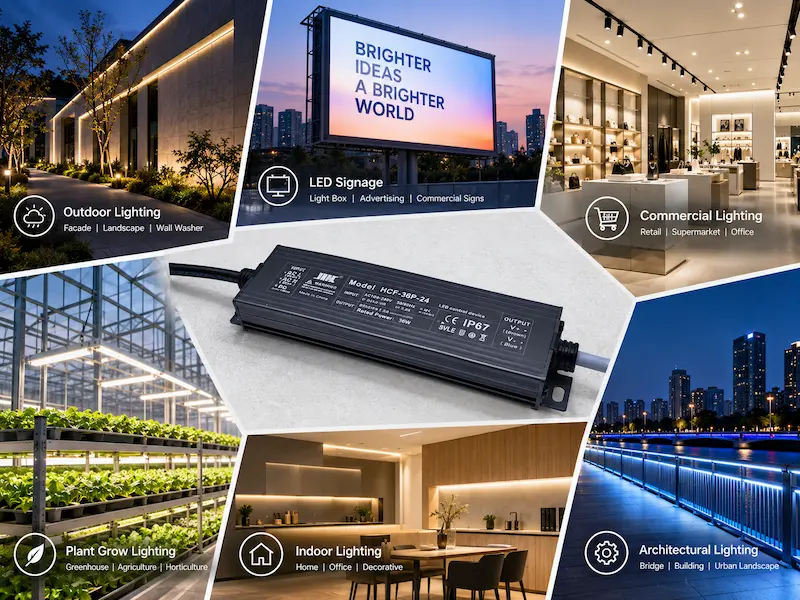
A reliable LED driver manufacturing company should ask where the driver will be used before recommending a model. The same nominal wattage can operate in very different environments: inside a narrow retail fixture, behind an advertising light box, within architectural lighting, in an exterior sign, or in a landscape installation. Installation space, ambient temperature, ventilation, cable routing, moisture exposure, control system, maintenance access, and actual LED load can all change the appropriate product choice.
For protected indoor projects, buyers can begin with JMHC's indoor power supply range. Outdoor or more environmentally exposed applications can start from the waterproof power supply range, while controlled-lighting projects should separately review the dimmable LED driver category. A category is only a starting point; model selection still requires the actual operating conditions.
Use a Supplier Qualification Specification Before Comparing Quotes
Comparing quotations without a common specification can create a false price comparison. One supplier may quote a different cable, output version, enclosure, test scope, packaging configuration, or compliance document than another. Before requesting the final price, create a requirement sheet that identifies what must be supplied and what remains open for technical confirmation.
| Qualification Area | What the Buyer Should Confirm | Evidence to Review |
|---|---|---|
| Application | Fixture, signage, architectural, retail, outdoor or equipment use | Application brief |
| Input | Required voltage range and frequency | Datasheet and approved specification |
| Output | Constant voltage/current type and required rating | Electrical specification |
| Load | Actual operating load and rated requirement | Test conditions |
| Mechanical | Dimensions, mounting points and clearance | Mechanical drawing |
| Environment | Indoor/outdoor conditions and temperature | Model-specific application information |
| Wiring | Cable type, length, polarity and connector | Wiring drawing |
| Control | Dimming or control method where applicable | Compatibility test plan |
| Construction | Housing and relevant controlled materials | Approved product specification |
| Quality | Routine tests, sampling checks and aging requirements | Inspection plan |
| Identification | Buyer SKU, manufacturer model and revision | Product record |
| Documentation | Required reports, certificates and drawings | Document matrix |
The key is to distinguish buyer requirement, manufacturer proposal, approved specification, and unresolved question. That prevents an early quotation or sample description from being mistaken for the final production configuration.
How Should Buyers Evaluate Engineering Capability?
Engineering capability becomes visible when the supplier can explain why a proposed driver fits the application rather than simply providing a catalog. For electrical design, buyers should confirm the required input, output type, rated power, actual load, protection expectations, and control requirements. For mechanical integration, the manufacturer should understand available space, cable exits, mounting, connectors, and surrounding heat sources. For thermal evaluation, the relevant question is how the product behaves in the final installation—not only on an open laboratory bench.
A capable LED driver manufacturing company should also know when a standard platform is enough and when a project requires deeper customization. Unnecessary redesign can increase tooling, testing, documentation, and schedule risk. When an existing platform satisfies most requirements, adapting only the necessary variables can provide a more controlled route to production.
Materials and Components Should Be Controlled by Specification
Professional sourcing should not rely only on requests for “brand-name components.” A better approach is to determine which component characteristics are critical, how approved alternatives are managed, and which substitutions require engineering review. Capacitors, magnetic components, switching devices, protection components, PCBs, housing materials, cables, connectors, and potting materials can all influence the finished driver.
For repeat orders, ask how a proposed material change is communicated. If a component becomes unavailable, does purchasing substitute it directly, or does engineering assess the change first? The answer reveals more about manufacturing discipline than a component-brand list alone. The approved BOM or controlled material specification should remain connected to the production revision so that a repeat order does not silently become a different product.
Workmanship Matters From Assembly Through Waterproof Processing
An LED driver factory should have process controls that correspond to the product construction. For standard assembly this can include PCB identification, soldering quality, wiring, polarity, fixing, housing assembly, and first-article verification. Waterproof models introduce additional controls around potting material, filling, cable entry, curing, and enclosure construction.
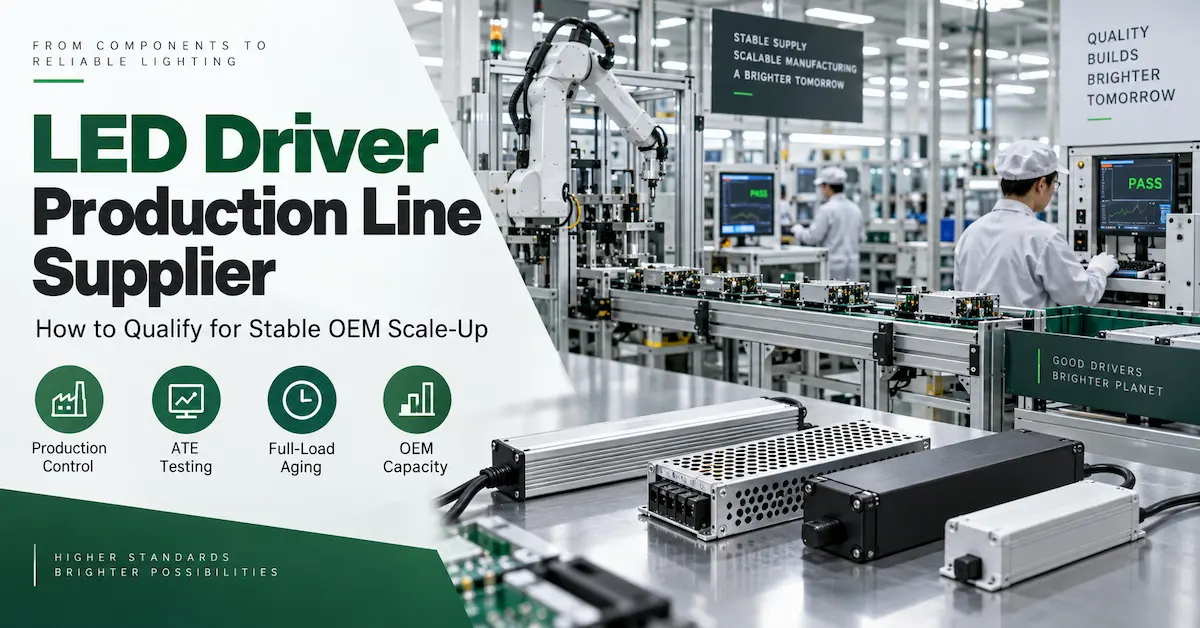
JMHC states on its About Us page that its manufacturing facility uses automatic vacuum glue-filling production lines for relevant products. For a buyer, the machine itself is only part of the evidence. The more useful questions are which models use the process, what material and filling requirements apply, how curing is controlled, and what happens when the result does not meet the specified acceptance criteria.
Electrical Testing Should Be Linked to the Approved Model
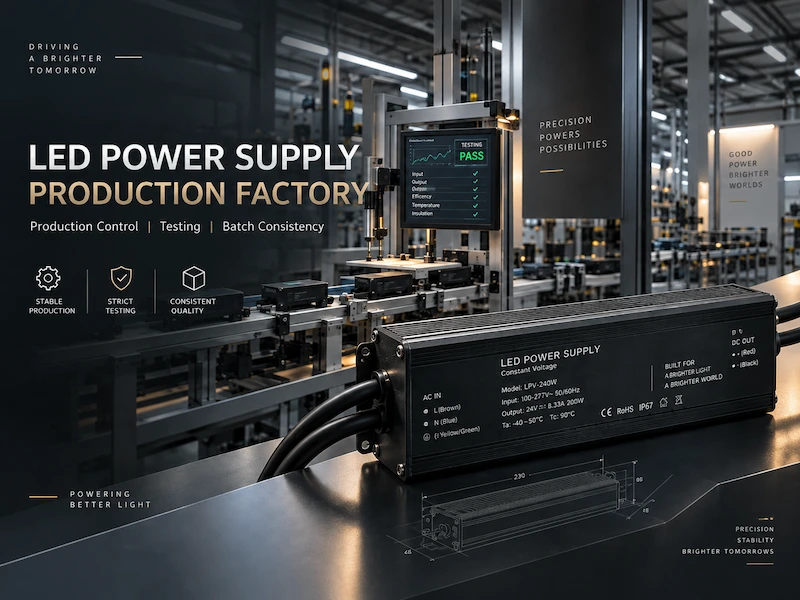
JMHC also states that its manufacturing system includes automated test equipment, or ATE. ATE can improve repeatability, but a buyer should still ask which parameters are checked and what limits belong to the specific model. A pass/fail screen means little if the wrong test program or wrong acceptance limits are used.
During a factory audit, ask how operators select the correct program for a 12V, 24V, or other output version and how a model mismatch is prevented. Review whether output voltage, current-related parameters, protection functions, or other agreed electrical characteristics are tested routinely or during separate qualification. The goal is not to demand that every possible engineering test be performed on every unit; it is to understand what the production test actually proves.
What Does 100% Full-Load Aging Mean?
JMHC states that its products undergo 100% full-load aging as part of its manufacturing process. That statement describes test coverage, but it does not by itself define the duration, ambient temperature, monitoring method, or acceptance rules. Buyers should request those conditions for the selected product or project.
Aging is useful as a production-screening stage; it should not be converted into an unsupported lifetime guarantee. A strong quality discussion explains what happens when a unit fails during aging, whether it can be repaired, what must be retested, and how the final accepted quantity is recorded. This creates a clearer relationship between factory quality control and shipment release.
How Should Certification Claims Be Reviewed?
JMHC's company information lists certification and compliance items including CE-related LVD/EMC, CCC, BIS, UKCA, and RoHS. Buyers should verify which documents apply to the exact model, output version, construction, and destination market rather than assuming the complete company-level list covers every product.
This is especially important for custom products. A different cable, enclosure, circuit, component, or electrical configuration may require document review or additional evaluation. A professional LED driver manufacturing company should help the buyer connect the proposed production version to the correct documentation before artwork, packaging, and mass production are finalized.
Compare Product Platforms Instead of Comparing Manufacturers Only by Price
Existing products can reveal how a factory approaches different applications. The following JMHC models provide useful reference points when discussing waterproof LED power-supply platforms. They should be used as starting points for technical evaluation rather than treated as interchangeable products.
| JMHC Reference Product | Published Direction | Suitable Evaluation Scenario | Key Buyer Question |
|---|---|---|---|
| HCF-A Series 10W IP67 LED Power Supply | Compact 10W waterproof platform | Smaller lighting and signage requirements | Does the output, size and wiring match the installation? |
| HCF-C Series 20W IP67 LED Power Supply | 20W waterproof platform | Signage and decorative lighting | What exact configuration and environmental conditions are approved? |
| HCF-P Series 36W PFC LED Power Supply | 36W IP67 platform with published PFC feature | Projects with a defined power-factor requirement | Under which input and load conditions does the published PF apply? |
When reviewing the HCF-P platform, note that the published PF up to 0.95 refers to power factor, not 95% conversion efficiency. Distinguishing these terms is an example of the technical accuracy buyers should expect from both the supplier and their own procurement documents.
Production Capacity Must Be Evaluated at the Order Level
JMHC reports a facility area of more than 5,000 square meters and annual production capacity above five million power supplies on its company page. These figures indicate company-scale manufacturing capability, but they do not guarantee a particular customer's delivery date. An order competes for materials, assembly capacity, potting or curing resources where applicable, electrical testing, aging space, inspection, and packaging.
A buyer evaluating an LED driver manufacturing company should therefore request an order-specific schedule. Ask which milestone starts the quoted lead time, whether materials are available, how mixed-model orders are planned, what buyer approvals can delay production, and what happens if a batch requires rework. Capacity is useful only when it can be converted into a realistic delivery commitment for the actual product mix.
How Much Should Manufacturing Capability Affect Price?
Unit price should be compared only after product configuration and quality scope are aligned. A lower quote may exclude custom wiring, testing requirements, branded packaging, engineering support, or documentation included elsewhere. Separate recurring product cost from one-time development, tooling, testing, or packaging setup charges.
Also consider the cost of inconsistency. If a cheaper supplier changes materials without approval, ships the wrong output version, or cannot reproduce the approved sample, the buyer may incur incoming inspection, rework, delayed fixture assembly, replacement logistics, warranty handling, and customer-service costs. Supplier evaluation should therefore consider total purchasing risk rather than treating the lowest quoted unit cost as the complete decision.
OEM and ODM Capability Should Be Connected to Production Control
OEM/ODM capability is not demonstrated by simply saying “customization available.” For OEM projects, buyers may need changes to labels, cables, connectors, packaging, or another approved configuration. ODM projects can require deeper electrical, mechanical, thermal, or control-system development. In both cases, the critical question is how the approved engineering version enters manufacturing.
JMHC supports customized and application-based power-supply projects through its solutions and existing product platforms. Before bulk production, the final release should connect the approved model, specification revision, drawings, relevant materials, cables, connectors, label, packaging, test requirements, and approved sample. Changes after release should follow a documented review instead of being introduced informally during production.
A Practical LED Driver Factory Audit Workflow
When qualifying an LED driver manufacturing company, begin with one representative product rather than trying to inspect the entire factory at once. First confirm the application and approved specification; then trace the corresponding materials, production instructions, assembly operations, process controls, electrical tests, aging stage, final inspection, product identification, and shipping records. Ask the factory to explain what happens when something fails at each stage. A clean production line is useful, but the ability to trace a nonconforming unit often reveals more about the maturity of the quality system.
For a repeat-order program, add one more question: How does the factory make sure the next batch is the same approved product? Revision management, material-change control, test-program control, label identification, and customer approval records are essential to that answer.
What Information Should You Send Before Requesting a Quote?
A useful RFQ for an LED driver manufacturer should include the application, required input, output type and rating, actual LED load, target wattage, dimensions, installation arrangement, operating environment, dimming requirements where applicable, cable and connector details, destination market, expected documentation, label or packaging requirements, sample quantity, first production quantity, forecast volume, and requested schedule. Mechanical drawings, fixture photographs, existing samples, LED-module data, and controller information can improve the evaluation.
Instead of sending only “Please quote 100W LED driver,” submit the complete requirement through JMHC Contact Us. This allows the manufacturer to identify an existing platform, required customization, unresolved engineering questions, and the correct quotation scope.
Frequently Asked Questions
1. What is the difference between an LED driver manufacturing company and a trader?
A manufacturer directly controls at least part of product engineering, manufacturing, testing, and production quality processes, while a trading company primarily manages sourcing and commercial coordination. Buyers should verify actual operations rather than relying only on the company description.
2. What should I check first when auditing an LED driver factory?
Start with one real product specification and trace it through materials, production, testing, aging, final inspection, and shipment identification. This gives more meaningful evidence than reviewing machines without connecting them to an actual order.
3. Is factory size the best indicator of manufacturing capability?
No. Facility size can indicate scale, but buyers also need to review engineering support, process control, test coverage, quality records, change management, and the capacity allocated to their particular product.
4. Why is ATE important in LED driver manufacturing?
ATE can standardize electrical testing and reduce variation caused by manual measurement. Its value depends on using the correct test program, limits, fixtures, and product identification for the model being tested.
5. What should I ask about full-load aging?
Ask about coverage, duration, load condition, ambient conditions, monitoring, failure handling, and retesting requirements. Do not interpret aging alone as a guaranteed service-life claim.
6. How do I evaluate waterproof LED driver manufacturing?
Review the complete product construction and process, including housing, cables, cable entries, potting or sealing where applicable, curing controls, and supporting model-specific validation. A potting machine alone does not prove the complete finished product meets every installation condition.
7. Should I ask for every certification shown on the manufacturer's website?
Ask for the documents relevant to your selected model, configuration, and target market. Company-level certification lists should not automatically be treated as model-level coverage.
8. Can an LED driver manufacturing company provide OEM and ODM services?
Many manufacturers can support different levels of customization, but the scope varies by project. Define exactly which electrical, mechanical, cable, labeling, packaging, testing, and documentation changes are required and obtain model-specific confirmation.
9. How can I reduce quality problems on repeat orders?
Maintain a controlled approved specification linked to the model number, drawings, materials or relevant construction requirements, wiring, label, packaging, test requirements, and revision. Require review of changes before they enter production.
10. What information helps a manufacturer quote accurately?
Provide application, electrical requirements, load, mechanical limits, environment, control requirements, target market, documentation, customization, quantities, and delivery expectations. Complete technical information reduces assumptions and makes supplier comparisons more meaningful.
Conclusion
Choosing an LED driver manufacturing company is a supplier-qualification decision, not simply a search for the lowest unit price. Lighting brands and project buyers should verify how the manufacturer converts an approved specification into repeatable production, how materials and revisions are controlled, what electrical and aging tests are actually performed, how certifications relate to the selected model, and how OEM/ODM changes are transferred into mass production. JMHC describes integrated R&D and manufacturing capabilities, automatic vacuum glue filling, ATE testing, 100% full-load aging, and multiple indoor, waterproof, and dimmable LED power-supply platforms on its About Us page. For a product-specific factory and sourcing evaluation, submit your application, electrical requirements, installation conditions, target market, customization needs, and expected quantities through JMHC Contact Us.