What Makes a Custom LED Power Supply Manufacturer Different?
A custom LED power supply manufacturer should be able to do something more useful than simply ask, “What wattage do you need?”
The manufacturer needs to understand what the power supply will actually power, where it will be installed, how much space is available, what electrical characteristics matter, which market the finished product will enter, and whether the buyer expects one shipment or several years of repeat production.
That distinction becomes important very quickly.
A 24V power supply for an indoor retail light box does not face the same design constraints as a 24V unit installed in an outdoor sign. The wattage may be similar, but enclosure protection, dimensions, cable entry, thermal conditions, packaging, certification requirements, and installation access can all be different.
For a lighting brand, signage manufacturer, distributor, or equipment OEM, customization should therefore begin with the application—not with the logo.
A capable manufacturer should be able to move through four stages:
requirement definition → engineering evaluation → sample validation → controlled mass production
If one of those stages is missing, the buyer may receive a “custom” product that looks right on paper but creates trouble during assembly or in the field.
JMHC positions itself as an integrated LED switching power supply manufacturer covering design, R&D, production, testing, and sales. Its published factory information lists more than 5,000 m² of manufacturing space, automatic vacuum glue-filling lines, ATE testing equipment, annual production capacity above five million power supplies, and 100% full-load aging.
Review JMHC manufacturing capabilities
Start With a Customization Brief, Not a Generic RFQ
A surprisingly large amount of wasted development time comes from incomplete RFQs.
A buyer may send something like:
“We need a custom 24V 100W LED power supply. Please quote.”
There is enough information to discuss a category, but not enough to approve a product.
A useful engineering brief should answer questions such as these:
| Requirement | What the Manufacturer Needs to Know | Why It Changes the Solution |
|---|---|---|
| Application | Light box, strip lighting, façade, display, landscape,equipment | Defines operating environment |
| Input | Target AC input range | Affects electrical design |
| Output | Voltage and load requirement | Determines power architecture |
| Power | Actual load and required margin | Influences thermal design |
| Space | Length, width, height limits | Determines housing suitability |
| Environment | Indoor, protected outdoor,exposed outdoor | Influences enclosure choice |
| IP requirement | Required protection level | Affects housing and sealing |
| Cable | Length, type, entry direction | Affects assembly and installation |
| Connector | Standard or customer-specified | Influences fixture integration |
| Branding | Label, model,carton | Defines private-label scope |
| Market | Destination countries | Influences compliance planning |
| Volume | Pilot, first order, annual forecast | Influences production planning |
The better the brief, the easier it is for a custom LED power supply supplier to tell the buyer whether an existing platform can be adapted or whether deeper development is required.
This also makes quotations more meaningful. Two factories may quote very different prices because one assumes a standard housing and cable while the other has included the actual customized configuration.
Custom Does Not Always Mean Designing From Zero
For most B2B projects, beginning with an existing production platform is often more practical than creating a completely new circuit and housing.
That approach can shorten validation and reduce unnecessary development risk.
JMHC currently lists products across compact indoor, long-shape, PFC, waterproof, and higher-power applications.
| Existing Platform | Published Positioning | Possible Custom Direction |
|---|---|---|
| HCF-A Series 10W | IP67 waterproof | Compact outdoor products |
| HCF-C Series 20W | IP67 waterproof | Signage and decorative lighting |
| HCF-P Series 36W | IP67 with PFC | Commercial/project applications |
| HCA Series 18W Mini | Compact indoor format | Light boxes and shallow spaces |
| HCC-L Series 120W | Long-shape format | Narrow installations |
| HCF-PE Series 380W | High-power IP67 | Larger outdoor systems |
View current JMHC LED power supply products
Suppose a light-box manufacturer already finds that the electrical characteristics of an existing platform fit the project, but the standard cable is inconvenient for assembly.
In that case, redesigning the complete power supply may create more risk than value.
A better custom project may involve retaining the proven electrical platform while changing cable length, connector arrangement, labeling, and packaging.
That is still meaningful customization because it solves the buyer's production problem without changing parts of the product that do not need to change.
What Can Actually Be Customized?
The word “custom” is often used too loosely in supplier marketing.
Buyers should separate cosmetic customization from engineering customization.
Electrical Requirements
Depending on the product platform and engineering feasibility, a project may involve different output voltages, wattage requirements, power factor targets, or application-specific electrical matching.
A custom constant voltage LED power supply, for example, should not be selected only because the label says 12V or 24V.
The manufacturer still needs to evaluate:
- the real LED load;
- startup behavior;
- operating temperature;
- cable losses where relevant;
- required power margin;
- installation environment.
IEC 62384:2020 covers performance requirements for electronic controlgear used with LED modules and includes controlgear designed to provide constant voltage or constant current. This makes it a useful technical reference when discussing how a customized driver should perform, although actual certification and test requirements depend on the final product and target market.
IEC 62384:2020 performance requirements
Housing and Form Factor
Mechanical constraints are often as important as wattage.
A lighting company may have plenty of length inside a fixture but very little height. Another project may require a compact body because the power supply sits behind a shallow sign panel.
The correct housing should be chosen around the available installation space rather than forcing the fixture design to accommodate a generic power supply.
Cable and Connector Configuration
This is one of the most commercially useful customization areas.
Changing cable length or connector type can reduce:
- extra wiring;
- manual termination;
- installation time;
- assembly mistakes;
- additional components on the customer's production line.
For an OEM buyer producing thousands of fixtures, even a small assembly improvement can be more valuable than a small reduction in power supply unit price.
Labels and Packaging
A private label LED power supply project may include customer branding, model identification, carton markings, electrical information, traceability details, and packaging requirements.
This part looks simple, but it should still be controlled.
A production label should not be changed casually after engineering approval because electrical ratings and applicable compliance markings need to remain accurate.
A Custom LED Driver Manufacturer Should Explain What Cannot Be Changed
This is an underrated supplier test.
A strong custom LED driver manufacturer does not say “yes” to every request.
Some changes may affect thermal performance. Others may require circuit redesign, different tooling, additional validation, or certification review. A seemingly minor housing or cable-entry modification may also affect environmental protection.
If a supplier agrees immediately to every requested change without technical discussion, the buyer should ask how feasibility was evaluated.
A more credible engineering response sounds like this:
“This requirement is feasible on the existing platform.”
“This modification needs sample validation.”
“This change affects the enclosure and must be reviewed before maintaining the existing IP claim.”
“This electrical change is outside the current platform and requires a new development path.”
That kind of answer may take longer, but it reduces surprises after the purchase order is placed.
Define the Specification Before the Sample Is Built
Custom projects often drift because the buyer and supplier are working from different versions of the requirement.
Before sampling, both parties should agree on a controlled specification.
That specification can include:
| Item | Approval Point |
|---|---|
| Input | Approved range |
| Output | Voltage and rated load |
| Power | Approved wattage |
| Housing | Dimensions and material |
| Cable | Length,type and color |
| Connector | Approved model |
| IP requirement | Where applicable |
| Label | Final artwork |
| Packaging | Approved configuration |
| Product model | Final naming |
| Test criteria | Agreed checks |
| Revision | Documented version |
Once the sample is approved, this specification becomes the reference for pilot and mass production.
Without it, one department may approve the electrical sample while another later changes the cable, label, or housing during production.
That is how “small changes” become repeat-order inconsistencies.
Test the Sample in the Real Lighting System
A sample that lights an LED strip on a workbench has passed only the first test.
It has not necessarily proven that the product works inside the final lighting product.
For meaningful validation, the buyer should test the sample under conditions that resemble actual use.
For example, a power supply installed inside a narrow light box may run warmer than the same unit on an open laboratory table. A waterproof driver used outdoors may face a very different thermal environment from an indoor sample test.
Sample approval should therefore examine electrical performance, thermal behavior, installation fit, cable arrangement, connector compatibility, protection behavior, and environmental requirements.
IEC 61347-2-13:2024 specifies safety requirements for electronic controlgear for LED light sources. For customized products, the practical procurement lesson is not to assume that every modification automatically remains within the same compliance scope.
IEC 61347-2-13:2024 safety requirements
Certification should be checked against the exact finished configuration and destination market.
Why Pilot Production Matters More for Custom Products
A custom sample may be assembled carefully by a small engineering team.
Mass production is different.
Once a project moves into volume manufacturing, the product is exposed to normal production variables: larger component lots, operators, equipment, potting, labeling, packaging, test stations, and production scheduling.
A pilot run helps answer a question that a prototype cannot:
Can the factory reproduce the approved customization consistently?
For a buyer evaluating an OEM LED power supply manufacturer, pilot production is particularly useful when the project includes a new cable, new connector, different output specification, customer label, customized packaging, or enclosure-related change.
The buyer can use the pilot quantity to check incoming quality, fixture assembly efficiency, packaging, and installation before committing to a much larger order.
Production Testing Should Match the Risk of the Product
Customization adds value, but it also creates new variables that must be controlled.
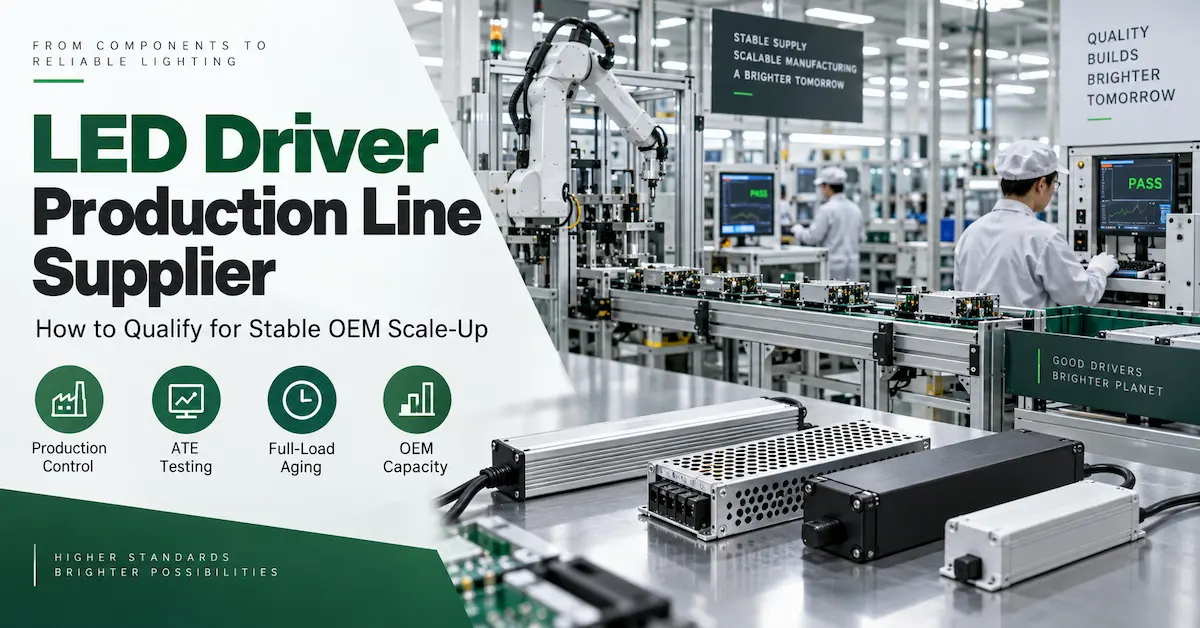
JMHC states that its manufacturing system includes ATE testing equipment, automatic vacuum glue-filling production lines, and 100% full-load aging. Its reported annual production capacity exceeds five million units.
These capabilities matter because they address different stages of production risk.
ATE Testing
Automated test equipment helps apply defined electrical checks in a repeatable way.
For a custom project, the important question is whether the testing criteria correspond to the approved specification rather than whether the factory simply owns test equipment.
Full-Load Aging
A power supply can pass an immediate functional test and still reveal a weakness after operating under load.
JMHC reports 100% full-load aging as part of its production process.
For B2B buyers, this is especially relevant when the power supply will be installed somewhere costly to access later, such as architectural lighting, commercial signage, façades, or landscape projects.
Waterproof Production
Outdoor power supplies introduce additional manufacturing controls around potting, sealing, cable entry, and housing integrity.
JMHC's current waterproof category lists HCF-A, HCF-C, HCF-P, and HCF-PE IP67 products.
Explore JMHC waterproof power supplies
When an OEM change affects the enclosure or cable entry, the buyer should confirm whether the environmental-protection requirement needs to be revalidated.
The Cheapest Custom Quote Is Often Not the Cheapest Project
Price comparison gets difficult when specifications are not identical.
One manufacturer may quote a standard product with a customer sticker.
Another may include a custom cable, connector, controlled specification, sample development, testing, packaging, and engineering support.
Those two quotations should not be compared as though they describe the same product.
A useful way to think about project cost is:
Project cost = unit cost + development cost + assembly cost + quality risk + warranty exposure + supply risk
Imagine a lighting factory buying 5,000 units.
Saving a small amount on each power supply looks attractive on the purchase order. But if the cable arrangement adds extra manual assembly to every fixture, the saving can disappear quickly. If inconsistent output or thermal behavior later causes field replacements, the apparent saving becomes even less meaningful.
High-conversion B2B sourcing decisions are usually made around total risk, not just FOB price.
Ask About Change Control Before You Ask About Repeat-Order Discounts
The first order receives a lot of attention.
The fifth order is where supplier discipline becomes visible.
A buyer should know what happens when a component becomes unavailable, a supplier changes a material, or production engineers want to adjust a process.
For a customized product, uncontrolled substitution can undermine the entire approval process.
Before placing long-term orders, ask:
Will the manufacturer notify us before changing a critical BOM item or approved specification?
How is the approved revision identified?
Can a repeat order be traced back to the agreed sample and specification?
Who approves engineering changes?
These questions are rarely found in simple supplier comparison articles, but they matter to lighting companies that expect to keep the same product platform for several years.
When Do You Need Custom Manufacturing Instead of Private Label?
Not every buyer needs the same level of customization.
| Requirement | Standard Product | Private Label | Custom Manufacturing |
|---|---|---|---|
| Existing voltage/wattage | Yes | Yes | Yes |
| Customer brand | No | Yes | Yes |
| Custom packaging | Limited | Yes | Yes |
| Cable change | Usually no | Sometimes | Yes |
| Connector change | Usually no | Sometimes | Yes |
| Electrical modification | No | No | Project dependent |
| Application engineering | Limited | Limited | Yes |
| New mechanical requirement | No | No | Project dependent |
| Pilot validation | Usually unnecessary | Sometimes | Recommended |
If the buyer only wants a logo and carton, a private-label program may be enough.
If the power supply needs to fit into a specific fixture, connect directly to the customer's harness, operate under unusual conditions, or meet application-specific electrical requirements, a deeper custom-manufacturing program makes more sense.
JMHC already supports OEM/ODM-oriented projects and application-based power solutions for lighting, signage, architectural lighting, industrial control, and related uses.
Explore JMHC application solutions
What Should You Send JMHC for a Custom Quote?
The fastest way to get a useful answer is to send engineering information rather than only a target price.
A good inquiry should contain:
- final application;
- input voltage;
- required output voltage;
- actual LED load and wattage;
- indoor or outdoor environment;
- installation dimensions;
- IP requirement;
- cable and connector requirement;
- dimming or PFC requirement if applicable;
- target market and certification needs;
- label and packaging requirements;
- sample quantity;
- first-order quantity;
- estimated annual volume;
- target delivery schedule.
This gives JMHC enough information to determine whether the requirement can be built from an existing platform or needs additional engineering work.
It also allows the quotation to address the actual product rather than a generic wattage category.
FAQ
What is a custom LED power supply manufacturer?
A custom LED power supply manufacturer develops or adapts LED power supplies around defined electrical, mechanical, environmental, branding, and production requirements instead of supplying only standard catalog products.
What is the difference between a custom LED power supply and an OEM LED power supply?
OEM can include relatively simple modifications such as customer labels or packaging. Custom manufacturing may go further into cable configuration, connectors, dimensions, output requirements, environmental protection, or application-specific engineering.
Can I customize only the cable and connector?
Yes, where the selected product platform supports the change. This is often useful for lighting manufacturers because it can reduce assembly work and simplify installation.
Can JMHC make a private label LED power supply?
JMHC supports OEM/ODM manufacturing for applicable projects, including customization requirements such as labels and packaging. The final specification and labeling should be confirmed before production.
Can I order a custom constant voltage LED power supply?
Constant-voltage requirements can be evaluated according to the application and available product platform. Buyers should provide the required output voltage, wattage, LED load, environment, and installation information before engineering confirmation.
Do I need a completely new design for a custom power supply?
Not necessarily. If an existing power supply platform already meets the core electrical and environmental requirements, adapting that platform can reduce development time and risk.
How long does a custom LED power supply project take?
There is no reliable universal lead time. Timing depends on the degree of customization, sample iterations, testing, tooling if required, certification review, and production quantity. The supplier should evaluate the complete requirement before confirming timing.
What is the MOQ for a custom LED power supply?
MOQ depends on whether the request involves only labeling and packaging or deeper electrical and mechanical changes. It should be confirmed after the customization scope is defined.
Should I test the custom sample inside my actual fixture?
Yes. Testing with the real fixture or a representative system is preferable because enclosure space, ventilation, cable layout, and load conditions can affect real-world operation.
How do I reduce risk before a large custom order?
Freeze the specification, approve the sample, test it in the intended application, confirm certification scope, run a pilot order where appropriate, define inspection criteria, and establish change control before scaling.
Conclusion
Selecting a custom LED power supply manufacturer is less about finding a factory that says “customization available” and more about finding one that can turn a real application requirement into a repeatable production specification.
The right partner should know when an existing platform is sufficient, when a change needs engineering validation, and when a request creates additional thermal, mechanical, waterproofing, testing, or compliance risk.
For lighting brands and OEM manufacturers, that discipline matters long after the first sample has been approved.
JMHC combines design and R&D with manufacturing, automatic vacuum glue filling, ATE testing, full-load aging, and scalable production capabilities for indoor and waterproof LED power supply applications.
If you are evaluating a new project, do not send only the wattage and target price. Send the actual application, input/output requirements, load, dimensions, environment, IP requirement, cable, connector, market, certification needs, branding, packaging, quantity, and delivery target.
That information gives the engineering team a much better starting point—and gives you a quotation that is actually comparable.