
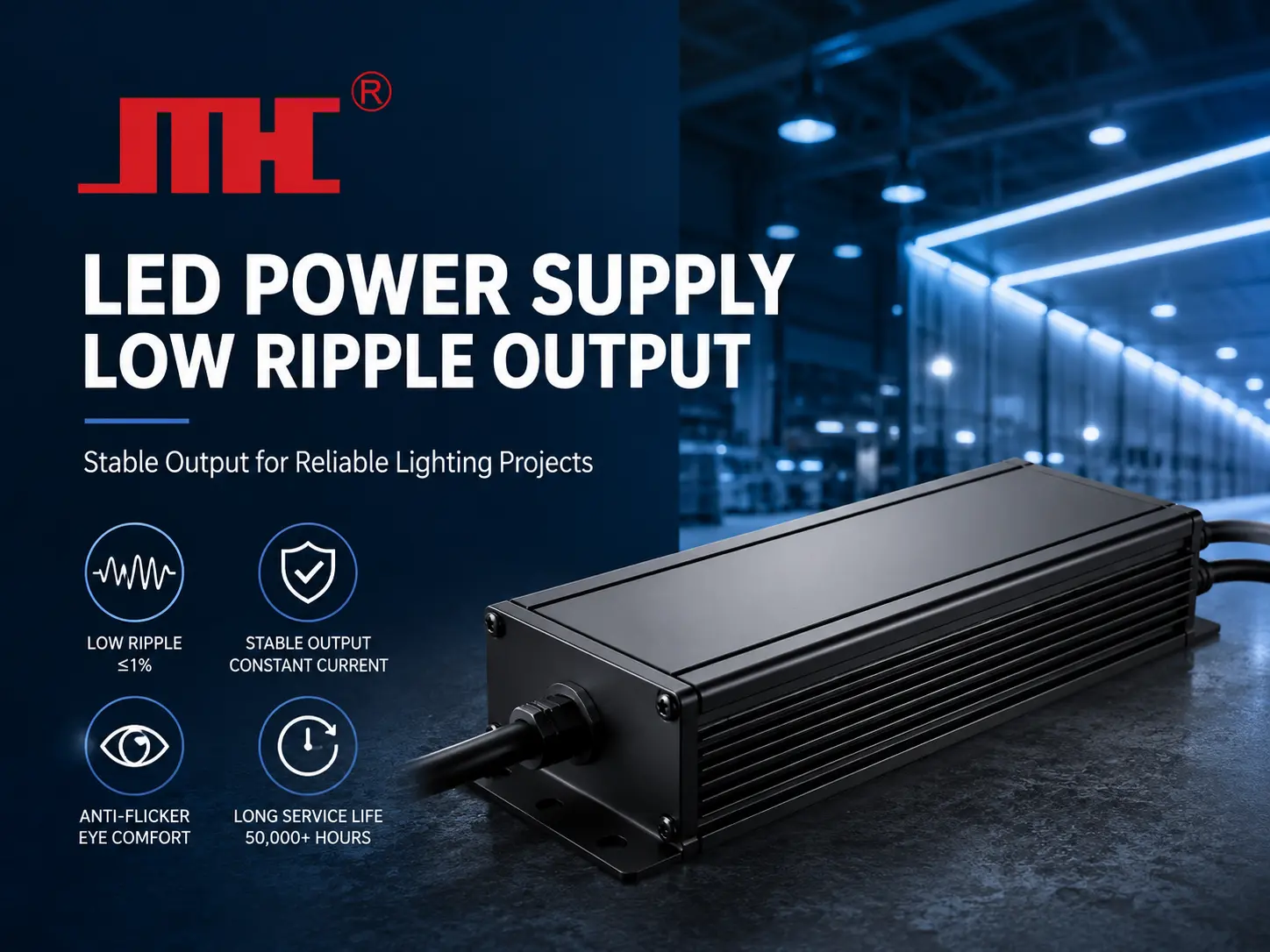
For lighting brands, contractors, signage companies, and OEM buyers, LED power supply low ripple output is an important factor that directly affects lighting quality, visual comfort, product lifespan, and project reliability.
Many buyers first compare voltage, wattage, price, and waterproof rating. These factors are important, but ripple performance should not be ignored. If the output ripple is too high, LED lights may flicker, brightness may become unstable, and LED modules may work under extra electrical stress.
In commercial lighting, flicker can affect user comfort. In advertising signage, unstable brightness can damage brand display quality. In architectural lighting, uneven output can reduce the visual effect of the whole project. For OEM lighting products, poor ripple control may also increase after-sales complaints.
As a professional LED power supply manufacturer, JMHC provides LED switching power supplies for indoor lighting, outdoor lighting, landscape lighting, advertising signboards, commercial decoration, security monitoring, and industrial control applications.
What Is Low Ripple Output in an LED Power Supply?
Ripple refers to the small unwanted fluctuation that remains in the DC output after AC power is converted and regulated. A good LED power supply should provide stable DC output with controlled ripple.
In simple terms, lower ripple means the LED driver delivers smoother power to the LED load. This helps the lighting system maintain more stable brightness and reduces flicker risk.
For B2B buyers, low ripple output is especially important when the lighting project requires:
- Stable visual performance
- Long working hours
- Commercial or retail lighting comfort
- Advertising display consistency
- Architectural lighting uniformity
- OEM product reliability
- Lower maintenance and after-sales risk
A low ripple LED power supply is not only a technical upgrade. It is a practical way to improve lighting quality.
Why Low Ripple Output Matters for Buyers
1. It Helps Reduce Flicker
Flicker is one of the most common lighting quality problems. Some flicker is visible to the human eye, while some is not easily noticed but may still affect comfort in long-term use.
In offices, retail stores, hotels, schools, and commercial spaces, flicker can create a poor lighting experience. For buyers selling finished lighting products, this may affect customer satisfaction and brand reputation.
Low ripple output helps reduce flicker risk by providing a more stable power supply to the LEDs.
2. It Improves Brightness Stability
Stable brightness is important for both functional and decorative lighting. If output power fluctuates too much, brightness may become uneven or unstable.
This is especially important for:
| Application | Why Brightness Stability Matters |
|---|---|
| Retail lighting | Product display needs clean and consistent lighting |
| Office lighting | Stable light improves workplace comfort |
| Advertising signboards | Brand images need uniform brightness |
| Architectural lighting | Facade effects must look consistent |
| Hotel lighting | Smooth lighting improves atmosphere |
| OEM LED fixtures | Stable performance reduces complaints |
For buyers working on lighting projects, low ripple output helps create a more professional visual result.
3. It Helps Protect LED Modules
LED modules are sensitive to power quality. If the output ripple is too high, LEDs may experience additional electrical stress over time. This may increase heat, reduce efficiency, or shorten service life.
A stable LED power supply with low ripple output can help reduce this stress and support longer system life.
For bulk buyers, this matters because after-sales cost is not only about replacing one driver. It can include labor, installation access, transportation, customer complaints, and project reputation.
Where Low Ripple LED Power Supplies Are Commonly Used
Low ripple performance is valuable in many lighting and power applications.
| Application | Buyer Concern | Recommended Focus |
| Indoor commercial lighting | Flicker and comfort | Low ripple, stable output |
| Office lighting | Long-time visual comfort | Low flicker and stable DC output |
| Retail display lighting | Product appearance | Brightness consistency |
| Advertising signage | Long working hours | Stable brightness and low heat |
| Architectural lighting | Visual uniformity | Stable output and batch consistency |
| Security monitoring | 24/7 operation | Reliable DC output |
| Industrial control | System reliability | Protection functions and testing |
| OEM lighting products | Brand quality | Low ripple and QC consistency |
JMHC’s LED power supply solutions help buyers match different power supply types with indoor lighting, outdoor lighting, signage, security monitoring, and industrial control applications.
How to Evaluate LED Power Supply Low Ripple Output
1. Check the Application First
Not every project has the same ripple requirement. Indoor commercial lighting and retail lighting usually require stronger flicker control because people stay under the lights for long periods. Outdoor signage may focus more on brightness stability and long working hours.
Before choosing a model, buyers should define:
- Indoor or outdoor use
- Lighting type
- LED load
- Working hours
- Installation space
- Dimming requirement
- Target market
- Certification needs
Complete project information allows the supplier to recommend a more suitable LED power supply.
2. Ask About Output Stability
Low ripple is closely connected with stable output design. Buyers should ask whether the power supply can maintain stable output under full-load operation and real working conditions.
Important questions include:
- Is the output voltage stable at full load?
- Is the product suitable for long-hour operation?
- Does the product have protection functions?
- Has the power supply passed aging tests?
- Can the supplier recommend a proper power margin?
- Is the model suitable for my LED application?
Buyers can compare different models through JMHC’s product center.
3. Consider Heat Dissipation
High temperature can affect power supply stability. Even if a product has good ripple performance during a short test, poor heat dissipation may reduce performance over time.
A reliable low ripple LED power supply should also have:
- Efficient circuit design
- Suitable housing structure
- Proper component selection
- Enough power margin
- Low temperature rise
- Stable performance during long operation
For light boxes, cabinets, narrow channels, or sealed installations, thermal design should be checked carefully.
Low Ripple Output and Full-Load Aging Tests
For B2B buyers, one sample test is not enough. Bulk orders need consistent performance across many units. This is why testing and aging processes are important.
A professional manufacturer should check product performance before shipment.
| QC Process | Why It Matters |
| Electrical testing | Confirms input and output performance |
| ATE testing | Improves testing accuracy and consistency |
| Full-load aging test | Helps reduce early failure risk |
| Temperature rise test | Checks thermal stability |
| Protection function test | Confirms safety response |
| Final inspection | Improves batch consistency |
JMHC introduces its manufacturing and quality control capability on the About Us page, including automatic vacuum glue filling production lines, ATE testing equipment, and full-load aging tests.
For lighting brands and contractors, these processes help reduce risk before mass installation.
Low Ripple Output for OEM Lighting Products
OEM buyers need stable quality because the final products may be sold under their own brand. If the power supply causes flicker or unstable brightness, the customer complaint may go directly to the brand owner.
For OEM LED lighting products, low ripple output can help improve:
- Product quality consistency
- User experience
- Lighting comfort
- Brand reliability
- Repeat order confidence
- Long-term after-sales control
JMHC supports OEM and ODM LED power supply requirements, including custom voltage, wattage, label, packaging, product matching, sample evaluation, and bulk production support.
Common Mistakes When Choosing Low Ripple LED Power Supplies
Mistake 1: Only comparing wattage and price
A lower-priced power supply may have unstable output or poor ripple control. Buyers should evaluate performance, testing, and reliability together.
Mistake 2: Ignoring the application environment
Indoor commercial lighting, outdoor signage, and industrial control have different requirements. The same model may not be suitable for every project.
Mistake 3: No power margin
Running a power supply too close to full load can increase heat and affect stable output.
Mistake 4: Skipping sample testing
Sample testing helps confirm brightness stability, flicker performance, heat performance, and installation fit.
Mistake 5: Ignoring supplier capability
Low ripple output depends on design, component selection, production control, and testing equipment. Supplier capability matters.
Buyer Checklist Before Requesting a Quote
To get a suitable low ripple LED power supply recommendation, buyers should prepare:
| Information Needed | Example |
| Application | Office lighting, signage, retail display, outdoor lighting |
| Input voltage | 100–240VAC |
| Output voltage | 12V / 24V / 36V / 48V |
| Total wattage | 60W / 120W / 240W |
| Installation environment | Indoor, outdoor, humid, enclosed |
| Working hours | 8 hours, 12 hours, 24/7 |
| Dimming requirement | 0-10V, PWM, TRIAC, non-dimming |
| Certification needs | CE, UKCA, BIS, RoHS, CCC |
| Quantity | Sample order or bulk order |
| Customization | Label, cable, packaging, housing |
Providing complete information helps the supplier recommend a suitable model and reduce the risk of wrong selection.
Why Choose JMHC for Low Ripple LED Power Supply Solutions?
JMHC focuses on LED switching power supplies and provides solutions for indoor lighting, outdoor lighting, landscape lighting, signage, commercial decoration, security monitoring, industrial control, and OEM lighting applications.
For buyers looking for LED power supply low ripple output solutions, JMHC can support:
- Application-based product selection
- Stable output LED power supply options
- Indoor and outdoor product series
- IP67 waterproof power supply options
- Full-load aging tests
- ATE testing equipment
- OEM/ODM customization
- Bulk production support
- Certification support for export markets
Instead of choosing only by price, buyers can work with JMHC to select a power supply based on real application conditions, output stability needs, installation environment, and target market.
FAQ
1. What does LED power supply low ripple output mean?
It means the power supply provides smoother DC output with smaller voltage fluctuation, helping reduce flicker and improve brightness stability.
2. Why is low ripple important for LED lighting?
Low ripple helps reduce flicker, improve visual comfort, protect LED modules, and support more stable lighting performance.
3. Does low ripple output help extend LED lifespan?
Yes. More stable output can reduce electrical stress on LED modules and support better long-term performance.
4. Which applications need low ripple LED power supplies?
Indoor lighting, commercial lighting, retail display lighting, signage, architectural lighting, OEM fixtures, and security systems can benefit from low ripple output.
5. How can I check if a power supply has stable output?
Ask the supplier about output testing, full-load aging, temperature rise testing, ripple control, and application suitability.
6. Can JMHC support OEM low ripple LED power supplies?
Yes. JMHC supports OEM and ODM requirements such as custom voltage, wattage, label, packaging, and application-based model selection.
7. Is low ripple output important for outdoor signage?
Yes. Outdoor signage often works for long hours, and stable output helps maintain consistent brightness and reduce after-sales issues.
8. What information should I provide for a quote?
You should provide application, input voltage, output voltage, wattage, working hours, environment, dimming needs, certification requirements, quantity, and customization details.
9. Does low ripple mean the product is always high quality?
Low ripple is important, but buyers should also check heat dissipation, protection functions, certifications, testing process, and manufacturer capability.
10. How can I start a project with JMHC?
You can send your project requirements through the JMHC contact page. JMHC can recommend suitable LED power supply options for sample testing and bulk production.
Conclusion
Choosing LED power supply low ripple output products is important for lighting projects that require stable brightness, reduced flicker, better visual comfort, and long-term reliability. Buyers should evaluate output stability, ripple control, heat dissipation, power margin, protection functions, testing process, certifications, and manufacturer capability before placing bulk orders.
JMHC provides LED power supply solutions for indoor lighting, outdoor lighting, signage, architectural lighting, commercial lighting, security monitoring, industrial control, and OEM applications.
If you need a low ripple LED power supply for your lighting project or OEM product line, you can contact JMHC with your application, voltage, wattage, working environment, quantity, and customization requirements.