
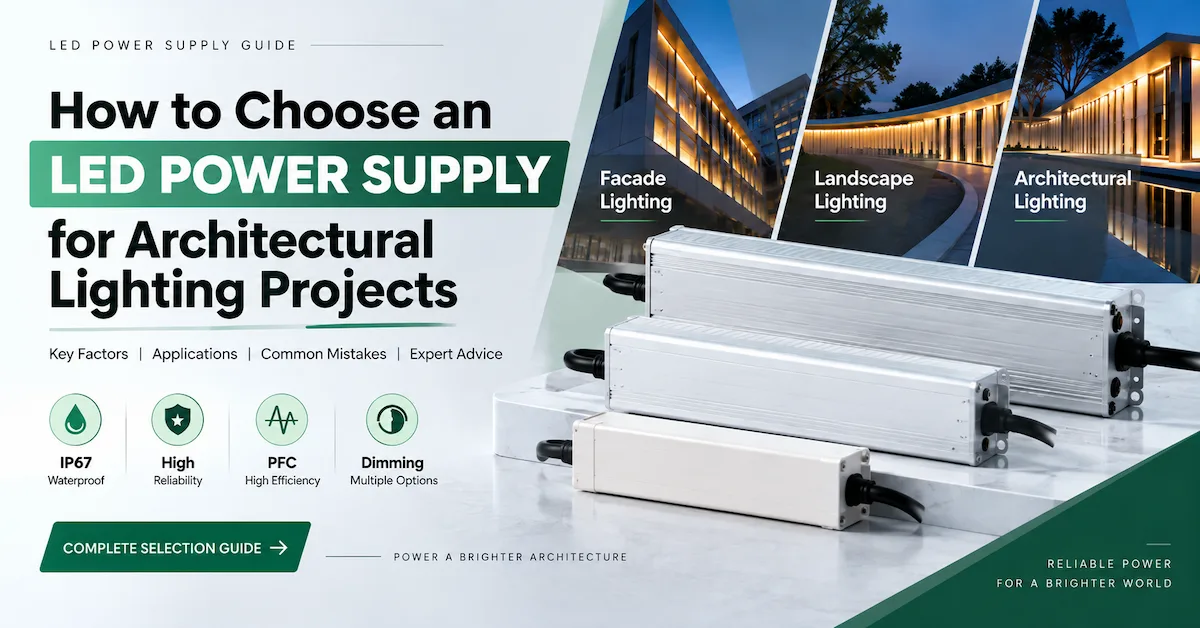
How to Choose an LED Power Supply for Architectural Lighting Projects
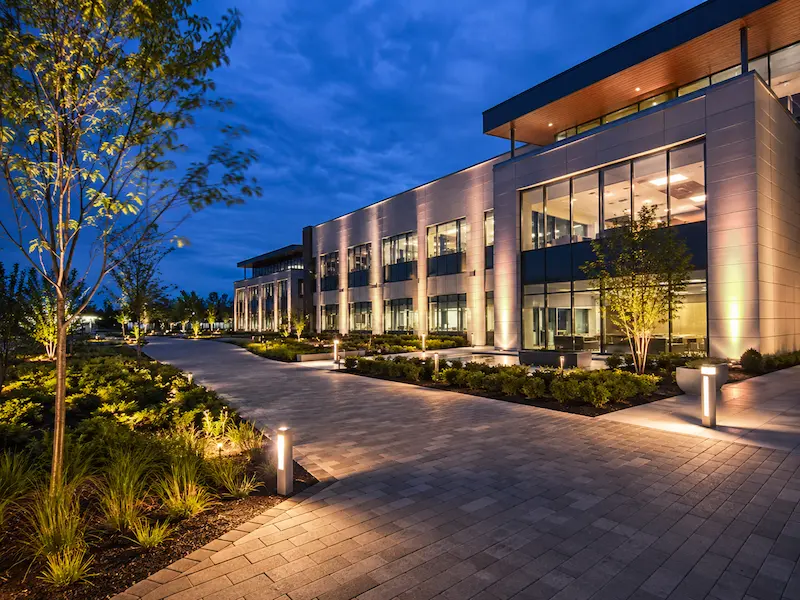
Architectural lighting places very different demands on an LED power supply than a small indoor decorative installation.
Façade lighting, building outlines, wall-washing systems, entrance canopies, landscape structures, bridges, commercial exteriors, and landmark lighting may operate for long hours while being exposed to heat, humidity, rain, long cable runs, and difficult maintenance conditions.
For these projects, selecting an LED power supply for architectural lighting only by output wattage can create avoidable problems. Voltage drop, insufficient environmental protection, excessive temperature rise, poor power factor, incompatible dimming, and inadequate load margin can all affect field reliability.
For lighting manufacturers, contractors, distributors, and project engineers, the better approach is to evaluate the power supply as part of the complete lighting system.
This guide explains the most important factors to consider before specifying a power supply for an architectural LED project.
What Makes Architectural Lighting Power Supplies Different?
Architectural lighting is normally designed to integrate light into a building or physical structure rather than simply illuminate a room.
Typical applications include:
-
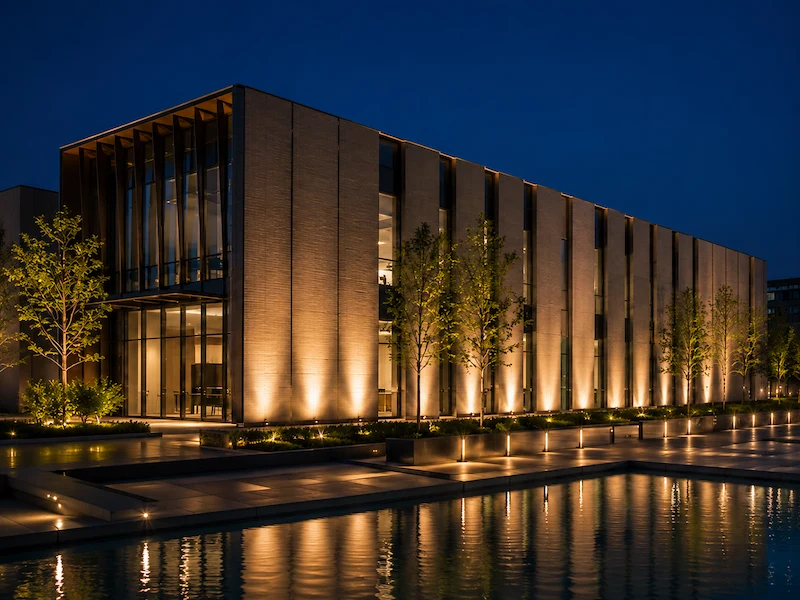
Building façade lighting
-
Wall grazing and wall washing
-
Roofline and contour lighting
-
Landscape architectural features
-
Bridges and public structures
-
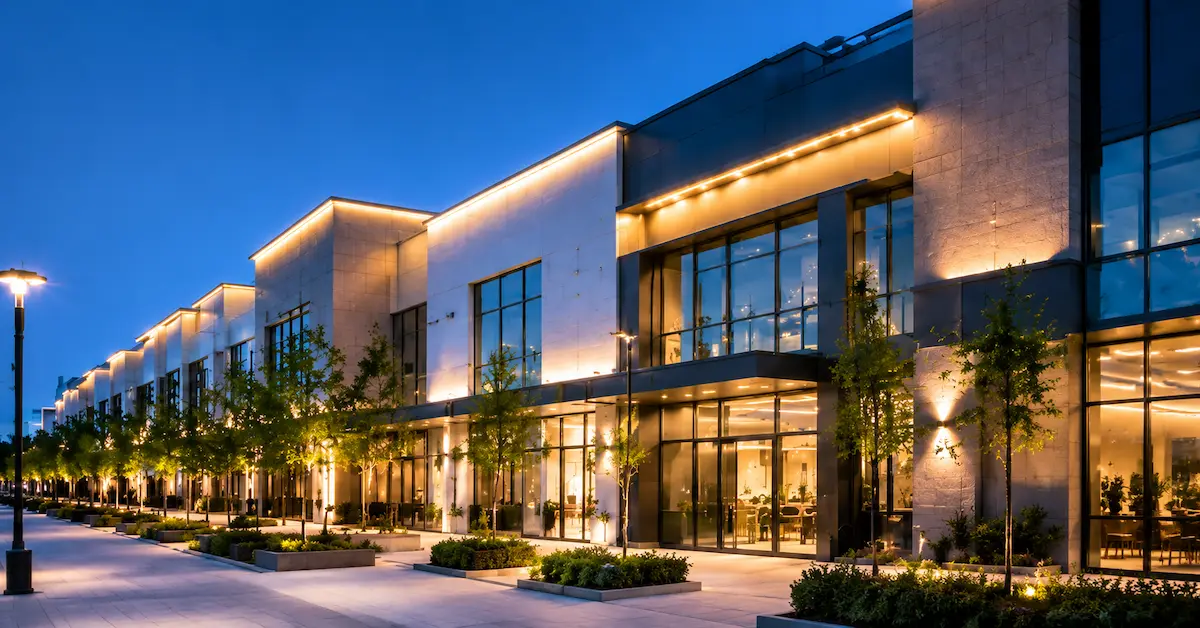
Hotel and commercial building exteriors
-
Entrance and canopy lighting
-
Outdoor decorative LED strips
-
Architectural signage
-
Landmark illumination
Unlike many residential lighting applications, these installations may involve hundreds of meters of LED products, multiple electrical zones, long daily operating cycles, outdoor exposure, and limited access after installation.
That means an architectural lighting power supply needs to support not only the LED load but also the environmental and operational conditions of the project.
For outdoor and engineering applications, JMHC lighting solutions include power supply platforms designed for different installation environments, power ranges, and project requirements.
Start With the LED Load, Not the Power Supply
The first selection step is to understand the LED load.
Before choosing a driver, confirm:
-
LED operating voltage
-
Total connected wattage
-
Constant-voltage or constant-current requirement
-
Number of fixtures or LED modules
-
Cable length
-
Installation layout
-
Operating hours
-
Dimming requirements
-
Indoor or outdoor location
-
Ambient temperature
-
Required certifications
For many architectural LED strips, modules, and linear lighting systems, a constant-voltage power supply is commonly used.
The power supply output voltage must match the LED system.
For example, a 24V LED system requires a compatible 24V constant-voltage source. Increasing the power supply wattage does not compensate for an incorrect output voltage.
How Much Wattage Should the Power Supply Have?
One of the most common project mistakes is selecting a driver whose rated output is almost identical to the calculated LED load.
Consider a simple example.
If an architectural LED installation consumes:
12 W/m × 15 m = 180 W
Selecting a 180W driver and continuously operating it near its full rated load may leave very little margin for actual operating conditions.
Real projects may be affected by:
-
Component tolerances
-
Ambient temperature
-
Enclosed installation spaces
-
Input voltage variation
-
Long operating hours
-
LED load variation
-
Cable losses
In many projects, engineers therefore avoid sizing the power supply exactly at the calculated load.
The appropriate margin should be determined according to the LED product, driver specifications, enclosure temperature, project standards, and operating environment rather than applying one universal percentage to every installation.
For large projects, dividing the lighting into several electrical zones can also provide advantages over using one oversized power source.
Zoning may improve:
-
Voltage stability
-
Maintenance accessibility
-
Fault isolation
-
Cable management
-
Thermal distribution
12V vs. 24V for Architectural Lighting
Both 12V and 24V constant-voltage LED systems are used in architectural lighting, but cable length can strongly influence the decision.
For the same power level, a higher system voltage requires less current.
That can help reduce voltage drop over longer cable runs.
For example, if two systems deliver the same load power, a 24V system generally carries approximately half the current of a comparable 12V system.
This can make 24V particularly practical for:
-
Long linear LED installations
-
Building outlines
-
Façade lighting
-
Remote driver installations
-
Large signage structures
However, the correct choice depends on the LED fixture or module. The power supply voltage must always match the rated voltage of the connected lighting equipment.
Why IP Rating Matters in Architectural Lighting
Outdoor architectural lighting is frequently exposed to:
-
Rain
-
Humidity
-
Condensation
-
Dust
-
Temperature changes
-
Cleaning water
-
Moisture inside installation cavities
An indoor open-frame or basic enclosed power supply should not automatically be used in an exposed outdoor application.
For installations requiring a high degree of environmental protection, an IP67 LED power supply may be more appropriate.
IP protection should be considered together with the complete installation.
A waterproof driver alone does not make the whole electrical system waterproof.
Engineers should also evaluate:
-
Cable entries
-
Connectors
-
Junction boxes
-
Wiring joints
-
Drainage
-
Mounting orientation
-
Installation cavities
JMHC provides several waterproof power supply platforms within its LED power supply product range.
For lower-power architectural and decorative applications, the HCF-A Series IP67 LED power supply is one example of a compact waterproof configuration.
For other project power levels, different platforms can be selected according to load and installation requirements.
Waterproofing Is More Than an IP Label
For a project buyer, seeing “IP67” on a specification should be the start of the evaluation rather than the end.
The internal construction and production process also matter.
In waterproof LED power supplies, potting can help protect electronic components from environmental exposure and improve consistency when properly controlled.
JMHC uses automatic vacuum glue-filling processes as part of its waterproof power supply manufacturing capability.
For architectural projects where hundreds or thousands of power supplies may be deployed, process consistency becomes particularly important.
A buyer should therefore ask a supplier:
-
How is potting performed?
-
How is filling consistency controlled?
-
Are units electrically tested after assembly?
-
Is aging performed before shipment?
-
How are production batches traced?
-
Are samples and bulk production based on the same approved specification?
These questions often provide more useful information than simply comparing supplier quotations.
Evaluate Temperature Before Selecting a Driver
Temperature is one of the most important factors affecting power supply reliability.
Architectural drivers are often installed:
-
Behind façade panels
-
Inside metal structures
-
Above ceilings
-
Inside light boxes
-
Inside cabinets
-
Near roofs
-
In enclosed wall cavities
The ambient temperature inside these spaces can be significantly higher than the outdoor air temperature.
A driver may therefore be operating in a much harsher thermal environment than expected.
When selecting an architectural lighting power supply, evaluate:
-
Actual ambient temperature around the driver
-
Available ventilation
-
Heat generated by nearby equipment
-
Mounting surface
-
Continuous operating duration
-
Driver efficiency
-
Manufacturer temperature specifications
High efficiency is useful not only for energy consumption.
Lower conversion losses can also reduce the amount of heat that the power supply must dissipate.
This becomes increasingly important in compact architectural structures.
Power Factor and PFC Matter More on Larger Projects
Power factor may have little influence on a very small decorative installation, but it can become much more important when a commercial or architectural project contains many LED drivers.
Poor power factor can increase current demand on the electrical system relative to the useful power delivered to the load.
For larger projects, buyers may therefore specify power supplies with power-factor-correction capability.
The HCF-P Series IP67 power supply, for example, is a waterproof JMHC platform designed with PFC functionality.
For higher-power constant-voltage applications, the HCF-380PE LED driver incorporates active PFC and is positioned for higher-power requirements.
The exact model should always be selected according to project load, voltage, installation environment, and electrical requirements.
Do You Need Dimming?
Architectural lighting is increasingly used to create different scenes rather than operate at a single brightness level.
Projects may require:
-
Scheduled brightness changes
-
Night-time energy reduction
-
Scene control
-
Façade animation
-
Integration with lighting controls
-
Commercial building automation
Common control approaches can include:
-
0–10V
-
1–10V
-
PWM
-
TRIAC
-
ELV
However, a “dimmable driver” is not automatically compatible with every control system.
Before purchasing, confirm:
-
Driver dimming method
-
Controller output type
-
Minimum dimming level
-
Dimming range
-
Wiring method
-
LED load compatibility
-
Behaviour at low brightness
For project buyers, confirming control compatibility during sample testing is usually much less expensive than solving dimming problems after installation.
Long Cable Runs Can Create Voltage-Drop Problems
Architectural projects frequently place the driver some distance away from the LED load.
Long cable runs create resistance, and resistance causes voltage drop.
If excessive, this may result in:
-
Uneven brightness
-
Dim LEDs at the end of a run
-
Colour inconsistency
-
Unstable operation
-
Difficult commissioning
Voltage drop becomes more significant as:
-
Current increases
-
Cable length increases
-
Conductor size decreases
Project designers can manage it through better electrical zoning, suitable conductor sizing, correct system voltage, and appropriate driver placement.
This is another reason architectural lighting power supply selection should be considered during the electrical design stage rather than after the lighting layout is finished.
Architectural Lighting Power Supply Selection Table
| Project Condition | Main Selection Priority | Power Supply Direction |
|---|---|---|
| Outdoor façade lighting | Moisture protection, reliability | IP67 waterproof power supply |
| Building contour lighting | Long cable runs, stable voltage | Constant-voltage platform with correct zoning |
| Commercial exterior | Efficiency, PFC, long operating hours | High-efficiency PFC power supply |
| Compact installation space | Dimensions, heat dissipation | Compact or slim power supply |
| Dynamic lighting scenes | Control compatibility | Dimmable LED driver |
| High-power façade system | Power capacity, PFC, thermal management | High-power constant-voltage driver |
| Landscape architecture | Waterproofing, humidity resistance | Outdoor waterproof platform |
| Large repeat project | Batch consistency, QC, supply stability | Manufacturer with controlled production and testing |
There is no single “best architectural lighting power supply.”
The correct product depends on the relationship between the lighting load, environment, control system, installation space, and project risk.
Why Testing and Aging Matter for Architectural Projects
Replacing a power supply on a workbench is simple.
Replacing one installed high on a building façade may require:
-
Lift equipment
-
Technicians
-
Traffic control
-
Site access
-
Removal of architectural panels
-
Recommissioning
-
Customer downtime
This means the cost of a failed power supply can be far higher than its purchase price.
For B2B architectural projects, manufacturing quality control should therefore be included in supplier evaluation.
JMHC's manufacturing process includes ATE testing and 100% full-load aging for its power supply production.
ATE can support repeatable electrical testing across production batches, while full-load aging is intended to expose units to operating conditions before shipment.
You can learn more about JMHC's production background and factory capability on the About JMHC page.
Unit Price Should Not Be the Only Procurement Metric
Architectural project procurement often focuses heavily on unit price because the quantity of drivers can be large.
However, the lowest quotation does not necessarily create the lowest project cost.
A useful comparison should include:
| Cost Factor | Why It Matters |
|---|---|
| Unit price | Initial procurement cost |
| Failure rate | Determines replacement frequency |
| Labour cost | Faulty drivers require technicians |
| Access cost | Façade repair may require lifts or scaffolding |
| Project delay | Failure during commissioning can delay handover |
| Batch consistency | Reduces installation and troubleshooting variation |
| Warranty handling | Influences long-term supplier cost |
| Lead time | Affects construction and replacement schedules |
For a large architectural project, supplier consistency can therefore be more important than a small difference in unit price.
What Should Be Included in an RFQ?
A detailed RFQ allows a power supply manufacturer to recommend a more appropriate solution.
Instead of sending only:
“Need 200W LED power supply.”
Provide:
-
Application: façade / landscape / contour / wall washer
-
Input voltage
-
LED operating voltage
-
Total load wattage
-
Quantity
-
Indoor/outdoor installation
-
Required IP rating
-
Installation dimensions
-
Ambient temperature
-
Cable length
-
Dimming requirement
-
Certification market
-
Connector or cable requirements
-
Label requirements
-
Packaging requirements
-
Expected annual demand
This reduces repeated communication and helps identify technical issues before sampling.
OEM and ODM Options for Architectural Lighting Brands
Lighting brands and project integrators may need more than a standard catalogue product.
Depending on the project, customization may involve:
-
Output voltage
-
Wattage platform
-
Cable configuration
-
Connector type
-
Wire length
-
Product label
-
Private branding
-
Packaging
-
Application-specific configuration
JMHC supports OEM/ODM and engineering-oriented power supply development for B2B customers.
For a new architectural lighting project, the recommended process is usually:
Requirement confirmation → engineering review → product selection → customization → sample validation → specification approval → mass production → testing and aging → shipment.
More information about available engineering support can be found on the JMHC Solutions page.
For specific project requirements, buyers can also submit their electrical and application information through the Contact JMHC page.
Common Mistakes When Selecting an Architectural LED Power Supply
1. Choosing by wattage alone
Two power supplies with the same rated wattage may have very different environmental protection, efficiency, dimensions, PFC, thermal characteristics, and control functions.
2. Using an indoor driver outdoors
A protected cabinet does not automatically guarantee a dry internal environment. Humidity and condensation must also be considered.
3. Ignoring installation temperature
A driver mounted behind a façade panel can experience much higher temperatures than ambient weather data suggests.
4. Ignoring voltage drop
Long low-voltage cable runs can produce visible brightness differences.
5. Running every driver near maximum load
Engineering margin should be considered according to the real thermal and electrical conditions.
6. Selecting dimming after the power supply
The control strategy should be confirmed before final driver approval.
7. Approving a sample without controlling bulk specifications
For large orders, the approved sample, specification, BOM, wiring, label, testing criteria, and packaging requirements should be clearly defined before mass production.
8. Comparing suppliers only by price
For architectural projects, replacement labour and access costs can easily outweigh a small initial saving.
FAQ
What type of LED power supply is commonly used for architectural lighting?
Constant-voltage LED power supplies are widely used with architectural LED strips, modules, signage, and linear lighting systems. The correct type depends on the LED load, voltage, environment, dimming method, and installation layout.
Is an IP67 power supply necessary for façade lighting?
IP67 is commonly considered for outdoor or moisture-exposed applications, but the required protection level depends on the actual installation environment. Connectors, joints, cables, and junction boxes must also be protected appropriately.
How do I calculate the required power supply wattage?
Calculate the total wattage of the connected LED load first. Then evaluate suitable engineering margin based on the driver specification, operating temperature, installation environment, and continuous operating conditions.
Is 24V better than 12V for architectural lighting?
Neither voltage is universally better. However, for the same power, 24V requires less current than 12V and can help reduce voltage drop in longer cable runs. The LED load voltage must match the power supply output.
Why is PFC important in architectural lighting?
Projects using many power supplies can place a significant load on the electrical system. A higher power factor and suitable PFC design can be particularly valuable in larger commercial installations.
Can one large power supply operate an entire façade?
Technically this depends on the system design, but dividing large installations into several electrical zones can improve voltage management, maintenance, fault isolation, and cable routing.
What causes LED power supplies to overheat?
Common factors include high ambient temperature, insufficient ventilation, enclosed installation, excessive loading, poor heat dissipation, and unsuitable product selection.
Can architectural lighting power supplies be customized?
Yes. Depending on the manufacturer and product platform, options may include voltage, wattage, wire configuration, connectors, labels, packaging, and other OEM/ODM requirements.
What should I test before approving a power supply?
Important checks can include output stability, actual LED load operation, temperature rise, cable and connector compatibility, installation fit, dimming behaviour, environmental requirements, and prolonged operating performance.
How should I evaluate an LED power supply manufacturer?
Look beyond the catalogue. Review engineering support, production processes, testing equipment, aging procedures, waterproofing processes, certification documentation, capacity, batch consistency, and ability to control OEM specifications.
Conclusion
Choosing the right LED power supply for architectural lighting requires a system-level evaluation rather than a simple wattage comparison.
For façade, landscape, contour, commercial exterior, and other architectural applications, buyers should consider output voltage, load margin, IP protection, thermal conditions, cable length, power factor, dimming compatibility, installation space, testing, and long-term maintenance risk together.
A well-selected power supply can reduce commissioning problems and make future maintenance more predictable. For large B2B projects, production consistency, testing procedures, and engineering communication are also critical because a product that performs correctly as a sample must deliver the same performance across the full production batch.
JMHC provides indoor, waterproof, PFC, compact, and high-power LED power supply platforms for different lighting applications. Buyers planning a new architectural lighting project can review the JMHC product range or provide project voltage, wattage, quantity, environment, control, and customization requirements through the JMHC contact page for product selection and engineering evaluation.