For lighting brands, contractors, and OEM buyers, choosing an LED driver solution provider is different from buying a standard power supply from a catalog. A standard product may meet basic voltage and wattage requirements, but a real lighting project often needs more: stable output, low temperature rise, waterproof protection, certification support, compact installation, and long-term supply reliability.
As a professional LED power supply manufacturer, JMHC provides LED switching power supplies and LED driver solutions for indoor lighting, outdoor lighting, advertising signboards, architectural lighting, security monitoring, and industrial control applications.
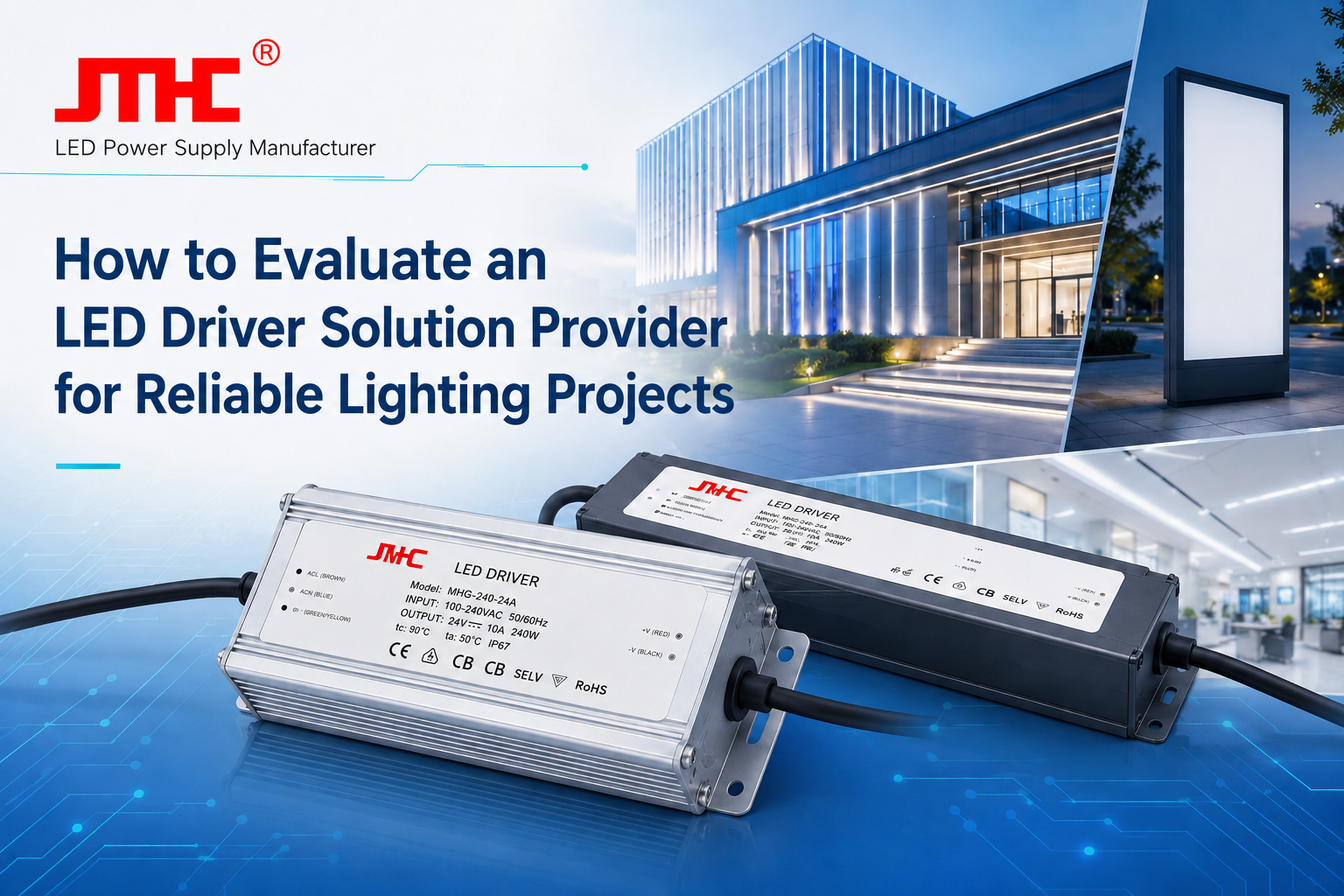
What Does an LED Driver Solution Provider Do?
An LED driver solution provider does more than supply a power unit. It helps buyers match the right driver to the real working environment, LED load, installation space, certification requirement, and project risk.
A solution-based provider should support buyers in several key areas:
| Service Area | What It Means for Buyers |
|---|---|
| Product Selection | Matching voltage, wattage, power type, size, and application environment |
| Technical Support | Helping buyers reduce flicker, overheating, overload, and compatibility issues |
| Application Matching | Recommending indoor, waterproof, long-shape, mini, or PFC power supply options |
| Quality Control | Testing stability, protection functions, temperature rise, and aging performance |
| OEM/ODM Support | Supporting custom labels, packaging, specifications, and project-based requirements |
| Certification Support | Providing products that meet market requirements such as CE, CCC, BIS, UKCA, and RoHS |
For B2B buyers, this support can reduce project uncertainty and make the procurement process more efficient. You can also explore JMHC’s LED power supply solutions to understand how different products are matched with different lighting applications.
Why Standard LED Drivers May Not Be Enough
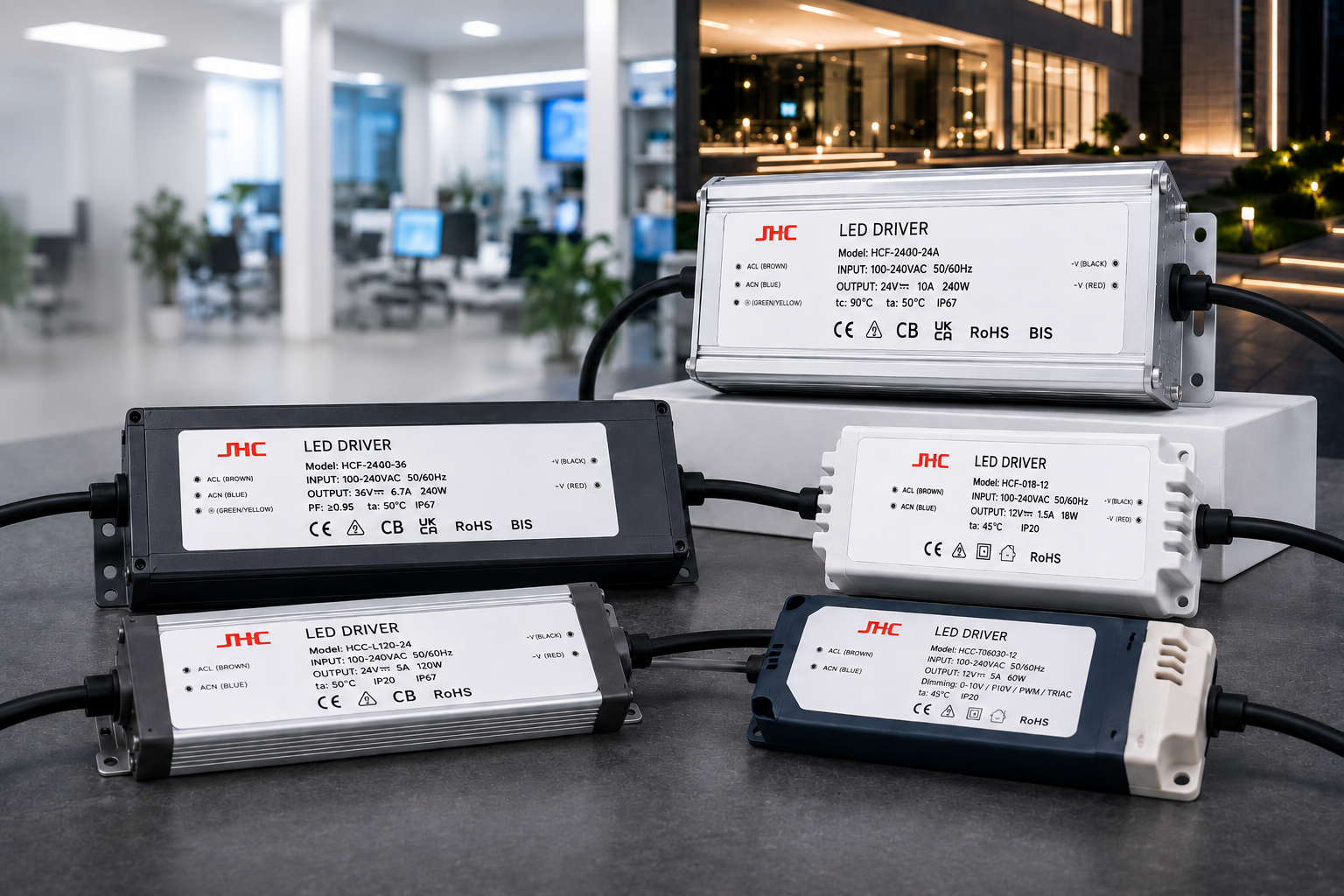
Many buyers start by comparing wattage and price. However, this approach can create hidden risks.
A low-cost LED driver may work during a simple test, but problems can appear after installation, especially in humid, hot, dusty, or continuous-operation environments. Common issues include unstable brightness, abnormal heat, waterproof failure, short service life, and inconsistent quality between batches.
For example, an advertising light box may require continuous operation for long hours every day. A landscape lighting project may face rain, humidity, and temperature changes. A security monitoring system may need stable 24/7 power output. These conditions require more than a basic driver.
A professional LED driver solution provider considers the whole system, not only the product name.
Key Factors to Evaluate Before Choosing a Provider
1. Application-Based Product Matching
The first question is not “Which driver is the cheapest?” It should be: “Which driver fits my application best?”
Different lighting applications have different requirements:
| Application | Main Requirement | Suitable Driver Direction |
| Indoor LED lighting | Compact size, low noise, stable output | IP20 indoor LED power supply |
| Outdoor landscape lighting | Waterproof protection, low temperature rise | IP67 waterproof LED power supply |
| Advertising signboards | Continuous operation, stable brightness | Waterproof or long-shape LED power supply |
| Light boxes | Small installation space | Mini LED power supply |
| Architectural lighting | Efficiency, consistency, project stability | PFC or high-efficiency LED power supply |
| Security monitoring | 24/7 stable performance | Reliable switching power supply |
| Industrial control | Long service life, protection functions | Industrial-grade power supply solution |
For buyers who need to compare models, JMHC’s product center provides different LED power supply series for indoor, waterproof, mini, long-shape, and project-based applications.
2. Stable Output and Low Ripple Performance
Stable output is one of the most important signs of a good LED driver. If the output is unstable, the lighting system may experience flickering, inconsistent brightness, or reduced LED lifespan.
For commercial and indoor lighting, low ripple output helps improve visual comfort. For signage and outdoor lighting, stable output helps maintain consistent brightness across long operating hours.
When evaluating a supplier, buyers should ask:
- Is the output voltage stable under full-load operation?
- Has the product been tested for long working hours?
- Does the driver include short-circuit, overload, and over-voltage protection?
- Can the supplier recommend the right power margin for the project?
These questions help buyers avoid choosing a driver that only works under ideal conditions.
3. Waterproof and Environmental Protection
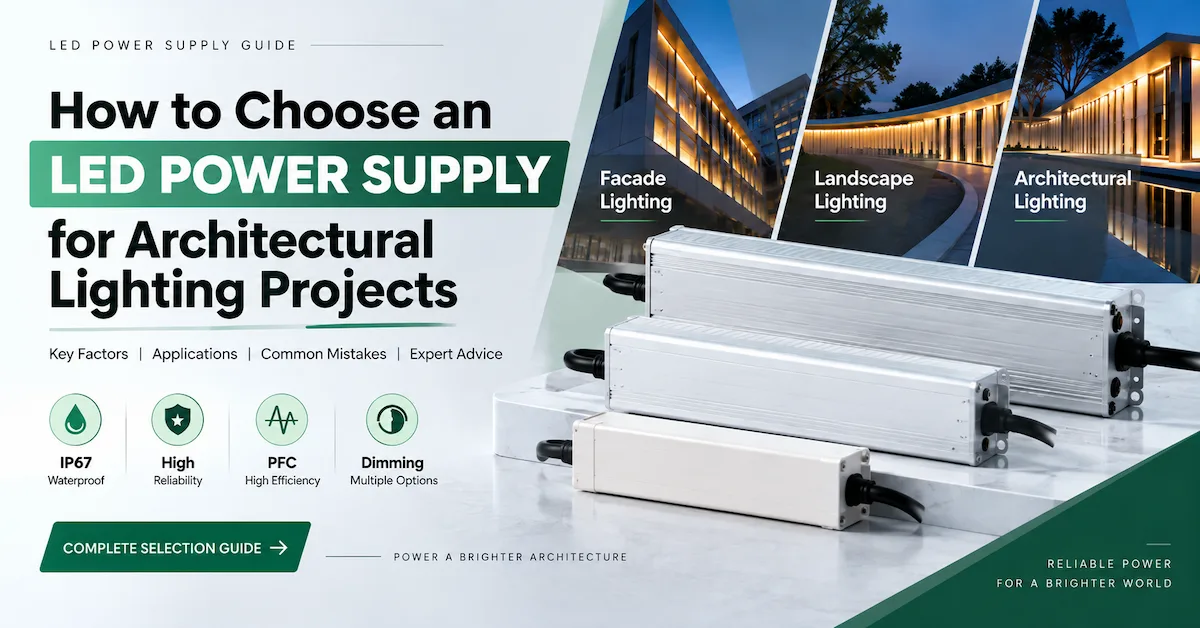
For outdoor lighting projects, waterproof protection is a major decision factor. An IP67 waterproof LED power supply is usually needed for applications exposed to rain, moisture, dust, or outdoor temperature changes.
For example, the HCF-A Series IP67 LED Power Supply is designed for waterproof lighting applications where stable output and environmental protection are important.
However, waterproof performance is not only about the IP rating. Buyers should also pay attention to sealing structure, glue filling process, heat dissipation, and long-term aging performance.
A professional LED driver solution provider should understand how outdoor environments affect power supply reliability. For landscape lighting, building facade lighting, outdoor signboards, and public lighting projects, waterproof design can directly reduce maintenance frequency and project risk.
4. Thermal Management and Low Temperature Rise
Heat is one of the main reasons power supplies fail early. Even when the electrical parameters look correct, poor thermal design can shorten product life.
A good LED power supply should be designed with proper heat dissipation, suitable housing structure, efficient components, and enough power margin. For high-load or enclosed installation environments, thermal management becomes even more important.
Buyers should check whether the provider can explain:
- Working temperature range
- Heat dissipation method
- Housing material and structure
- Recommended installation environment
- Power derating advice when needed
For projects requiring higher efficiency and power factor performance, the HCF-P Series IP67 PFC LED Power Supply can be considered for commercial, outdoor, and engineering lighting applications.
5. Testing, Aging, and Batch Consistency
For B2B buyers, one sample working well is not enough. The real challenge is whether hundreds or thousands of units can perform consistently in different projects.
A reliable LED driver solution provider should have a clear quality control process, including electrical testing, protection testing, and full-load aging. ATE testing equipment can help improve testing consistency, while full-load aging helps reduce early failure risk before delivery.
JMHC introduces its factory background and quality control capabilities on the About Us page, including automatic vacuum glue filling production lines, ATE testing equipment, and full-load aging tests.
Buyers should ask whether the supplier performs:
- Input and output testing
- Full-load aging test
- Protection function test
- Temperature rise inspection
- Batch quality control
- Pre-shipment inspection
For bulk orders, these steps are often more important than a small price difference.
How JMHC Supports LED Driver Solutions
JMHC focuses on LED switching power supplies and LED driver solutions for global lighting and industrial applications. The company integrates design, R&D, production, and sales, providing buyers with both standard products and flexible power supply solutions.
JMHC supports different types of LED power supply products, including waterproof power supplies, indoor power supplies, mini power supplies, long-shape power supplies, PFC power supplies, and customized power solutions.
For project buyers, JMHC’s value is not only product supply. The company helps customers match the right driver according to application environment, wattage, voltage, certification needs, installation space, and long-term reliability requirements.
Recommended Product Directions by Application
| Buyer Type | Common Need | JMHC Product Direction |
| Lighting fixture manufacturers | Stable output, compact structure, easy installation | Indoor IP20 power supply, long-shape series |
| Outdoor lighting contractors | Waterproof protection, low maintenance | IP67 waterproof LED power supply |
| Signage and light box companies | Continuous operation, small space, stable brightness | Mini power supply, long-shape power supply |
| Architectural lighting projects | Efficiency, power consistency, project reliability | PFC LED power supply, waterproof series |
| Security system integrators | 24/7 operation, stable DC output | Reliable switching power supply |
| Industrial equipment buyers | Long life, protection function, consistent quality | Industrial power supply solutions |
| OEM/ODM buyers | Branding, custom specification, bulk supply | Customized LED driver solution |
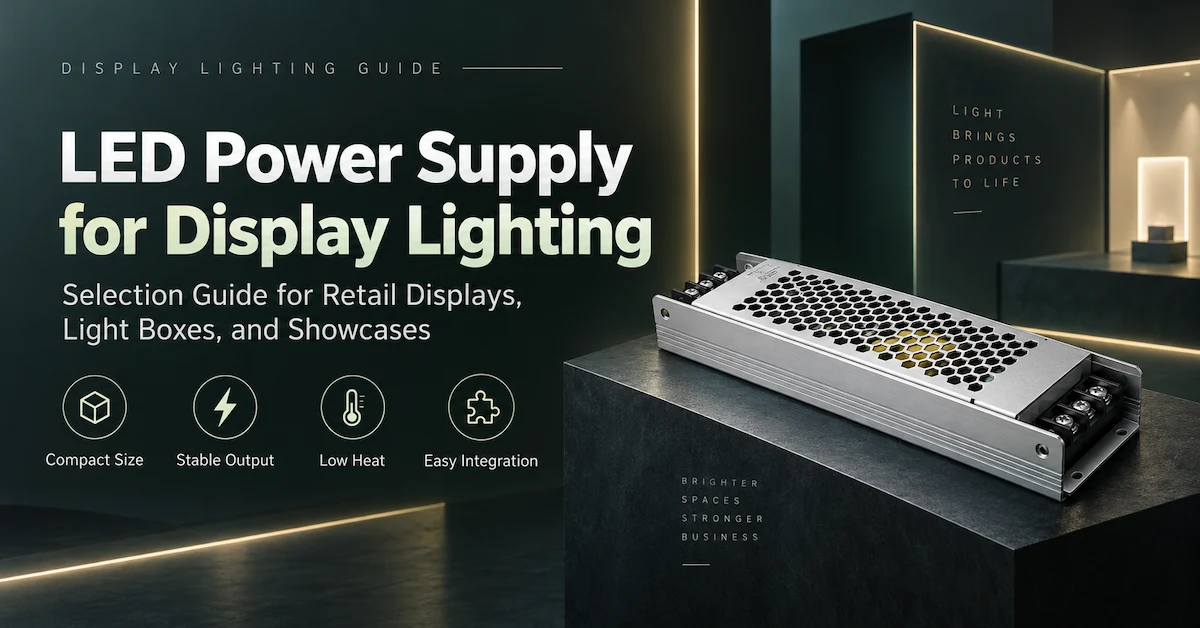
For light box and compact installation projects, buyers can review the HCA Series IP20 18W Mini Power Supply. For narrow installation spaces or linear lighting applications, the HCC-L Series IP20 Long Shape LED Power Supply may be a better fit.
Why Certifications Matter for Global Buyers
For international buyers, certifications are not only marketing points. They are often required for import, project approval, distribution, and end-user trust.
A qualified LED driver solution provider should understand the certification expectations of different markets and provide products that meet relevant safety and environmental standards.
For buyers selling to Europe, the Middle East, India, Southeast Asia, or other export markets, certification support can reduce compliance uncertainty. It also makes communication with distributors, engineering companies, and project owners easier.
When evaluating suppliers, buyers should ask:
- Which certifications are available for this product series?
- Are the certificates suitable for my target market?
- Can the supplier provide technical documents?
- Are certified models available for bulk orders?
- Can the product be customized while still meeting compliance requirements?
OEM and ODM Support for Lighting Brands
Many lighting brands and distributors need more than standard products. They may require private label packaging, customized output voltage, special wattage, different housing size, or application-specific design.
This is where OEM and ODM support becomes important.
A professional provider should be able to support:
- Custom voltage and wattage
- Brand label and packaging
- Product structure adjustment
- Application-based recommendation
- Sample development
- Certification planning
- Stable mass production
- Long-term product iteration
For lighting brands, this support can help shorten development time and improve market response speed. For project contractors, it can help solve special installation and environmental challenges.
Cost Should Not Be Judged by Unit Price Alone
When comparing suppliers, many buyers focus on the unit price. However, for lighting projects, the true cost includes installation, replacement, maintenance, downtime, shipping delay, and project reputation.
A cheaper LED driver may become more expensive if it causes frequent failures after installation. This is especially true for outdoor projects, high-location installations, advertising signboards, and large-scale commercial lighting systems.
Instead of asking only for the lowest price, buyers should compare:
| Cost Factor | Why It Matters |
| Product failure rate | Affects maintenance and replacement cost |
| Testing process | Reduces early failure risk |
| Certification readiness | Reduces compliance risk |
| Supplier response speed | Affects project schedule |
| Product consistency | Reduces batch quality problems |
| OEM/ODM ability | Supports long-term brand development |
| Technical support | Helps solve project compatibility issues |
A stable LED driver solution provider helps buyers reduce total project cost, not just purchase price.
Questions to Ask Before Placing an Order
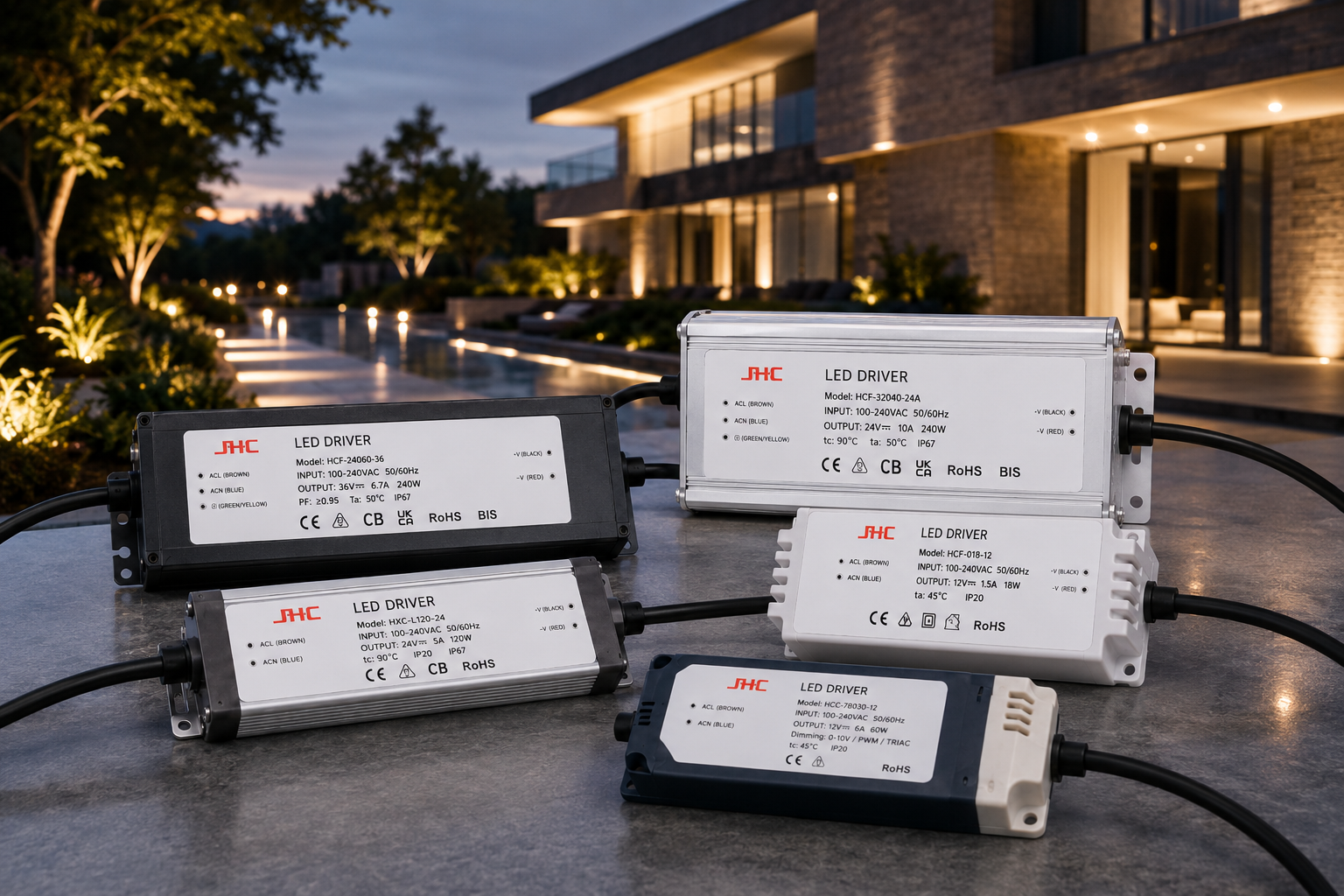
Before choosing a provider, buyers can use the following checklist:
- What LED driver series is suitable for my application?
- Is the driver for indoor or outdoor use?
- Do I need IP67 waterproof protection?
- What voltage and wattage options are available?
- Is there enough power margin for long-term operation?
- What certifications are available?
- Does the supplier provide full-load aging tests?
- Can the supplier support OEM or ODM customization?
- What is the production capacity for bulk orders?
- Can the supplier provide technical support for project selection?
These questions help buyers identify whether the supplier is a simple product seller or a real LED driver solution provider.
FAQ
1. What is an LED driver solution provider?
An LED driver solution provider offers more than standard power supplies. It helps buyers choose the right driver based on voltage, wattage, application environment, certification needs, installation space, and long-term reliability.
2. How is a solution provider different from a regular supplier?
A regular supplier may only provide product models and prices. A solution provider offers technical support, application matching, testing, OEM/ODM customization, and project-based recommendations.
3. Why is stable output important for LED lighting?
Stable output helps reduce flicker, brightness fluctuation, overheating, and premature LED failure. It is especially important for commercial lighting, signage, and long-hour operation systems.
4. Do outdoor lighting projects need IP67 LED drivers?
Many outdoor lighting projects require IP67 waterproof LED power supplies because the drivers may face rain, humidity, dust, and temperature changes. Buyers can review JMHC’s IP67 waterproof LED power supply products for different outdoor lighting needs.
5. Can JMHC support OEM LED driver projects?
Yes. JMHC supports OEM requirements such as customized labels, packaging, voltage, wattage, product matching, and project-based power supply solutions.
6. What applications can JMHC LED power supplies support?
JMHC LED power supplies can be used in indoor lighting, landscape lighting, building facade lighting, advertising signboards, commercial decoration, security monitoring, and industrial control systems.
7. Why is full-load aging testing important?
Full-load aging testing helps identify potential early failures before delivery. It improves reliability and gives buyers more confidence for bulk orders and long-term projects.
8. How should I choose between indoor and waterproof LED power supplies?
Indoor IP20 power supplies are suitable for protected environments, while IP67 waterproof power supplies are better for outdoor, humid, dusty, or exposed installations.
9. What information should I provide when requesting a quote?
You should provide input voltage, output voltage, wattage, application environment, installation space, certification needs, quantity, and whether OEM/ODM customization is required.
10. How can I start a project with JMHC?
You can send your application requirements, target market, technical parameters, and expected order quantity through the JMHC contact page. JMHC can help recommend suitable LED driver solutions for sample testing and bulk production.
Conclusion
Choosing an LED driver solution provider is an important decision for lighting brands, project contractors, signage companies, and OEM buyers. The right provider should help buyers solve real project challenges, including stable output, waterproof reliability, thermal management, certification, batch consistency, and long-term supply.
JMHC provides LED power supply solutions for indoor lighting, outdoor lighting, advertising signboards, landscape and building lighting, security monitoring, and industrial control applications. With manufacturing capability, testing equipment, certification support, and OEM/ODM flexibility, JMHC helps global buyers choose reliable power supplies for different project requirements.
If you are looking for a stable LED driver solution provider for your lighting project, you can contact JMHC to discuss product selection, sample evaluation, customized specifications, and bulk production.