Why LED Power Supply Consistent Quality Matters in Bulk Purchasing
For a B2B buyer, LED power supply consistent quality means that approved electrical, thermal, mechanical, and environmental performance can be reproduced not only in a sample, but also across hundreds or thousands of units and future repeat orders.
A sample that powers an LED strip correctly is only the beginning. Lighting manufacturers, signage companies, distributors, contractors, and OEM brands also need to know whether the next production batch will deliver similar output voltage, temperature rise, protection behavior, workmanship, waterproof performance, and service reliability.
This distinction becomes especially important for LED power supplies installed in commercial lighting, advertising signs, building façades, landscape lighting, or other applications where replacing a failed power supply may require technicians, lifting equipment, site access, or customer service.
JMHC's manufacturing information states that its production system includes automatic vacuum glue-filling lines, ATE testing equipment, production and aging equipment, and 100% full-load aging. The company operates from a manufacturing base of more than 5,000 m² with reported annual capacity above five million power supply units.
Buyers can review the company's manufacturing background on the JMHC About Us page.
What Does Consistent Quality Mean for an LED Power Supply?
Quality consistency should be evaluated as a group of measurable characteristics rather than a general statement such as "high quality."
For LED power supplies, buyers should normally examine at least four dimensions.
| Quality Dimension | What Should Remain Consistent | Why It Matters |
|---|---|---|
| Electrical performance | Output voltage/current, ripple, efficiency, power factor where applicable | Affects LED operation and system stability |
| Thermal performance | Temperature rise under defined load and environment | Influences component stress and long-term reliability |
| Mechanical workmanship | PCB assembly, wiring, terminals, housing, labels | Reduces assembly and installation variation |
| Environmental protection | Potting, sealing, cable entry, housing integrity | Critical for outdoor and humid applications |
| Protection behavior | Short circuit, overload and applicable protection functions | Helps protect the power supply and connected load |
| Production configuration | Approved BOM, components and design revision | Prevents uncontrolled changes between orders |
The objective is therefore not to make every measured value mathematically identical. Electronic components naturally have manufacturing tolerances.
The real requirement is to keep important characteristics inside approved engineering limits with controlled variation.
Why One Good Sample Does Not Prove Batch Consistency
One of the most common sourcing mistakes is approving several excellent samples and assuming mass production will automatically be identical.
Samples are produced in very small quantities. Bulk production introduces variables that may not appear during sampling:
- Larger component lots
- Different production operators or shifts
- Multiple assembly batches
- Potting or curing variation
- Equipment calibration differences
- Supplier component changes
- Longer production periods
- Packaging and transport handling
- Engineering changes between repeat orders
A professional purchasing process therefore separates sample qualification from production quality verification.
Sample Approval Answers One Question
A sample primarily answers:
Can this design meet my application requirements?
Buyers should verify voltage, load compatibility, dimensions, cables, installation, temperature behavior, protection, waterproof requirements, dimming if applicable, and other project-specific conditions.
Production Inspection Answers a Different Question
Production inspection asks:
Can the factory reproduce the approved design consistently at scale?
That requires process controls, inspection records, testing equipment, defined acceptance criteria, and controlled engineering changes.
JMHC's published quality-control workflow includes incoming inspection, first-article inspection, in-process inspection, electrical and protection testing, ATE testing, full-load aging, final inspection, and packaging inspection.
Seven Factors That Affect LED Power Supply Batch Consistency
1. Component and BOM Control
Two power supplies with the same housing and model label can behave differently if important internal components change.
Areas that buyers should discuss with the manufacturer include:
- Capacitors
- MOSFETs and switching devices
- Transformers and magnetic components
- Rectifiers
- ICs
- Resistors and other tolerance-sensitive components
- Cables and connectors
- Potting materials
- Housing materials
For repeat OEM production, the approved BOM and engineering revision should be controlled.
Substitutions may sometimes be necessary because of availability or lifecycle changes, but important changes should be technically evaluated rather than introduced without review.
2. Electrical Testing
A power supply simply turning on does not demonstrate complete quality.
Electrical verification may include, depending on the model and specification:
- Input performance
- Output voltage
- Output current
- Functional operation
- Full-load behavior
- Ripple or output stability where specified
- Power factor for PFC models
- Efficiency where required
- Protection response
ATE, or automated test equipment, helps standardize repeatable electrical checks and reduce variation caused by manual testing methods.
JMHC lists ATE testing as part of its production capability and quality-control process.
3. Thermal Management
Temperature is one of the most important variables in power electronics reliability.
Research published by the Illuminating Engineering Society discusses how LED driver components such as electrolytic capacitors and semiconductor switches degrade under thermal and operating stress. In the cited accelerated-life research, increasing operating temperature accelerated degradation, and output-capacitor useful life showed an inverse exponential relationship with operating temperature.
Buyers can review the research through the Illuminating Engineering Society's LED driver useful-life study.
This is why buyers should not evaluate only nominal wattage.
Installation conditions also matter:
- Open-air installation
- Enclosed light boxes
- Narrow sign cabinets
- High ambient temperature
- Continuous operation
- Outdoor enclosures
- Poor ventilation
A 100 W power supply operating comfortably in open air may face a different thermal environment when installed inside a sealed advertising cabinet.
4. Full-Load Aging
A short end-of-line functional test can verify basic operation, but some early failures or heat-related problems may take longer to appear.
Full-load aging can help expose issues such as:
- Abnormal temperature rise
- Early component failure
- Intermittent operation
- Unstable output
- Poor internal connections
- Workmanship problems
- Protection-related abnormalities
JMHC states that it conducts 100% full-load aging tests, rather than relying only on a small final sample.
For purchasing teams, an important supplier-audit question is therefore:
Is aging performed on every unit, on a sampling basis, or only on selected product series?
The answer provides much more useful information than simply asking whether a factory has an aging room.
5. Waterproof Potting and Sealing
Consistency becomes more complex for outdoor power supplies.
A waterproof product has additional process variables that an indoor IP20 product may not have, including:
- Potting completeness
- Air voids
- Adhesion
- Cable entry sealing
- Housing fit
- Potting-material ratio
- Curing conditions
- Moisture paths
JMHC uses automatic vacuum glue-filling in its waterproof power-supply manufacturing process. The company currently lists IP67 products including HCF-A, HCF-C, HCF-P and HCF-PE models in its waterproof LED power supply range.
For landscape lighting, exterior signage and façade projects, buyers should evaluate waterproof manufacturing as a repeatable process, rather than treating an IP label alone as proof of every production batch.
Certification Is Important, but It Is Not the Same as Production Consistency
Safety and compliance standards provide an essential technical framework, but certification does not replace daily manufacturing quality control.
For example, IEC 61347-2-13:2024 specifies safety requirements for electronic controlgear for LED light sources and includes requirements relating to rated output characteristics and other safety considerations.
Buyers needing applicable international requirements can review IEC 61347-2-13:2024.
However, a certificate should not be interpreted as proof that every model from a supplier carries the same approval.
Before placing an order, verify:
- Exact model number
- Input and output range
- Product construction covered by the certificate
- Housing version
- Label requirements
- Applicable report or certificate number
- Whether OEM changes affect compliance
- Whether component substitutions require reassessment
JMHC states that relevant product series have certifications including CE, CCC, BIS, UKCA and RoHS, but buyers should confirm certification against the specific model being purchased.
How B2B Buyers Can Audit LED Power Supply Consistent Quality
A useful supplier audit should focus on evidence and process control rather than marketing claims.
| What to Check | What to Ask the Supplier | Why It Matters |
| BOM control | How are approved components and substitutions controlled? | Prevents unexpected changes |
| Incoming inspection | Which components and materials are checked? | Finds defects before assembly |
| First-article inspection | Is the first production unit checked against the approved specification? | Confirms production setup |
| In-process inspection | What is checked during assembly and potting? | Controls workmanship |
| Electrical testing | Which electrical parameters are tested? | Confirms output performance |
| ATE coverage | Which models and units pass through ATE? | Improves test repeatability |
| Aging | Is aging 100% or sampling-based? | Screens early failures |
| Waterproof process | How are potting and sealing controlled? | Important for outdoor products |
| Final inspection | What data and appearance items are verified? | Confirms shipment condition |
| Change control | How are BOM or design changes communicated? | Protects repeat-order consistency |
Ask for Data, Not Only Statements
Instead of asking:
"Is your quality stable?"
Ask more specific questions:
- What does your ATE system test?
- What is your full-load aging procedure?
- Do all units undergo aging?
- How is the first production article approved?
- How do you control repeat-order BOM changes?
- How are waterproof products potted?
- What records are retained?
- How are abnormal units isolated?
- What happens when a component must be substituted?
- How do you manage an OEM engineering revision?
These questions make supplier comparison much more objective.
Choose the Power Supply According to the Application
Quality consistency does not mean using one power-supply design for every environment.
The correct product should first match the application.
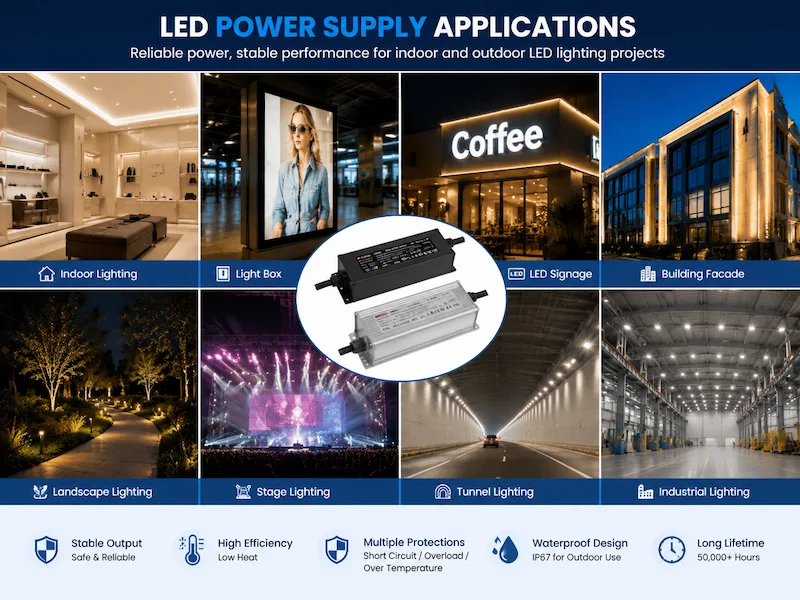
Indoor Light Boxes and Signage
Indoor signage often involves restricted installation space and long operating hours.
Buyers may prioritize:
- Compact dimensions
- Stable constant-voltage output
- Low temperature rise
- Appropriate wattage margin
- Suitable cable configuration
JMHC's indoor LED power supply range currently includes an HCA IP20 18 W mini model for light-box applications and HCC-L long-shape models in 60 W, 100 W and 120 W versions.
Outdoor Signs and Landscape Lighting
Outdoor applications add moisture, rain, dust and temperature variation.
The evaluation therefore expands to include:
- Appropriate IP rating
- Potting quality
- Cable sealing
- Housing durability
- Thermal performance
- Long-term maintenance accessibility
The JMHC waterproof power supply range includes IP67 HCF-A, HCF-C, HCF-P and HCF-PE products for different power requirements.
Architectural and Engineering Projects
For façade lighting and larger engineering projects, buyers may also evaluate:
- Power factor
- Efficiency
- System voltage
- Long operating periods
- Maintenance difficulty
- Certification
- Batch quantity
- Project schedule
- Replacement continuity
In these projects, a slightly lower unit price can become irrelevant if inconsistent products generate site replacement and after-sales costs.
Indoor vs Waterproof Power Supply: Different Quality Priorities
| Application Type | Main Environment | Important Consistency Points |
| Indoor commercial lighting | Controlled indoor environment | Output, thermal behavior, electrical test |
| Light box | Narrow/enclosed space | Size, temperature rise, long operating stability |
| Indoor signage | Long operating hours | Output stability, connectors, workmanship |
| Outdoor signage | Rain and humidity | IP protection, potting, cable sealing |
| Landscape lighting | Weather and temperature variation | Waterproof process, thermal design, aging |
| Building façade | Difficult maintenance | Reliability, batch consistency, protection |
| OEM lighting product | Repeat production | BOM, engineering revision, certification |
This is why supplier qualification should begin with the final installation environment rather than with wattage alone.
How OEM Buyers Should Control Repeat Orders
OEM and private-label buyers have another risk: the product may continue for several years.
A successful first shipment is therefore not enough.
Repeat-order quality should consider:
- Approved electrical specification
- Approved mechanical drawing
- BOM revision
- Cable specification
- Connector type
- Label content
- Housing
- Packaging
- Applicable certification
- Approved engineering changes
JMHC supports OEM and ODM requirements including voltage, wattage, labels, packaging, cables, connectors, housings and application matching. Its published OEM workflow covers requirement confirmation, engineering or product selection, sample development, compatibility testing, approval, pilot production, bulk production, aging, final inspection and repeat-order support.
This staged process is particularly useful when a lighting brand wants the bulk product to remain aligned with the approved sample.
Unit Price vs Quality Consistency: Calculate the Real Cost
For B2B purchasing, the lowest quoted power supply is not automatically the lowest-cost solution.
A more complete calculation may include:
Total procurement cost = unit price + incoming inspection + assembly disruption + replacement labor + site service + logistics + warranty handling + customer complaints
Consider an outdoor advertising project.
If the power supply is mounted several meters above ground, replacing one failed unit may involve transportation, technician time, access equipment and interruption to the installation.
In that situation, preventing a small number of avoidable failures can matter more than a minor difference in initial purchase price.
Lighting manufacturers should therefore compare suppliers using both:
purchase cost and failure-risk cost.
What Information Should You Send Before Requesting a Sample?
Consistent quality starts with a clearly defined specification.
Before asking a manufacturer to recommend a model, provide:
- Final application
- Input voltage
- Required output voltage
- Required output type
- Total LED load
- Expected operating hours
- Installation space
- Indoor or outdoor environment
- Temperature and humidity conditions where relevant
- Required IP rating
- Dimming requirements
- Applicable certification requirements
- Sample quantity
- Estimated production quantity
- Annual forecast if available
- Cable or connector requirements
- Label and packaging requirements
- Required delivery schedule
A technically complete RFQ reduces the risk that the supplier selects a product based only on wattage.
Why Manufacturing Process Matters at JMHC
JMHC positions itself as an LED switching power supply manufacturer integrating design, R&D, production, testing and sales. Its reported production capability includes automatic vacuum glue filling, ATE testing, production and aging equipment, and 100% full-load aging.
These capabilities are relevant to consistency because they address different production risks:
Automatic vacuum glue filling supports repeatable processing of waterproof products.
ATE testing provides standardized electrical evaluation.
Full-load aging helps screen early failures and abnormal operating behavior.
Incoming and in-process inspection controls materials and workmanship before final testing.
First-article inspection provides a checkpoint between the approved requirement and actual production.
Final inspection verifies finished-product condition before shipment.
Buyers evaluating JMHC can compare suitable models through the LED power supply product center and review the company's facilities and manufacturing background on the About JMHC page.
A Practical Quality Checklist Before Your Next Bulk Order
Before approving a supplier, confirm these ten points:
- Application match — Is the power supply suitable for the actual LED load and environment?
- Approved specification — Are electrical and mechanical requirements documented?
- BOM control — Are important component substitutions controlled?
- First-article verification — Is production checked against the approved sample?
- Electrical testing — Are important parameters tested systematically?
- ATE capability — Is automated testing used where applicable?
- Thermal evaluation — Has the product been evaluated under realistic load conditions?
- Aging coverage — Is full-load aging performed, and on what percentage of units?
- Environmental process control — For waterproof models, how are potting and sealing controlled?
- Repeat-order change management — How are future changes documented and communicated?
A supplier capable of answering these questions clearly is easier to evaluate than one relying mainly on claims such as "best quality" or "premium components."
FAQ
What does LED power supply consistent quality mean?
It means important electrical, thermal, mechanical and environmental characteristics remain within approved specifications across samples, mass-production batches and repeat orders. Consistency is therefore a process-control issue, not simply whether one unit works.
How can I verify LED driver batch consistency before a large order?
Start with an approved sample and specification, then review incoming inspection, first-article inspection, production controls, electrical testing, ATE coverage, aging procedures, final inspection and engineering-change management.
Is a good sample enough to approve an LED power supply supplier?
No. A good sample proves that a design can meet requirements under tested conditions. It does not by itself prove that thousands of units can be produced with the same controlled performance.
Why is ATE testing useful for LED power supply quality control?
ATE provides repeatable automated electrical evaluation according to programmed criteria. It can reduce variation associated with purely manual checking and is useful for high-volume manufacturing.
Why does temperature matter for LED driver reliability?
Temperature affects electronic-component degradation. Research summarized by the Illuminating Engineering Society shows that factors such as operating temperature and thermal cycling influence degradation mechanisms in LED-driver capacitors and semiconductor switches.
Why is full-load aging important?
Full-load aging allows the power supply to operate under sustained electrical stress before shipment and may reveal abnormal heat, unstable output, intermittent operation, assembly defects or early component failures that a short functional test may not expose.
Do all outdoor LED applications require IP67 power supplies?
Not automatically. The correct IP rating depends on actual exposure to water, dust, enclosure conditions and project requirements. An exposed outdoor sign may require substantially different protection from a driver installed inside a protected cabinet.
Does certification guarantee consistent production quality?
No. Certification verifies specific compliance requirements for covered products, while production consistency depends on materials, workmanship, testing, inspection and change control. Buyers should also verify that the certificate applies to the exact model being purchased.
What should an OEM buyer control after sample approval?
Control the electrical specification, drawing, BOM revision, housing, cables, connectors, labels, packaging, applicable certification and engineering-change procedure. These records help maintain continuity when repeat orders are placed months or years later.
Can JMHC support bulk and customized LED power supply orders?
JMHC states that it supports OEM/ODM customization, samples, pilot production, mass production, ATE testing, aging and repeat-order supply. Buyers should provide the application, voltage, wattage, environment, certification requirements, quantity and customization details so the correct model and production plan can be evaluated.
Conclusion
LED power supply consistent quality should be verified through repeatable manufacturing and testing controls, not judged from one sample or a supplier's marketing claims.
For lighting manufacturers, signage companies, distributors, contractors and OEM brands, the most important controls include component and BOM management, electrical testing, thermal performance, first-article inspection, ATE testing, full-load aging, waterproof-process control and engineering-change management.
JMHC manufactures indoor and waterproof LED power supplies for lighting, signage, landscape, architectural and related applications, with manufacturing capabilities that include automatic vacuum glue filling, ATE testing and 100% full-load aging.
If you are preparing a sample, pilot order or bulk sourcing program, send your application, input/output requirements, wattage, installation environment, IP rating, certification requirements, quantity and customization needs through the JMHC contact page for product matching and quotation.