
For lighting brands, distributors, engineering contractors, and OEM buyers, LED power supply bulk production is not simply a larger version of a sample order. It requires controlled specifications, stable components, consistent production processes, clear inspection criteria, realistic lead times, and reliable communication.
A sample may perform well during evaluation, but a bulk order introduces new risks. Different component batches, incorrect labels, unapproved substitutions, inconsistent potting, output variation, incomplete aging tests, and packaging mistakes can affect hundreds or thousands of units.
The most successful bulk orders begin before the production line starts. Buyers and manufacturers should first freeze the technical specifications, approve a reference sample, confirm the bill of materials, define testing standards, and agree on packaging and delivery requirements.
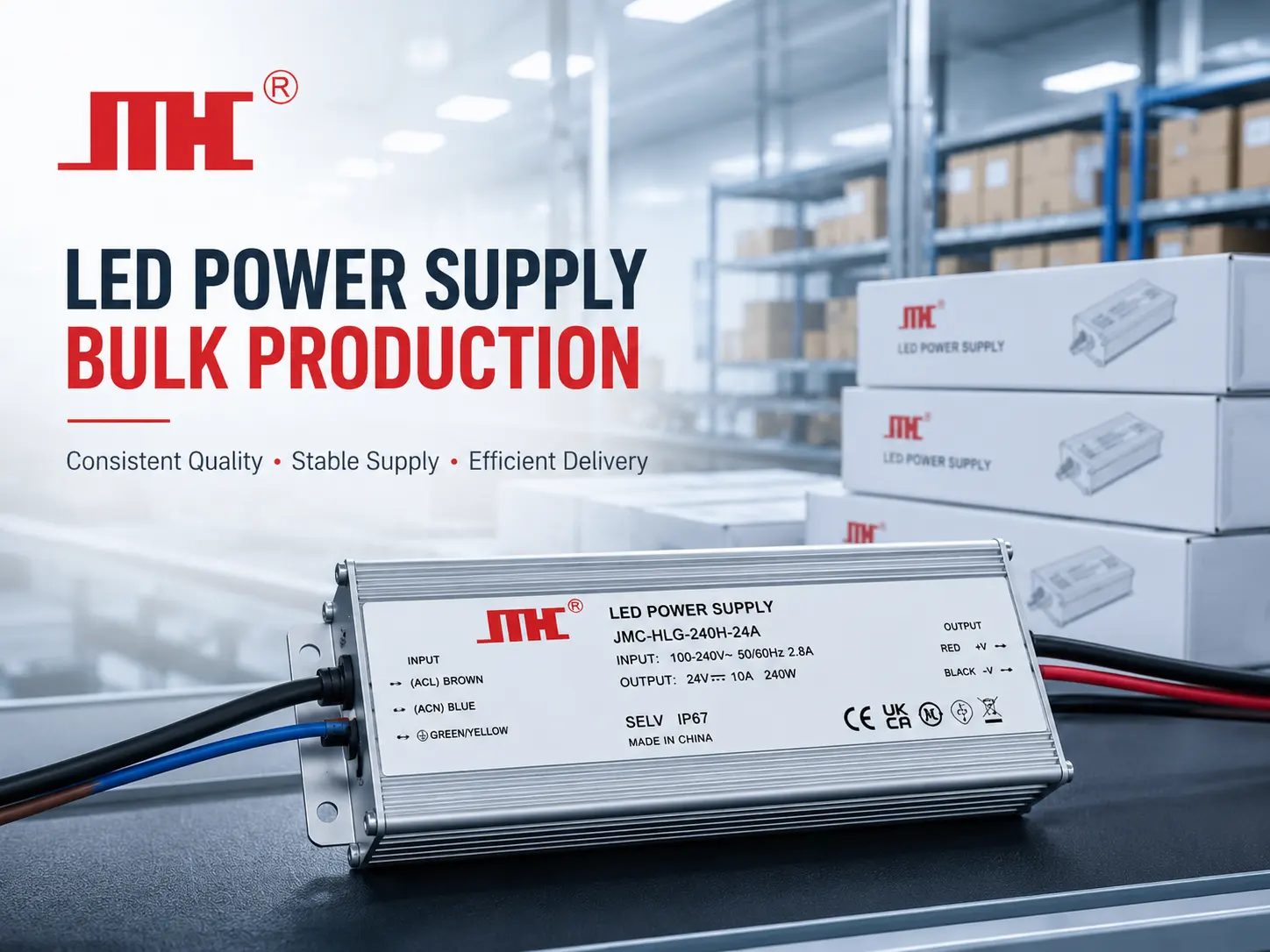
What Does LED Power Supply Bulk Production Include?
Bulk production covers the complete process of turning an approved LED power supply sample into a consistent commercial order.
It normally includes:
- Technical specification confirmation
- Approved sample or golden sample
- Component and material preparation
- Production schedule planning
- Assembly and workmanship control
- Electrical performance testing
- Waterproof potting when required
- Full-load aging
- Final inspection
- Label and packaging verification
- Shipment preparation
- Batch documentation and traceability
The objective is not only to manufacture the required quantity. The objective is to ensure that every production unit remains consistent with the approved product.
Which Buyers Need Bulk LED Power Supply Manufacturing?
Large-scale production support is especially important for buyers who need repeatable products, stable delivery, and long-term supply.
| Buyer Type | Main Bulk Production Requirement |
|---|---|
| Lighting fixture manufacturers | Consistent drivers for repeated fixture production |
| OEM lighting brands | Private labels, packaging, stable specifications |
| Distributors and wholesalers | Reliable stock replenishment and model continuity |
| Project contractors | Batch consistency for large lighting installations |
| Signage manufacturers | Stable supply for light boxes and advertising systems |
| Outdoor lighting companies | Waterproof quality and long-term reliability |
| Commercial lighting brands | Low ripple, certification, and stable output |
| Industrial equipment buyers | Protection functions and continuous-operation reliability |
Bulk production may not be the right first step when the output specifications are not final, the LED load has not been tested, the installation environment is unclear, or the target-market certifications have not been confirmed.
In those cases, buyers should begin with engineering evaluation and sample testing.
Why an Approved Sample Is Not Enough
A working sample is necessary, but it does not automatically guarantee successful mass production.
Sample production may use specially selected components or receive extra engineering attention. Bulk production introduces larger material quantities, multiple production stages, more operators, and tighter delivery schedules.
Before approving LED power supply bulk production, buyers should convert the sample into a controlled production standard.
The Three Main Production Stages
| Stage | Purpose | Buyer Decision |
|---|---|---|
| Engineering sample | Confirms basic electrical and structural design | Is the design technically suitable? |
| Pilot production | Verifies process stability with a small batch | Can the product be produced consistently? |
| Bulk production | Produces the confirmed commercial quantity | Can the factory maintain quality and delivery? |
A pilot order is particularly valuable for customized products. It allows buyers to identify label, cable, housing, compatibility, heat, and packaging issues before committing to a larger quantity.
What Must Be Confirmed Before Production Starts?
The most important bulk production document is the final specification confirmation.
Buyers and suppliers should approve the following details in writing.
| Item | Details to Confirm |
|---|---|
| Input | Voltage range, frequency, input current |
| Output | Voltage, current, wattage, tolerance |
| Output type | Constant voltage or constant current |
| Efficiency | Required efficiency level if specified |
| Ripple | Acceptable output ripple requirement |
| Power factor | PFC requirement where applicable |
| Protection | Short circuit, overload, over-voltage, temperature |
| Environment | Indoor, outdoor, humid, dusty, enclosed |
| IP rating | IP20, IP67, IP68, or project requirement |
| Housing | Material, dimensions, mounting method |
| Cables | Length, wire specification, color, connector |
| Label | Logo, model, electrical data, certification marks |
| Packaging | Individual box, carton, pallet, private label |
| Certification | Required market and approved product model |
| Inspection | Testing method and acceptance criteria |
Verbal confirmation is not enough for a large order. A controlled specification sheet reduces misunderstandings between sales, engineering, purchasing, production, quality control, and packaging teams.
Why the Golden Sample Matters
The golden sample is the physical reference approved by both the buyer and manufacturer.
It should represent the final commercial product, including:
- Housing structure
- Product dimensions
- Input and output cables
- Electrical parameters
- Label content
- Logo position
- Surface appearance
- Potting or sealing method
- Connectors
- Packaging configuration
During production and final inspection, the factory can compare random units with the golden sample.
Buyers should clearly identify the approved sample with a model number, revision code, approval date, and photographs. This is especially important when several similar wattages or housing sizes are being produced at the same time.
How Should Components Be Controlled?
Component consistency is a major part of bulk LED driver quality.
Even when two components have similar electrical ratings, differences in quality, tolerance, temperature performance, or service life may affect the final power supply.
Before production, buyers should ask:
- Is there an approved bill of materials?
- Are critical components identified?
- Can components be changed without buyer approval?
- How are incoming components inspected?
- Are alternative components technically evaluated?
- Are component batch records retained?
- How is material traceability managed?
For standard orders, the manufacturer should still maintain internal component control. For OEM or project-specific products, buyers may also require formal change notification.
Uncontrolled component substitution can create differences between the approved sample and later production batches.
What Should the Production Workflow Look Like?
A controlled manufacturing process should include clear inspection points rather than relying only on final testing.
A practical workflow may include:
- Order and specification review
Engineering, production, purchasing, and quality teams confirm the final requirements. - Incoming material inspection
Critical components, housings, cables, labels, and packaging materials are checked. - Production preparation
Work instructions, inspection standards, tooling, and production schedules are prepared. - Assembly and workmanship control
Wiring, mounting, internal connections, housing assembly, and product appearance are checked. - Electrical testing
Input, output, voltage accuracy, current, protection functions, and related performance are verified. - Potting or sealing
Waterproof models receive the required glue-filling or sealing process. - Curing and appearance inspection
The product is checked after potting or structural completion. - ATE and functional testing
Automated equipment helps improve testing consistency. - Full-load aging
Units operate under load to identify early failures. - Final inspection and packaging
Electrical data, labels, appearance, accessories, cartons, and quantities are verified.
A factory should be able to explain this process clearly before a buyer places a large order.
How Is Quality Controlled During Bulk Production?
Quality control should be distributed throughout the manufacturing process.
| Quality Stage | Main Inspection Focus |
|---|---|
| Incoming inspection | Components, housings, wires, labels, packaging |
| First-article inspection | Confirms the first completed units match requirements |
| In-process inspection | Workmanship, wiring, assembly, potting, appearance |
| Electrical testing | Input/output data, voltage accuracy, load performance |
| Protection testing | Short circuit, overload, over-voltage where applicable |
| Aging testing | Early failure screening under working load |
| Final inspection | Label, appearance, electrical data, accessories |
| Packaging inspection | Carton marks, quantity, protection, packing list |
| Pre-shipment inspection | Random or agreed inspection before release |
The first-article inspection is particularly important. Production should not continue at full speed until the first completed units match the approved specifications.
Why Full-Load Aging Matters for Large Orders
A short electrical test can confirm that a power supply turns on and provides output. It does not always reveal early component failure, unstable operation under heat, or workmanship issues.
Full-load aging places the product under a controlled operating load before shipment.
This can help identify:
- Early component failures
- Abnormal temperature rise
- Intermittent output
- Poor internal connections
- Protection-function problems
- Inconsistent workmanship
For a bulk order, aging should be treated as a production control step rather than a marketing statement.
JMHC states that its products undergo 100% full-load aging. Its manufacturing setup also includes ATE testing equipment and automatic vacuum glue-filling lines for relevant products.
How Can Buyers Control Waterproof Batch Quality?
For IP67 or other waterproof power supplies, batch quality depends on more than the housing shape.
Important production controls include:
- Correct potting material
- Controlled glue quantity
- Complete internal coverage
- Cable-entry sealing
- Proper curing time
- Housing and end-cap assembly
- Surface inspection
- Waterproof verification
- Thermal performance after potting
Poorly controlled potting may leave air gaps or inconsistent coverage. Excessive potting or unsuitable material can also affect heat dissipation.
Buyers sourcing waterproof units should ask the manufacturer to explain its potting process, inspection method, curing controls, and production records.
How Should Certifications Be Managed in Bulk Orders?
Certification should be connected to the exact product model being produced.
Before production, buyers should verify:
- The required target market
- The certified model number
- Input and output specifications covered
- Housing and product-series consistency
- Certification marks permitted on the label
- Whether OEM changes affect documentation
- Whether component changes require evaluation
- Which reports or certificates can be supplied
Changing the housing, circuit, output range, or critical components may affect the relationship between the product and its certification documentation.
JMHC lists certification coverage including CE with LVD and EMC, CCC, BIS, UKCA, and RoHS for relevant products. Buyers should confirm the specific certification status of the exact model they plan to order.
How Should Production Capacity Be Evaluated?
A factory’s theoretical annual capacity does not automatically confirm that it can meet one buyer’s delivery schedule.
Buyers should ask practical questions:
- What is the available capacity for this product series?
- Is the product standard or customized?
- Are key components in stock?
- How long is material preparation?
- How many production lines can support the order?
- Is the quantity produced in one batch or several lots?
- What is the daily or weekly output?
- When will aging and final inspection be completed?
- Is partial shipment available?
- What happens if a material delay occurs?
A reliable production schedule should include material preparation, manufacturing, testing, aging, packaging, and shipment—not only assembly time.
JMHC reports a manufacturing area of more than 5,000 square meters and annual capacity of more than five million power supply units. Its solutions page also states that the company supports stable supply for large-scale mass-production orders.
What Factors Affect Bulk Production Lead Time?
Lead time depends on more than order quantity.
| Lead-Time Factor | Possible Impact |
|---|---|
| Standard or custom product | Customized models require more preparation |
| Component availability | Special parts may extend material lead time |
| Certification requirement | Additional confirmation or testing may be needed |
| Label and packaging | Private-label materials need approval and production |
| Cable or connector changes | Custom materials may require separate purchasing |
| Potting and curing | Waterproof products need additional process time |
| Aging requirement | Testing must be completed before release |
| Inspection standard | Third-party or special inspection adds scheduling time |
| Shipment plan | Partial, full, air, or sea shipment changes timing |
Buyers should avoid accepting an unrealistically short lead time without understanding which production and testing steps are included.
How Can Buyers Reduce Batch Inconsistency?
Batch consistency is especially important for lighting projects where many drivers operate in the same installation.
Inconsistent products may create differences in:
- Output voltage
- Brightness performance
- Temperature rise
- Flicker or ripple
- Cable length
- Housing appearance
- Labels
- Protection behavior
- Installation compatibility
To reduce this risk, buyers should use:
- One approved specification revision
- One golden sample
- Controlled component list
- First-article approval
- Defined inspection standards
- Batch records
- Final random inspection
- Change-notification requirements
For repeat orders, the purchase order should reference the same approved model and revision unless a formal update has been agreed.
What Is the Difference Between Pilot and Bulk Orders?
| Item | Pilot Order | Bulk Order |
|---|---|---|
| Main purpose | Verify design and production process | Commercial supply |
| Quantity | Small | Medium or large |
| Flexibility | Easier to change | Changes may affect cost and schedule |
| Testing | Detailed engineering review | Standardized production QC |
| Packaging | Can still be adjusted | Must be finalized |
| Component control | Validates selected components | Maintains approved component structure |
| Risk | Lower financial exposure | Higher quality and delivery exposure |
| Buyer decision | Approve, modify, or reject | Accept shipment or manage nonconformity |
A pilot order is recommended when the product includes a new housing, cable, output specification, label, packaging design, or target application.
How Does OEM/ODM Affect Bulk Production?
OEM and ODM projects require additional approval steps because the product may include buyer-specific specifications.
Typical customization may include:
- Brand logo
- Product label
- Model numbering
- Output voltage and wattage
- Cable length
- Connector type
- Housing structure
- Carton design
- User documentation
- Certification information
- Application-specific requirements
Before bulk production, the buyer should approve all artwork and technical data.
The supplier should also confirm:
- Minimum order quantity
- Sample and tooling charges
- Artwork approval process
- Component availability
- Production lead time
- Packaging lead time
- Certification impact
- Repeat-order requirements
No logo, label, cable, or packaging change should be left until final inspection.
What Costs Should Buyers Compare?
The lowest unit price does not always produce the lowest total cost.
| Cost Area | Hidden Risk |
|---|---|
| Product price | Low price may exclude testing or better components |
| Sample cost | Skipping samples increases bulk-order risk |
| Customization | Labels, cables, packaging, or tooling add cost |
| Certification | Wrong documentation can delay market entry |
| Inspection | No inspection may increase batch quality problems |
| Packaging | Weak packaging increases shipping damage |
| Rework | Specification mistakes can require costly correction |
| Delay | Late delivery can interrupt fixture or project production |
| Failure rate | Replacement, labor, and warranty costs may exceed savings |
| Communication | Unclear requirements create repeated changes |
Buyers should compare the total landed and operational cost, not only the quotation price.
What Red Flags Should Buyers Watch For?
Be cautious when a supplier:
- Cannot provide a clear specification sheet
- Avoids confirming a golden sample
- Does not explain component control
- Cannot describe the production workflow
- Gives an unusually short lead time
- Has no clear aging-test process
- Cannot confirm certification by model
- Changes technical details after payment
- Uses unclear labels or packaging
- Refuses pre-shipment inspection
- Cannot provide batch or production records
- Gives inconsistent answers about capacity
A reliable manufacturer should make the production process easier to understand, not more confusing.
Buyer Checklist Before Placing a Bulk Order
| Information to Provide | Example |
|---|---|
| Application | Commercial lighting, signage, outdoor lighting |
| Input voltage | 100–240VAC |
| Output voltage | 12V, 24V, 36V, or 48V |
| Output wattage | 60W, 120W, 240W, or project-specific |
| Output type | Constant voltage or constant current |
| Working environment | Indoor, outdoor, humid, enclosed |
| IP requirement | IP20, IP67, or other |
| Working hours | 8 hours, 12 hours, or 24/7 |
| Certification | CE, UKCA, BIS, CCC, RoHS |
| Quantity | Pilot quantity and bulk forecast |
| Delivery plan | One shipment or phased delivery |
| Customization | Label, logo, cable, connector, packaging |
| Inspection | Factory QC, buyer inspection, third-party inspection |
Providing this information at the quotation stage helps the factory evaluate cost, materials, capacity, and lead time more accurately.
Why Choose JMHC for LED Power Supply Bulk Production?
JMHC integrates LED power supply design, research and development, production, testing, and sales. Its available product directions include indoor, waterproof, mini, long-shape, PFC, dimming, and project-based power supply solutions for lighting, signage, security, and industrial applications.
For bulk buyers, JMHC can support:
- Standard and customized LED power supplies
- Different voltage and wattage requirements
- Application-based model selection
- Automatic vacuum glue filling
- ATE testing
- 100% full-load aging
- OEM and ODM requirements
- Certification support
- Large-volume manufacturing
- Repeat-order supply
The best way to begin is to provide the application, electrical specifications, environment, quantity, certification needs, customization details, and required delivery schedule.
FAQ
1. What is LED power supply bulk production?
LED power supply bulk production is the controlled manufacturing of medium or large quantities based on approved specifications, samples, components, testing standards, labels, and packaging.
2. Should I order a sample before bulk production?
Yes. A sample helps verify electrical performance, dimensions, installation compatibility, temperature rise, label content, and application suitability.
3. Is a pilot order necessary?
A pilot order is strongly recommended for customized products, new models, special cables, private labels, or new lighting applications.
4. How can I maintain quality across a large order?
Use a final specification sheet, golden sample, approved components, first-article inspection, in-process QC, full-load aging, and pre-shipment inspection.
5. Why is full-load aging important?
It helps identify early failures, unstable output, abnormal heat, connection problems, and other issues before shipment.
6. What information affects the production lead time?
Product type, quantity, component availability, potting process, customization, packaging, certification, testing, aging, and inspection requirements all affect lead time.
7. Can JMHC support OEM bulk orders?
Yes. JMHC supports OEM and ODM requirements such as custom voltage, wattage, labels, packaging, cables, connectors, and application-based product matching.
8. Can different LED power supply models be ordered together?
This depends on the quantity, material requirements, production schedule, and packaging plan. Buyers should provide a complete mixed-model list for evaluation.
9. How should certifications be checked?
Confirm that the certificate or report corresponds to the exact model, electrical specifications, housing, and target market of the bulk order.
10. What should I send when requesting a bulk quotation?
Send the application, input and output specifications, wattage, environment, IP rating, certifications, quantity, customization details, inspection requirements, and expected delivery date.
Conclusion
Successful LED power supply bulk production depends on specification control, approved samples, component consistency, production planning, testing, aging, certification management, packaging, and realistic delivery schedules.
Buyers should not move directly from a basic sample to a large order without confirming the golden sample, bill of materials, first-article inspection, acceptance criteria, and production timeline. These controls help reduce batch variation, rework, shipment delays, warranty claims, and project risk.
JMHC supports standard and customized LED power supply production for lighting manufacturers, OEM brands, distributors, contractors, signage companies, and industrial buyers.
To receive a suitable bulk-production recommendation and quotation, provide your required voltage, wattage, application environment, certifications, quantity, customization requirements, and delivery schedule.