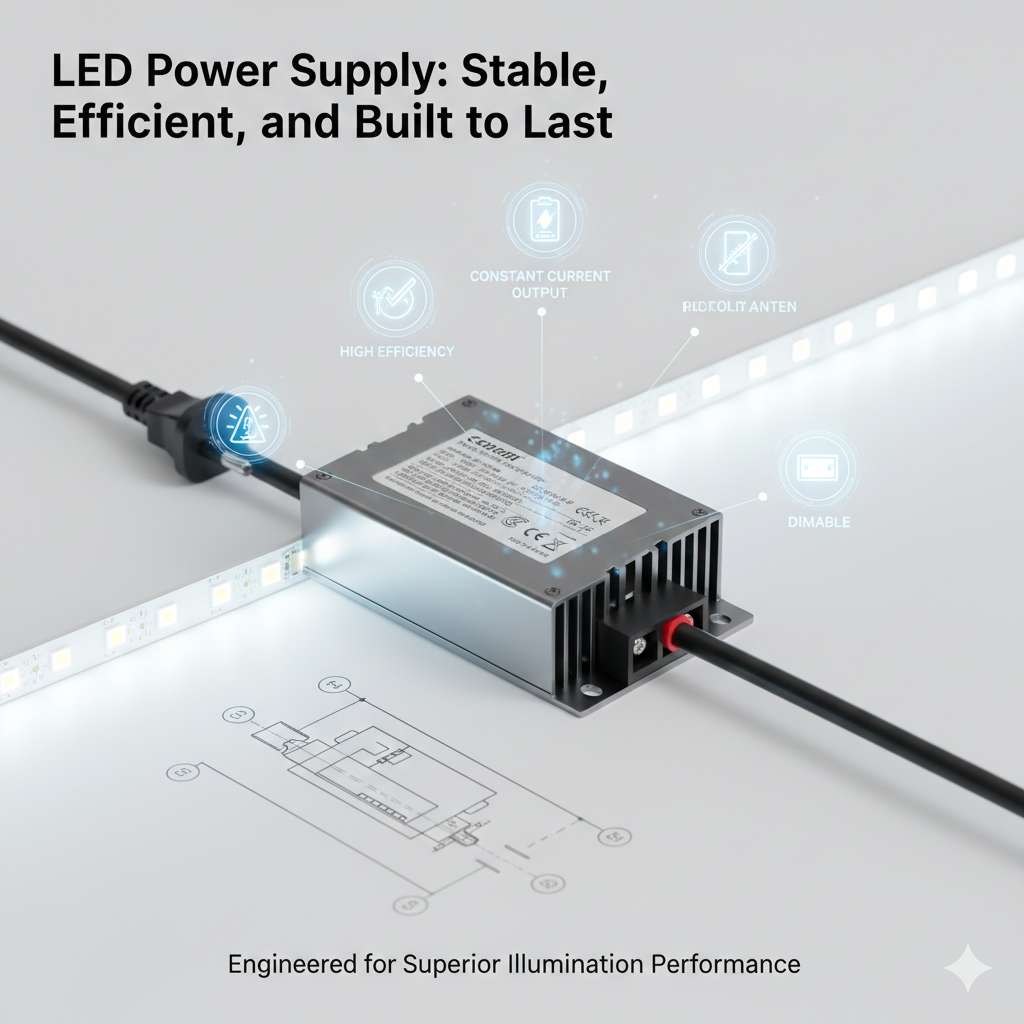
In the global LED lighting supply chain, China remains the primary manufacturing base for power supply products. However, the real difference is not simply location—it lies in how factories operate, control production, and scale output.
A professional LED power supply factory China is defined not only by production capacity, but by how effectively it integrates design, manufacturing, and quality validation into a repeatable system.
Why China Remains the Core Manufacturing Hub for LED Power Supplies
China’s advantage is built on a combination of ecosystem and specialization:
-
Mature supply chain for electronic components
-
Skilled labor for assembly and testing
-
Integrated production clusters for LED-related products
-
Cost-efficient scaling for large-volume orders
These factors allow a LED power supply factory China to respond quickly to OEM demand while maintaining competitive pricing.
Inside the Factory: How Production Lines Define Product Consistency
The difference between factories becomes clear at the production line level.
At JMHC, production is structured to ensure stability across batches:
-
SMT + assembly lines for consistent circuit integration
-
Standardized soldering and wiring processes
-
Dedicated waterproof production lines for outdoor models
-
Thermal layout control during assembly
Unlike small-scale workshops, a structured LED power supply factory China reduces variation by controlling every step of production rather than relying on manual adjustment.
Manufacturing Processes That Directly Impact Product Performance
Beyond assembly, specific processing techniques determine long-term reliability:
-
Vacuum glue filling improves insulation and moisture resistance
-
Housing sealing processes enhance waterproof performance
-
Component fixation reduces vibration-related failure
-
Thermal dissipation design lowers internal temperature rise
These processes are not optional—they are essential for ensuring stable performance in real-world applications.
Production Validation: From Testing to Full-Load Aging
A key difference between factories is how products are tested before shipment.
A professional LED power supply factory China applies:
-
Functional testing after assembly
-
Output verification under load
-
100% full-load aging tests
-
Final inspection and batch tracking
Compared to limited sampling methods, full-load validation significantly reduces early failure rates after installation.
Cost Structure: Why Factory-Level Control Reduces Long-Term Expenses
While initial pricing is often the focus, total cost is influenced by production stability.
| Cost Factor | Uncontrolled Factory | Controlled Factory (JMHC) |
|---|---|---|
| Unit price | Lower upfront | Slightly higher |
| Failure rate | 8–12% | <3% |
| Return & replacement cost | High | Reduced by 50%–70% |
| Delivery delays | Frequent | Stable (±5%) |
| Rework cost | High | Significantly reduced |
| Lifecycle cost | Higher overall | Optimized |
A stable LED power supply factory China reduces hidden costs by minimizing failure, rework, and delays.
Common Manufacturing Gaps—and How Strong Factories Address Them
In many projects, issues arise not from design, but from weak manufacturing execution.
1. Inconsistent Batch Quality
Problem: Variation between different production batches
Solution:
-
Standardize component sourcing
-
Fix production parameters
-
Apply full-load aging to every unit
2. Waterproof Failure in Outdoor Products
Problem: Moisture ingress over time
Solution:
-
Dedicated waterproof production line
-
Controlled glue filling process
-
IP65/IP67 validation
3. Delivery Instability for Large Orders
Problem: Delays during scaling
Solution:
-
Structured production planning
-
Stable supply chain integration
-
Capacity allocation for OEM orders
4. Limited Customization Capability
Problem: Inability to adapt to project-specific needs
Solution:
-
Integrate R&D with production
-
Standardize customization workflow
-
Align design with manufacturing feasibility
Factory Capability by Application Type
Different applications require different production priorities:
-
Indoor lighting: focus on compact design and efficiency
-
Outdoor lighting: emphasize waterproof processing and durability
-
Dimmable systems: require circuit precision and testing consistency
A capable factory aligns production processes with these requirements rather than treating all products the same.
Frequently Asked Questions
Q1: Why choose a China-based factory for LED power supplies?
Because of its integrated supply chain, scalable production, and cost efficiency for OEM projects.
Q2: What is the most important factory capability?
Consistent production quality across batches, not just sample performance.
Q3: How can buyers verify factory reliability?
By evaluating production processes, aging tests, and batch consistency control.
Working With a Manufacturing-Driven Partner
JMHC operates as an integrated manufacturing factory, combining product design, production, and quality control under one system. By maintaining structured production lines and full-load aging validation, the focus is on delivering stable, repeatable performance across all orders.
To explore product categories and manufacturing capabilities, visit our homepage:
👉 https://www.jmhce.com/
If you are planning OEM production or looking for a reliable manufacturing partner, contact our team here:
👉 https://www.jmhce.com/contact-us