
Why Display Lighting Needs a Different Power Supply Strategy
Display lighting may look like a relatively simple LED application, but the power supply often works under tighter mechanical and thermal constraints than buyers initially expect.
Retail shelves, illuminated cabinets, product showcases, branded wall displays, exhibition structures, light boxes, merchandising fixtures, and commercial display systems frequently place the driver inside narrow or enclosed spaces.
In these applications, choosing an LED power supply for display lighting only by voltage and wattage can create problems later.
A suitable power supply must also match:
- Available installation space
- Internal enclosure temperature
- Cable routing
- Operating hours
- Required output stability
- LED load type
- Service accessibility
- OEM integration needs
- Batch-production requirements
For display manufacturers, commercial lighting buyers, and OEM brands, the power supply should therefore be treated as part of the complete display system rather than as a separate commodity.
JMHC provides indoor and application-oriented LED power supply platforms through its product center, allowing buyers to compare different form factors and power ranges for commercial lighting projects.
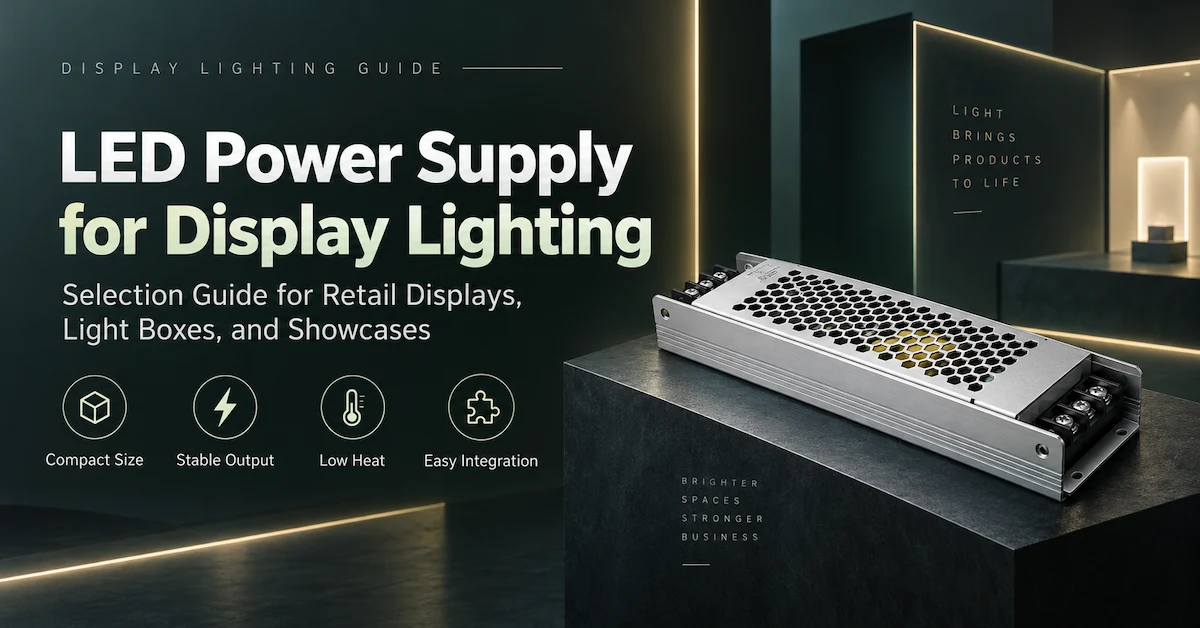
What Is Display Lighting?
Display lighting is used to illuminate products, graphics, merchandising structures, exhibits, or branded environments rather than simply provide general room lighting.
Typical applications include:
- Retail shelf lighting
- Cosmetic displays
- Jewelry showcases
- Exhibition booths
- Product cabinets
- Illuminated wall displays
- Light boxes
- Advertising panels
- Point-of-sale displays
- Branded commercial interiors
- Museum-style showcases
- Menu and promotional displays
The lighting may be integrated into wood, metal, aluminum profiles, acrylic panels, cabinets, or modular display structures.
This creates a major difference from ordinary ceiling lighting.
The power supply may need to fit behind a panel only a few centimeters deep, inside a long narrow cavity, or below a shelf where ventilation is limited.
That makes physical dimensions almost as important as electrical specifications.
Who Buys LED Power Supplies for Display Lighting?
Understanding the buyer helps define what matters most during product selection.
Retail Display Manufacturers
Retail fixture companies build shelves, branded walls, promotional displays, counters, and merchandising systems.
Their priorities often include:
- Compact dimensions
- Stable LED output
- Low heat generation
- Simple installation
- Repeat-order consistency
- Private-label capability
Light Box Manufacturers
Light boxes typically require a compact constant-voltage power supply that can fit inside a shallow housing.
Important considerations include:
- Output voltage
- Rated wattage
- Housing shape
- Wiring direction
- Internal temperature
- Continuous operating time
JMHC offers indoor power supply options that can be reviewed through the indoor power supply category.
Showcase and Cabinet Manufacturers
Jewelry cases, cosmetic displays, premium product cabinets, and exhibition showcases may have very little hidden installation space.
In these systems, the driver may need to fit:
- Under shelves
- Behind decorative panels
- Inside narrow bases
- Within aluminum channels
- In small service compartments
Exhibition Display Suppliers
Exhibition systems may be assembled and disassembled repeatedly.
Buyers may therefore value:
- Standardized connectors
- Easy replacement
- Compact dimensions
- Stable specifications
- Consistent repeat production
Commercial Interior Contractors
Contractors may integrate display lighting into:
- Shopping malls
- Hotels
- Restaurants
- Retail chains
- Showrooms
- Offices
Their main concerns often include reliable supply, installation convenience, serviceability, and project consistency.
Start With the LED Load
Before selecting a display lighting power supply, define the electrical load.
The basic information should include:
- LED operating voltage
- Total wattage
- Number of LED modules or strips
- Maximum continuous load
- Cable length
- Number of lighting branches
- Dimming requirements
- Operating hours
- Installation temperature
- Indoor or outdoor environment
Many display-lighting applications use constant-voltage LED strips or modules.
In that case, the power supply voltage must match the LED product.
A 24V LED strip requires a compatible 24V constant-voltage output.
Using a higher-wattage power supply does not solve a voltage mismatch.
12V or 24V for Display Lighting?
Both 12V and 24V systems can be suitable for display lighting.
The correct choice depends first on the LED load specification.
However, voltage also affects current.
For the same power:
Power = Voltage × Current
A 24V system generally uses less current than a 12V system delivering the same power.
This can be helpful in long retail displays or large light boxes because lower current can reduce voltage-drop problems.
A 24V system may therefore be practical for:
- Long shelving systems
- Large wall displays
- Long light boxes
- Extended linear displays
- Remote driver placement
But this does not mean 24V is automatically better.
The LED modules, connectors, controls, and power supply must all be designed for the same system voltage.
How Much Wattage Should You Choose?
One of the most common mistakes is choosing a power supply with a rated output almost identical to the calculated LED load.
Suppose a display consumes 72W.
A buyer may assume that a 72W power supply is sufficient.
In practice, the selection should also consider:
- LED tolerance
- Internal temperature
- Driver derating
- Long operating hours
- Limited ventilation
- Cable losses
- Input-voltage variation
- Actual operating conditions
The correct engineering margin should come from the selected power supply specification and the real installation environment.
There is no single percentage that should be applied to every display project.
This is why a buyer should provide actual project conditions rather than simply asking:
“Please quote a 100W LED power supply.”
Why Power Supply Size Matters So Much
Display lighting often creates mechanical constraints that are more difficult than the electrical requirements.
Two power supplies may have the same output wattage but completely different housing dimensions.
A product may be electrically suitable but impossible to install.
Typical space limitations include:
- Narrow light boxes
- Thin retail panels
- Slim cabinet bases
- Hidden channels
- Long but narrow cavities
- Shallow wall structures
For display manufacturers, the correct form factor can reduce redesign work and simplify assembly.
Mini Power Supply for Compact Displays
A mini power supply can be useful where the available enclosure space is limited.
JMHC currently provides compact indoor platforms within its indoor power supply range, including solutions intended for light-box and compact installation applications.
This type of product can be suitable for:
- Small light boxes
- Product cabinets
- Retail shelves
- Compact signs
- Interior display structures
Long-Shape Power Supply for Narrow Installations
Some displays have enough length but very little width.
A long-shape power supply can fit these installations more efficiently than a conventional wider enclosure.
JMHC provides a dedicated HCC-L long-shape power supply range for applications where installation geometry is an important consideration.
Possible applications include:
- Linear displays
- Long light boxes
- Narrow retail fixtures
- Built-in advertising panels
- Commercial display structures
Display Lighting Power Supply Selection Table
| Display Application | Main Buyer Concern | Recommended Selection Focus |
|---|---|---|
| Small retail light box | Very limited internal space | Compact or mini power supply |
| Long light box | Narrow installation channel | Long-shape power supply |
| Product showcase | Heat and hidden installation | Compact, thermally suitable design |
| Shelf lighting | Stable output across long runs | Correct voltage and zoning |
| Exhibition display | Easy assembly and servicing | Standardized wiring and connectors |
| Branded wall display | Long daily operating time | Stable output and reliability |
| OEM display platform | Repeat-order consistency | Controlled specification and QC |
| Outdoor display structure | Moisture exposure | Suitable waterproof platform |
The main lesson is simple:
Display lighting power supplies should be selected according to both electrical requirements and installation geometry.
Thermal Management Is a Hidden Selection Factor
Heat is one of the most overlooked issues in display lighting.
A retail store may be air-conditioned, but the power supply may still operate inside a warm enclosed structure.
Typical locations include:
- Inside MDF cabinets
- Behind decorative panels
- Under shelves
- Behind acrylic graphics
- Inside metal display structures
- Inside closed light boxes
These spaces may have little airflow.
The LED modules themselves also generate heat.
If the power supply is installed close to the LEDs, the internal temperature may rise significantly above room temperature.
Before selecting a model, evaluate:
- Actual installation location
- Ventilation conditions
- Internal enclosure temperature
- Distance from LED modules
- Daily operating hours
- Load percentage
- Manufacturer derating requirements
A power supply that appears adequate at room temperature may perform differently inside a sealed display.
Why Output Stability Matters in Retail Displays
Display lighting is highly visual.
Customers may never see the power supply, but they immediately notice unstable lighting.
Problems can include:
- Flicker
- Uneven brightness
- Dimming instability
- Different brightness between sections
- Intermittent operation
This is particularly important in premium retail environments.
Jewelry, cosmetics, fashion products, electronics, and branded packaging often depend on consistent illumination.
Poor lighting can reduce the perceived quality of the merchandise.
A reliable display lighting power supply should therefore be evaluated not only by rated power but also by how it performs with the actual LED load.
One Large Power Supply or Multiple Zones?
For a long display, using one large centralized power supply may appear simpler.
However, multiple power zones can sometimes provide better system performance.
Advantages may include:
- Shorter cable runs
- Easier voltage management
- Better fault isolation
- Easier maintenance
- More flexible installation
- Simpler replacement
Consider a long retail wall with several illuminated shelves.
If one central driver powers the entire display, some sections may require long low-voltage cable runs.
Dividing the structure into multiple zones may simplify both wiring and servicing.
The best layout depends on:
- Total display length
- LED wattage
- Cable size
- Driver location
- Service access
- Fixture construction
Power architecture should therefore be considered during the display design stage rather than after the mechanical structure is finalized.
Does Display Lighting Need IP67?
Not every display requires a waterproof power supply.
Many retail and exhibition applications operate indoors under controlled conditions.
In these cases, an appropriate indoor power supply may be the better choice.
However, some display systems are installed:
- Outdoors
- Near entrances
- In humid environments
- In partially exposed locations
- Inside outdoor advertising structures
For these applications, environmental protection becomes more important.
The required IP rating should be selected according to the actual installation environment.
Using an IP67 product where it is not needed may add unnecessary size or cost.
Using an indoor product in a moisture-exposed location may create reliability problems.
JMHC separates indoor and waterproof options within its LED power supply product range, allowing buyers to select according to project conditions.
Cable and Connector Design Can Reduce Assembly Time
For an OEM display manufacturer, power supply integration affects production efficiency.
Cable configuration can influence:
- Wiring time
- Assembly mistakes
- Installation speed
- Field servicing
- Internal cable management
Common problems include:
- Cable exits in the wrong direction
- Leads are too long
- Leads are too short
- Connectors do not match the lighting harness
- Cable routing interferes with mounting
These issues may look small during purchasing but become expensive when repeated across hundreds or thousands of displays.
The cable and connector layout should therefore be confirmed during sample development.
JMHC supports project-based engineering and customization through its solutions page.
Standard Product, OEM, or ODM?
Not every project needs a completely custom power supply.
Buyers can generally divide requirements into three levels.
| Project Type | Typical Requirement | Recommended Starting Point |
|---|---|---|
| Standard retail display | Existing voltage, wattage, dimensions | Standard product |
| Private-label display | Standard electronics with branding changes | OEM / private label |
| Integrated display fixture | Custom cable, connector or configuration | OEM customization |
| New display platform | Deeper mechanical or electrical development | ODM / engineering project |
Starting with a mature existing platform can reduce development time and validation risk.
If the electrical specification already fits the application, the customer may only need changes to:
- Cable length
- Connector
- Label
- Packaging
- Wiring configuration
This can be more efficient than developing a completely new power supply.
Why Sample Approval Is Not Enough
A successful sample does not automatically guarantee successful mass production.
For B2B buyers, the real question is:
Can the approved configuration be reproduced consistently across every production batch?
Before mass production, confirm:
- Approved model
- Output specification
- Housing
- Cable configuration
- Connector
- Label
- Packaging
- Testing requirements
- Approved BOM or configuration
- Revision status
This is especially important for retailers or display manufacturers ordering hundreds or thousands of identical units.
The sample should become the reference for controlled production rather than simply a one-time test unit.
Why ATE Testing and Full-Load Aging Matter
A power supply failure inside a completed display can create costs much greater than the price of the driver.
Possible costs include:
- Technician visits
- Display disassembly
- Replacement labor
- Store downtime
- Warranty claims
- Customer complaints
- Delayed retail launches
JMHC states that its production system includes ATE testing and 100% full-load aging.
ATE testing can help verify electrical characteristics using defined testing procedures.
Full-load aging allows units to operate under load before shipment, helping identify early failures before the product reaches the customer.
For buyers evaluating manufacturing capability, more information is available on the JMHC About Us page.
What Should Be Included in a Display Lighting RFQ?
A clear RFQ helps the supplier recommend a more suitable product.
Application Information
Specify the final application:
- Retail shelf
- Showcase
- Light box
- Exhibition booth
- Wall display
- Product cabinet
- Signage
- Decorative commercial fixture
Electrical Information
Provide:
- Input voltage
- Output voltage
- LED wattage
- Maximum load
- Number of branches
- Dimming requirement
Mechanical Information
Provide:
- Maximum length
- Maximum width
- Maximum height
- Mounting method
- Available installation space
Environmental Information
Explain:
- Indoor or outdoor
- Open or enclosed
- Expected temperature
- Moisture exposure
- Required IP level
Integration Information
Define:
- Cable length
- Cable exit direction
- Connector type
- Wiring harness
- Control system
Commercial Information
Include:
- Sample quantity
- Initial order quantity
- Annual forecast
- Branding requirements
- Packaging requirements
- Destination market
- Certification requirements
- Target delivery schedule
For project evaluation, these details can be submitted through the JMHC contact page.
Common Mistakes When Selecting a Display Lighting Power Supply
Choosing Only by Wattage
Wattage alone does not tell you whether the power supply will fit the display or operate correctly under the real thermal conditions.
Ignoring Housing Dimensions
A technically correct power supply is not useful if it cannot be installed inside the finished display.
Treating Every Indoor Display the Same
A ventilated shelf and a sealed light box can have very different operating temperatures.
Ignoring Cable Length
Long low-voltage cable runs may contribute to voltage drop and uneven brightness.
Using One Large Driver for Every Display
Large installations may sometimes benefit from multiple zones instead of one central power supply.
Ignoring Service Access
The power supply should not be installed where replacing it requires destroying or completely disassembling the display.
Finalizing Branding Too Early
Label and packaging should be finalized after electrical and mechanical integration has been approved.
Assuming the Sample Represents Every Batch
Repeat orders require controlled specifications, production processes, testing, and quality management.
Using Waterproof Products Without a Real Need
A sealed product may increase cost and dimensions without adding meaningful value in a controlled indoor environment.
Choosing Only by Unit Price
A lower purchase price may be offset by higher service, replacement, and warranty costs.
Display Lighting Power Supply Buyer Checklist
| Check | Buyer Question |
|---|---|
| Output voltage | Does the driver match the LED system voltage? |
| Wattage | Is the load within the approved operating range? |
| Dimensions | Does the housing fit the real installation space? |
| Temperature | What is the actual internal enclosure temperature? |
| Wiring | Are cable length and cable direction suitable? |
| Connector | Does it match the display wiring harness? |
| Output stability | Does the lighting remain visually consistent? |
| IP rating | Does protection match the actual environment? |
| Serviceability | Can the power supply be accessed for replacement? |
| QC | How is electrical performance tested? |
| Aging | Is production aging performed before shipment? |
| OEM | Are wiring, label and packaging requirements controlled? |
| Repeat production | Can the same approved configuration be reproduced? |
FAQ
What is the best LED power supply for display lighting?
There is no single best model for every display. The correct power supply depends on voltage, wattage, installation dimensions, thermal conditions, cable layout, operating hours, and environmental requirements.
Are display lighting systems usually constant voltage?
Many LED strips, light boxes, shelf systems, and display modules use constant-voltage power supplies. Buyers should always verify the actual LED specification before choosing the driver.
Is 12V or 24V better for retail display lighting?
Both can be suitable. The LED system determines the required voltage, while cable length and current may influence the overall system design.
How much extra wattage should I leave?
Do not apply one fixed percentage to every project. Review the actual LED load, power supply specification, enclosure temperature, ventilation, derating requirements, and operating hours.
Why are compact power supplies useful for light boxes?
Compact power supplies are easier to integrate into shallow or narrow housings where a conventional enclosure may not fit.
When should I use a long-shape power supply?
A long-shape housing can be useful in long but narrow display structures, including linear fixtures, light boxes, and slim built-in display compartments.
Does indoor display lighting need IP67?
Usually not unless the product is exposed to moisture or environmental conditions requiring higher ingress protection.
Can cables and connectors be customized?
For suitable OEM projects, cable length, connector configuration, labels, packaging, and other integration details can be specified according to the approved project requirements.
What should I test before approving the power supply?
Test the power supply with the actual LED load and final display structure. Review output stability, temperature, fit, connector compatibility, wiring, brightness consistency, and long-duration operation.
How can I request a display-lighting power supply from JMHC?
Prepare the application, input voltage, output voltage, load wattage, dimensions, installation environment, cable and connector requirements, quantity, and customization needs. Submit the information through the JMHC contact page for product selection and engineering evaluation.
Conclusion
Choosing the right LED power supply for display lighting requires balancing electrical performance with the mechanical design of the finished display. Voltage, wattage, form factor, thermal conditions, wiring layout, operating hours, environmental protection, and serviceability should all be evaluated before approving a model.
For retail displays, light boxes, showcases, exhibition systems, and commercial fixtures, buyers should also consider production testing, aging, OEM integration, and repeat-order consistency rather than comparing unit price alone. Review the JMHC indoor power supply range or submit your application requirements through the JMHC contact page for product selection and project evaluation.