For lighting manufacturers, OEM brands, distributors, and engineering companies, LED driver mass production is not simply about producing a large quantity of drivers. It requires stable engineering control, consistent components, reliable testing, controlled production processes, and a supplier capable of maintaining quality across thousands of units.
A single LED driver failure may affect the reputation of the lighting brand, delay a project, or increase warranty costs. During mass production, even small variations in components, assembly processes, output performance, or testing standards can create large quality differences across batches.
Therefore, buyers should evaluate not only product price but also manufacturing capability, production control, testing procedures, certification support, and long-term supply reliability.
As a professional LED power supply manufacturer, JMHC provides LED driver and switching power supply solutions for lighting manufacturers, OEM brands, distributors, signage companies, commercial lighting projects, and industrial applications.
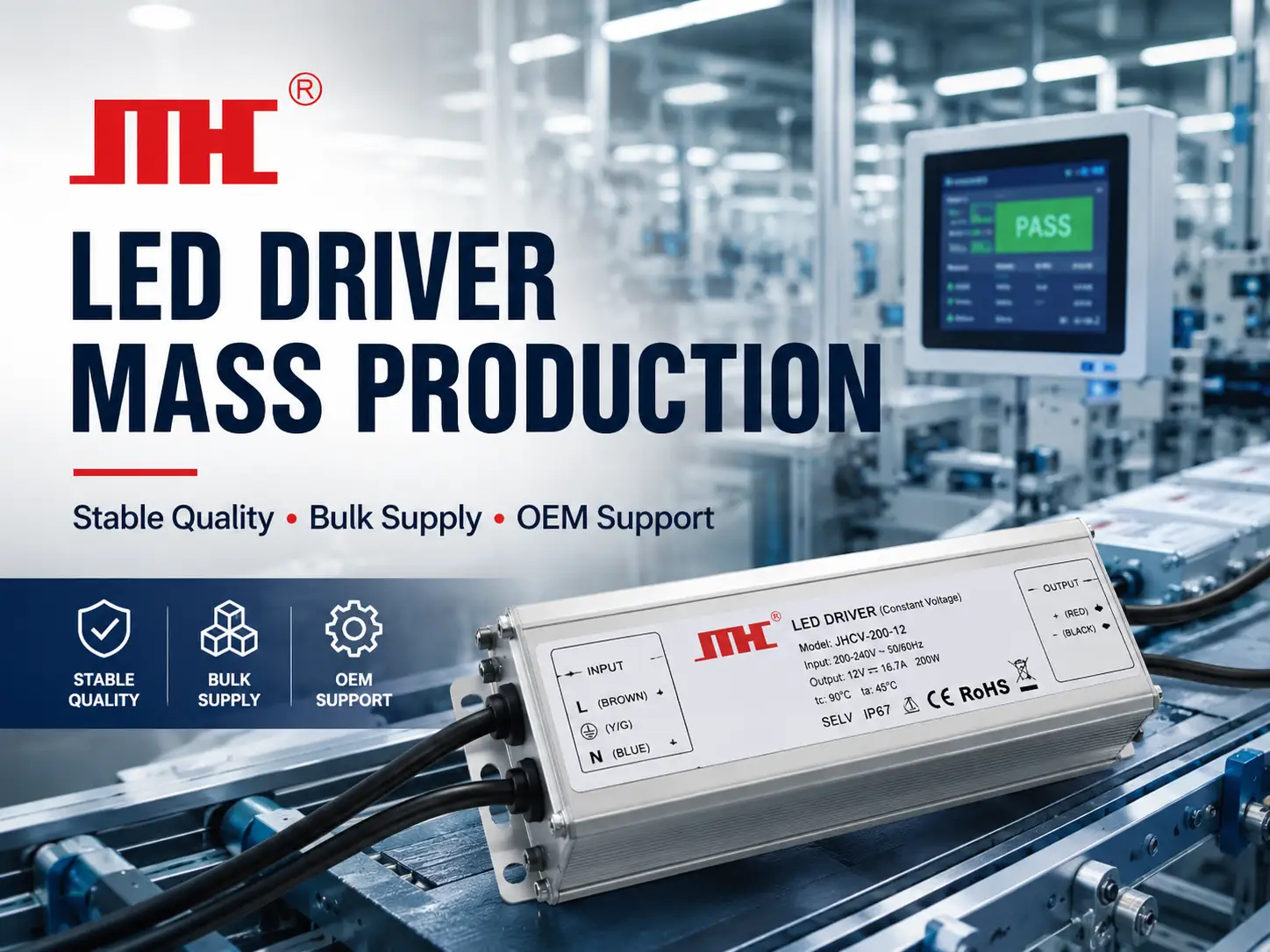
Why Mass Production Capability Matters for LED Drivers
When purchasing LED drivers in bulk, buyers need more than a working sample. They need a manufacturing partner that can repeatedly produce the same quality product.
Mass production capability directly affects:
- Product consistency
- Delivery reliability
- Project schedule
- Warranty cost
- Customer satisfaction
- Brand reputation
- Long-term cooperation
For lighting manufacturers, a reliable LED driver factory helps reduce production interruptions and ensures every finished lighting product performs consistently.
What Is LED Driver Mass Production?
LED driver mass production is the process of manufacturing large quantities of LED drivers according to approved technical specifications, quality standards, and production requirements.
A complete mass production process usually includes:
| Production Stage | Main Purpose |
|---|---|
| Engineering review | Confirms product requirements |
| Sample approval | Establishes production reference |
| Material preparation | Ensures component availability |
| Pilot production | Verifies manufacturing stability |
| Mass assembly | Produces commercial quantities |
| Electrical testing | Confirms performance |
| Aging testing | Detects early failures |
| Final inspection | Ensures shipment quality |
A professional supplier should have a clear process from product approval to final delivery.
Why Sample Approval Is Critical Before Mass Production
Many production problems happen because buyers move directly from a prototype to a large order without a proper approval process.
Before starting LED driver mass production, buyers should confirm:
- Electrical specifications
- Housing design
- Label information
- Logo position
- Cable specifications
- Connector type
- Packaging design
- Certification requirements
- Testing standards
The approved sample becomes the production reference for future batches.
For OEM customers, this is especially important because customized products often include private labels, special cables, customized packaging, and unique specifications.
Key Factors Affecting LED Driver Mass Production Quality
1. Stable Component Supply
Component consistency is one of the most important factors in mass production.
LED drivers contain multiple electronic components, and differences between component batches may affect performance.
Buyers should evaluate:
- Component sourcing control
- Approved material list
- Supplier management
- Alternative component approval process
- Material inspection procedures
- Production traceability
A reliable manufacturer should not replace critical components without technical evaluation and customer approval.
2. Manufacturing Process Control
Mass production requires standardized manufacturing procedures.
Important production controls include:
- Standard operating instructions
- Assembly process control
- Workmanship inspection
- Production line management
- Operator training
- Process verification
- Quality checkpoints
Without process control, the first batch and later batches may have inconsistent performance.
3. Electrical Testing During Production
Electrical testing ensures every LED driver meets the required specifications.
Common production tests include:
| Test Item | Purpose |
| Input voltage test | Confirms input compatibility |
| Output voltage test | Checks output stability |
| Current test | Verifies load performance |
| Efficiency test | Evaluates energy performance |
| Protection test | Confirms safety functions |
| Ripple test | Checks output quality |
| Insulation test | Supports electrical safety |
| Functional test | Confirms normal operation |
For lighting manufacturers, these tests help prevent defective products from reaching assembly lines or customers.
4. Full-Load Aging Testing
Aging testing is one of the most important steps in LED driver mass production.
A driver may pass a short functional test but still fail after continuous operation due to:
- Component stress
- Heat problems
- Internal connection issues
- Output instability
- Protection failures
Full-load aging helps identify potential problems before shipment.
JMHC applies full-load aging tests as part of its quality control process and uses ATE testing equipment to improve production consistency. (JMHC About Us)
LED Driver Mass Production for Different Applications
Different lighting applications have different requirements during mass production.
| Application | Production Focus |
| Commercial lighting | Low ripple, stable output, certification |
| Outdoor lighting | Waterproof reliability, IP67 protection |
| Signage systems | Long operation time, consistent brightness |
| Architectural lighting | Batch consistency and long service life |
| Industrial lighting | Protection functions and durability |
| OEM lighting products | Custom specifications and repeatability |
| Smart lighting | Compatibility and stable performance |
Manufacturers should select suppliers according to the final application rather than only comparing product prices.
Certification Management During Mass Production
Certification is important for global lighting products.
During LED driver mass production, buyers should confirm:
- Certified product model
- Approved electrical specifications
- Label requirements
- Certification marks
- Documentation availability
- OEM customization impact
Common certification requirements include:
| Certification | Application |
| CE | European market |
| UKCA | UK market |
| RoHS | Environmental compliance |
| EMC | Electromagnetic compatibility |
| LVD | Electrical safety |
| CCC | China market |
| BIS | India market |
| IP Rating | Waterproof requirements |
A product modification during production may affect certification status, so changes should always be reviewed.
OEM and ODM Support in LED Driver Mass Production
Many lighting companies require customized LED drivers instead of standard models.
OEM/ODM requirements may include:
- Custom output voltage
- Custom wattage
- Private label logo
- Customized packaging
- Cable length
- Connector design
- Housing changes
- Product series development
- Certification support
A capable LED driver factory should support both engineering communication and commercial production.
JMHC supports OEM and ODM LED driver requirements for lighting brands, distributors, and project customers.
How to Evaluate an LED Driver Factory
Before selecting a manufacturing partner, buyers should evaluate:
| Evaluation Factor | What to Check |
| Production capacity | Can it support your order quantity? |
| Testing equipment | ATE testing, aging equipment, QC tools |
| Product range | Indoor, waterproof, mini, long-shape, PFC models |
| Engineering support | Technical recommendation capability |
| Certification support | Export market requirements |
| OEM ability | Label, packaging, customization |
| Quality system | Inspection and traceability |
| Delivery ability | Stable production scheduling |
The right factory should provide both manufacturing ability and technical support.
Common Mistakes in LED Driver Mass Production
Mistake 1: Starting bulk production without sample approval
Without a confirmed reference sample, quality disputes are more likely.
Mistake 2: Choosing only by unit price
A lower price may increase warranty cost and production risk.
Mistake 3: Ignoring production capacity
A supplier may provide samples but lack capacity for large orders.
Mistake 4: Skipping aging tests
Without aging testing, early failures may appear after installation.
Mistake 5: Allowing uncontrolled changes
Component, label, cable, or specification changes should require approval.
Buyer Checklist Before Mass Production
Before placing an LED driver mass production order, buyers should prepare:
| Requirement | Example |
| Product application | Commercial lighting, signage, outdoor lighting |
| Input voltage | 100–240VAC |
| Output voltage | 12V / 24V / 36V / 48V |
| Output type | Constant voltage/current |
| Wattage | 60W / 120W / 240W |
| Environment | Indoor/outdoor/humid |
| Certification | CE, UKCA, RoHS, BIS |
| Quantity | Monthly demand forecast |
| Packaging | Standard or private label |
| Customization | Logo, cable, housing |
| Inspection | Factory QC or third-party inspection |
Clear requirements help suppliers prepare materials, production schedules, and quality standards.
Why Choose JMHC for LED Driver Mass Production?
JMHC provides LED driver and power supply solutions for lighting manufacturers, OEM brands, distributors, and engineering customers.
JMHC supports:
- Standard LED driver production
- Customized LED driver manufacturing
- OEM and ODM projects
- Stable bulk production
- ATE testing
- Full-load aging testing
- Certification support
- Quality inspection
- Long-term supply cooperation
With professional production processes and application-based support, JMHC helps buyers reduce production risks and improve product reliability.
FAQ
1. What is LED driver mass production?
LED driver mass production refers to manufacturing large quantities of LED drivers with controlled specifications, testing standards, and consistent quality.
2. Why is mass production different from sample production?
Mass production requires stronger process control, material management, testing procedures, and quality consistency across thousands of units.
3. What should buyers confirm before production?
Buyers should confirm specifications, approved samples, components, labels, packaging, certifications, testing standards, and delivery requirements.
4. Why is aging testing important?
Aging testing helps detect early failures caused by heat, components, internal connections, or unstable output.
5. Can JMHC support OEM LED driver production?
Yes. JMHC supports OEM and ODM customization, including voltage, wattage, labels, packaging, cables, and product matching.
6. How do manufacturers maintain batch consistency?
Through approved samples, controlled components, standardized processes, electrical testing, aging tests, and final inspection.
7. What certifications are available for LED drivers?
Depending on the model and market, certifications may include CE, UKCA, RoHS, EMC, LVD, CCC, BIS, and IP ratings.
8. How long does LED driver mass production take?
Lead time depends on product type, customization, quantity, component availability, testing requirements, and packaging needs.
9. What applications need mass-produced LED drivers?
Commercial lighting, outdoor lighting, signage, architectural lighting, industrial lighting, and OEM lighting products commonly require bulk production.
10. How can I start an LED driver mass production project?
You can provide your product specifications, application, quantity, certification requirements, and customization needs to JMHC for evaluation and quotation.
Conclusion
Successful LED driver mass production requires more than manufacturing quantity. It depends on engineering control, component consistency, production capability, testing standards, certification management, and reliable supplier support.
Lighting manufacturers and OEM brands should choose partners that can provide stable quality, scalable production, and long-term cooperation.
JMHC supports LED driver manufacturing for commercial lighting, outdoor lighting, signage, architectural lighting, industrial applications, and OEM projects.
Contact JMHC with your product requirements, production quantity, customization needs, and target application to start your LED driver mass production project.