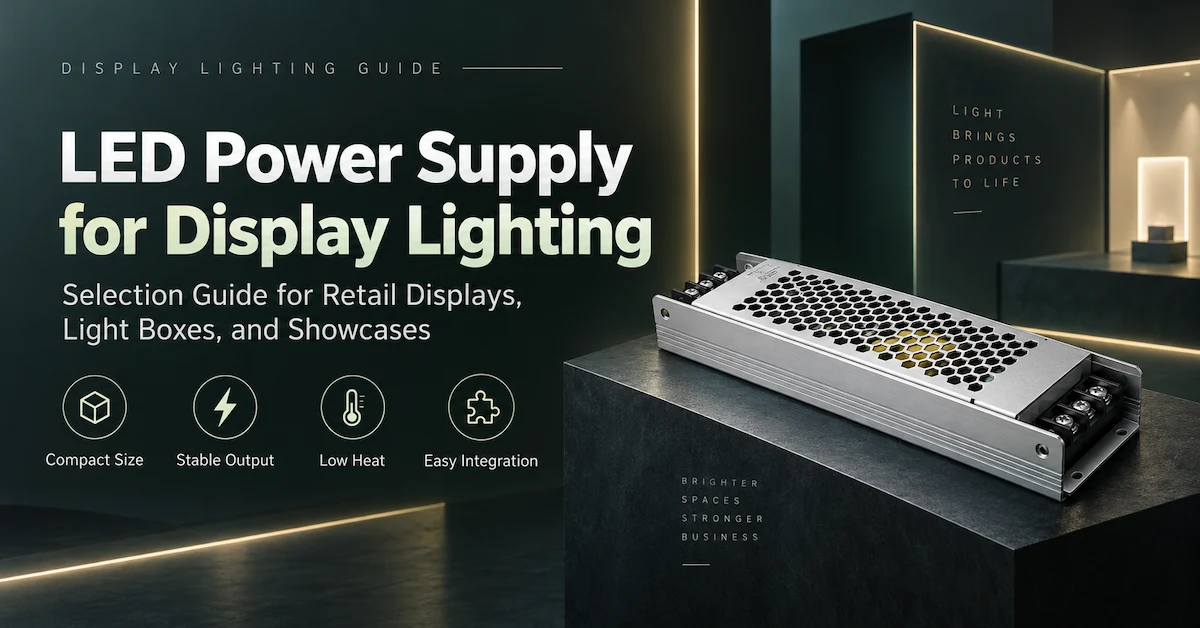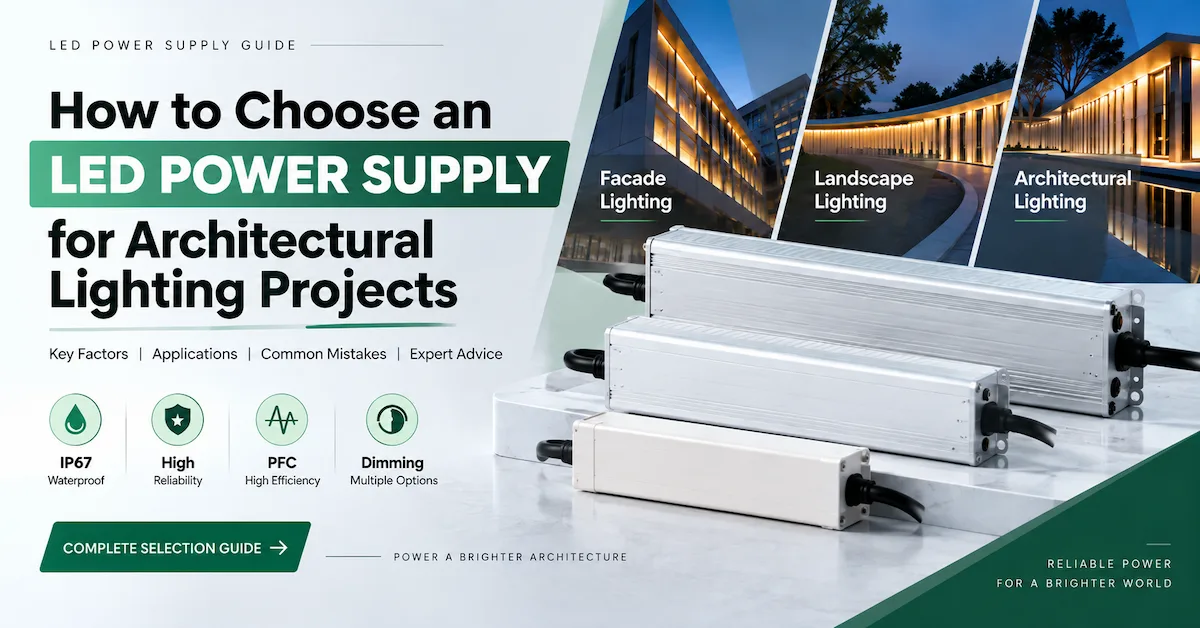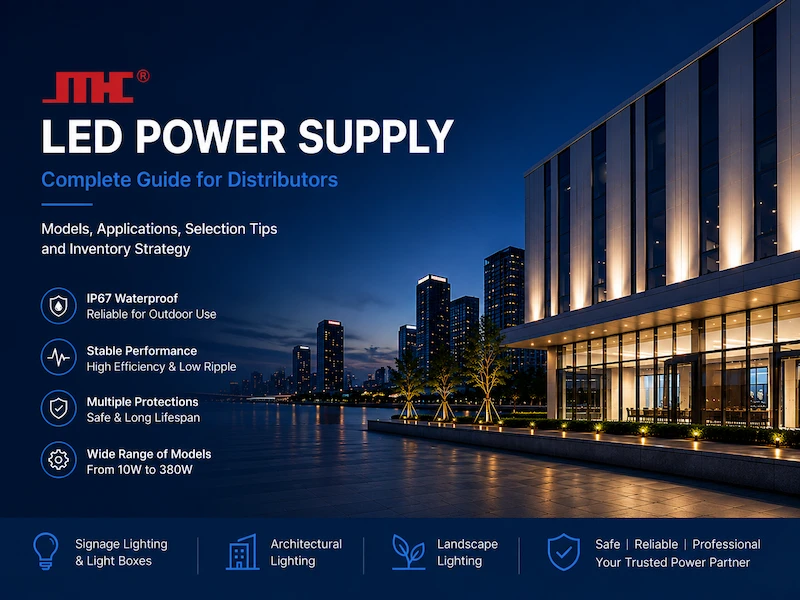
For lighting brands, project contractors, distributors, signage companies, and OEM buyers, LED power supply safety certified products are not only about meeting formal requirements. They directly affect import approval, market access, project acceptance, product safety, and long-term buyer trust.
A power supply may look suitable by voltage, wattage, and price, but without proper certification and quality control, buyers may face compliance problems, project delays, safety concerns, or after-sales risks. This is especially important for outdoor lighting, commercial lighting, advertising signboards, security monitoring, industrial control equipment, and private label LED products.
As a professional LED power supply manufacturer, JMHC provides LED switching power supplies for indoor lighting, outdoor lighting, landscape lighting, advertising signboards, commercial decoration, security monitoring, and industrial control applications. For global buyers, certified products help reduce risk before bulk orders and project installation.
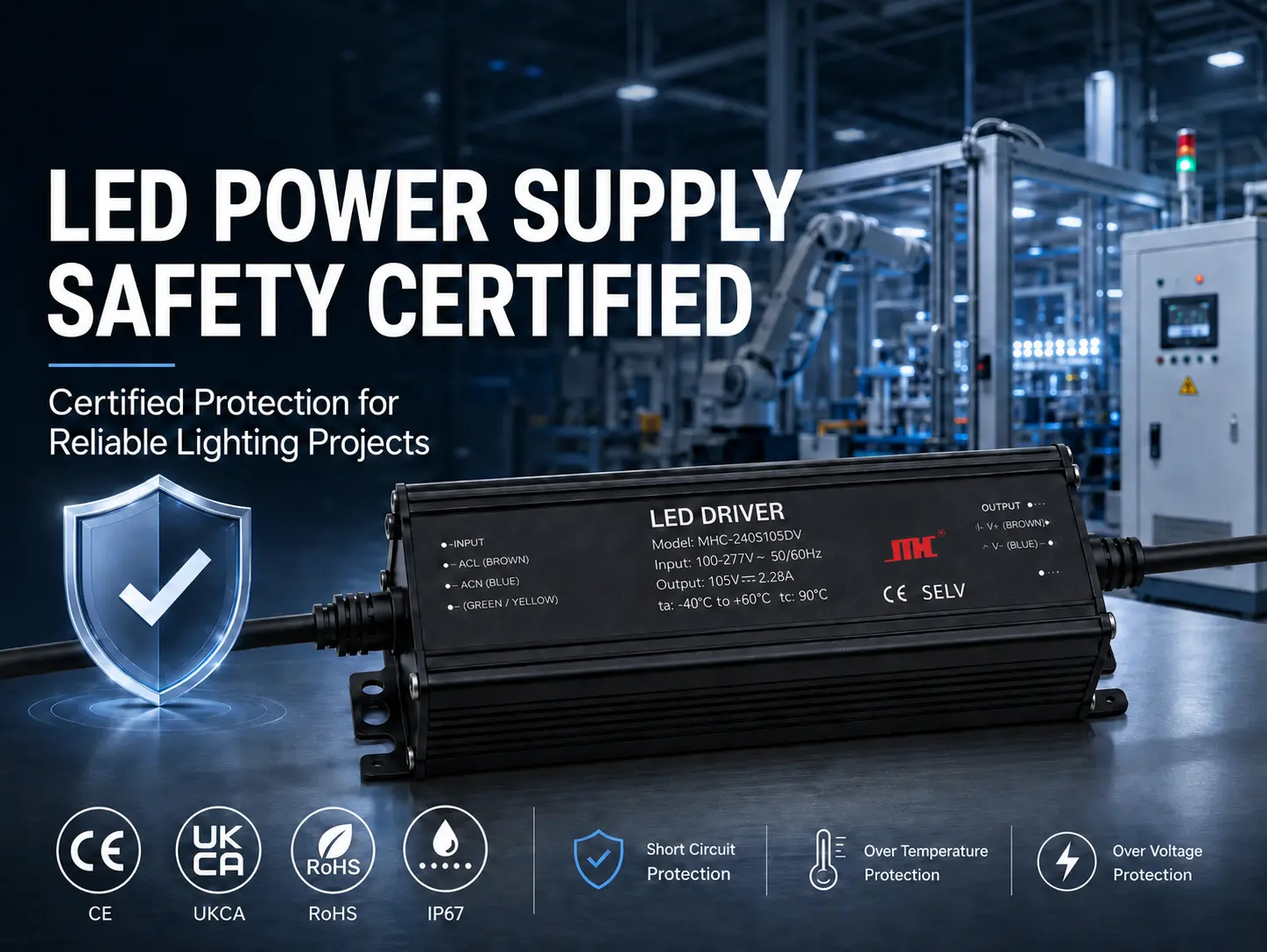
Why Safety Certification Matters for LED Power Supplies
Safety certification helps confirm that an LED power supply has been evaluated according to relevant electrical, safety, environmental, or market requirements. For B2B buyers, this is important because many lighting products need to enter different regional markets or be used in public, commercial, or industrial projects.
Safety-certified LED power supplies can help buyers:
- Reduce import and customs compliance risk
- Support distributor and retailer requirements
- Improve project approval confidence
- Reduce safety-related after-sales concerns
- Build trust with contractors and end customers
- Support OEM/private label product sales
- Avoid delays caused by missing documents
In many cases, buyers are not only purchasing a product. They are purchasing a power supply solution that must match the target market’s safety expectations.
What Certifications Should Buyers Check?
Different markets and applications may require different certifications. Buyers should not assume that one certificate is suitable for every region or project.
Common certification directions include:
| Certification / Standard Direction | What Buyers Usually Care About |
|---|---|
| CE | European market safety and compliance requirements |
| LVD | Low voltage safety requirements for electrical products |
| EMC | Electromagnetic compatibility and interference control |
| RoHS | Restriction of hazardous substances |
| UKCA | UK market compliance requirement |
| CCC | China compulsory certification for relevant products |
| BIS | India market certification requirement |
| IP Rating | Waterproof and dust protection level, such as IP67 |
| SELV | Safety extra-low voltage design consideration |
Before placing an order, buyers should confirm which certifications are required for their target market, application, and sales channel.
Safety Certified Does Not Mean Only Having a Logo
A common mistake is judging certification only by symbols printed on the label. For professional buyers, certification should be checked together with product model, technical documents, testing reports, and supplier reliability.
Before confirming bulk orders, buyers should ask:
- Does the selected model have valid certification?
- Does the certificate match the actual product series?
- Is the certification suitable for the target market?
- Can the supplier provide technical files or test reports?
- Will OEM customization affect certification validity?
- Is the product label consistent with the approved model?
- Are certified models available for stable bulk production?
This is especially important for OEM buyers who may need private labels, custom output specifications, or special packaging.
Safety Features Buyers Should Evaluate
Certification is important, but real safety also depends on product design and protection functions. A safety certified LED power supply should include protection mechanisms that reduce risk during abnormal use.
| Safety Feature | Buyer Benefit |
| Short-circuit protection | Helps reduce damage risk during wiring faults |
| Overload protection | Protects the power supply when the load is too high |
| Over-voltage protection | Helps prevent abnormal output from damaging LEDs |
| Over-temperature protection | Supports safer operation in high-heat environments |
| Self-recovery function | Helps restore operation after some fault conditions |
| Stable insulation design | Supports safer electrical performance |
| Proper grounding design | Improves safety in applicable installations |
These functions are especially important for outdoor lighting, industrial control, security monitoring, and commercial lighting projects where replacement is difficult or downtime is costly.
Application Scenarios for Safety Certified LED Power Supplies
Different applications have different safety and certification priorities. Buyers should match the power supply with both the technical environment and the compliance requirement.
| Application | Main Risk | Certification / Safety Focus |
| Indoor commercial lighting | Flicker, overheating, electrical safety | CE, EMC, LVD, RoHS |
| Outdoor landscape lighting | Rain, humidity, dust | IP67, waterproof design, safety protection |
| Advertising signboards | Long working hours, outdoor exposure | Certified waterproof LED driver |
| Architectural lighting | Difficult maintenance, public project use | Safety certification and stable output |
| Security monitoring | 24/7 operation | Reliable DC output and protection functions |
| Industrial control | Electrical stress, enclosed cabinets | Protection functions and thermal control |
| OEM lighting products | Private label sales and market access | Certification documents and model consistency |
JMHC’s LED power supply solutions help buyers match different power supply types with indoor, outdoor, signage, security, and industrial applications.
Why Testing and Aging Are Part of Safety
A certificate is not the only proof of product reliability. For bulk buyers, production testing and aging processes are also important. A product may pass a sample evaluation, but every batch still needs consistent quality control.
A reliable manufacturer should support strict inspection before shipment.
| QC Process | Why It Matters |
| Incoming material inspection | Controls component quality before production |
| Electrical performance testing | Confirms input and output stability |
| ATE testing | Improves testing accuracy and consistency |
| Full-load aging test | Helps reduce early failure risk |
| Temperature rise test | Checks thermal performance under operation |
| Protection function test | Verifies safety response under abnormal conditions |
| Waterproof inspection | Supports outdoor application reliability |
| Final inspection | Improves consistency before shipment |
JMHC introduces its manufacturing capability on the About Us page, including automatic vacuum glue filling production lines, ATE testing equipment, and full-load aging tests.
Certified LED Power Supply for Outdoor and Waterproof Projects
For outdoor projects, safety certification should be combined with waterproof protection. A power supply used outdoors may face rain, humidity, dust, temperature changes, and long working hours.
For applications such as landscape lighting, outdoor signage, architectural lighting, and garden lighting, buyers often need IP67 waterproof LED power supplies. However, IP rating alone is not enough. Buyers should also check the sealing structure, cable connection, potting process, housing material, and heat dissipation design.
Outdoor buyers should ask:
- Is the product suitable for outdoor use?
- What IP rating is available?
- Has the waterproof design been tested?
- Does the product have protection functions?
- Is there enough power margin?
- Can the supplier recommend the right series for the environment?
Buyers can compare different options through JMHC’s product center.
OEM/ODM Certification Considerations
Many lighting brands and distributors need private label LED power supplies. In this case, certification becomes more complex. Custom labels, packaging, cable length, output voltage, housing structure, or wattage may affect how certification should be handled.
Before starting an OEM project, buyers should confirm:
- Whether the existing certified model can support private label needs
- Whether custom specifications require additional testing
- Whether the label information matches compliance requirements
- Whether packaging must show certification information
- Whether technical files can be provided for distributors or project owners
JMHC supports OEM and ODM LED power supply requirements, including product matching, private label packaging, custom output specifications, sample evaluation, and bulk production support.
How to Choose a Safety Certified LED Power Supply Manufacturer
A good supplier should not only provide a product list. It should help buyers reduce technical and compliance risks.
Buyers should evaluate the supplier from these aspects:
| Supplier Evaluation Point | What to Check |
| Product range | Indoor, waterproof, mini, long-shape, PFC models |
| Certification support | CE, CCC, BIS, UKCA, RoHS and related directions |
| Testing capability | ATE testing, full-load aging, protection testing |
| Engineering support | Help with voltage, wattage, environment, and model selection |
| OEM/ODM ability | Label, packaging, cable, output specs, housing options |
| Bulk production capacity | Stable supply for repeat orders |
| Communication speed | Fast response for sample, documents, and quotation |
| Quality consistency | Batch inspection and shipment control |
For B2B buyers, these factors are more important than simply comparing the lowest price.
Common Mistakes When Buying Certified LED Power Supplies
Mistake 1: Only checking the label mark
The label mark should match the actual certified model and documentation.
Mistake 2: Ignoring target market requirements
A product suitable for one market may not automatically meet another market’s requirements.
Mistake 3: Using indoor models outdoors
Outdoor applications may need IP67 waterproof protection and stronger environmental resistance.
Mistake 4: Customizing without checking certification impact
OEM changes may affect certification, label information, or documentation needs.
Mistake 5: Skipping batch testing
Certification does not replace production quality control. Bulk orders still need testing and inspection.
Buyer Checklist Before Requesting a Quote
To get a suitable safety certified LED power supply recommendation, buyers should prepare:
| Information Needed | Example |
| Application | Indoor lighting, signage, outdoor lighting, industrial control |
| Target market | EU, UK, India, China, Southeast Asia |
| Required certification | CE, UKCA, BIS, CCC, RoHS, IP67 |
| Input voltage | 100–240VAC |
| Output voltage | 12V / 24V / 36V / 48V |
| Total wattage | 60W / 120W / 240W |
| Installation environment | Indoor, outdoor, humid, dusty, enclosed |
| Working hours | 8 hours, 12 hours, 24/7 |
| Order quantity | Sample order or bulk order |
| OEM requirement | Label, packaging, cable, housing, output specification |
Providing complete information helps the supplier recommend the right certified model and avoid compliance problems later.
Why Choose JMHC for Safety Certified LED Power Supplies?
JMHC focuses on LED switching power supplies and provides solutions for lighting brands, contractors, signage companies, distributors, security system integrators, industrial equipment buyers, and OEM customers.
For buyers looking for LED power supply safety certified products, JMHC can support:
- Application-based product selection
- Certified LED power supply options
- IP67 waterproof series for outdoor projects
- Stable output and low temperature rise design
- Full-load aging tests
- ATE testing equipment
- OEM/ODM customization support
- Certification support for export markets
- Bulk production and long-term cooperation
Instead of only choosing by price, buyers can work with JMHC to select products based on target market, installation environment, safety requirement, and long-term supply plan.
FAQ
1. What does LED power supply safety certified mean?
It means the LED power supply has relevant certification or compliance support for safety, environmental, EMC, waterproof, or market access requirements, depending on the target application and region.
2. Which certifications should LED power supply buyers check?
Buyers may need CE, LVD, EMC, RoHS, UKCA, CCC, BIS, IP rating, or other market-specific certifications depending on the application and sales region.
3. Is a logo on the label enough to prove certification?
No. Buyers should check whether the certificate, test report, product model, and label information are consistent.
4. Do outdoor LED power supplies need safety certification?
Outdoor power supplies should be evaluated for both safety compliance and environmental protection, such as IP67 waterproof design, depending on the project.
5. Can OEM customization affect certification?
Yes. Changes to voltage, wattage, housing, cable, label, or internal design may affect certification or documentation requirements.
6. Why is full-load aging important for certified products?
Full-load aging helps detect early failures before shipment and supports better reliability in bulk orders.
7. Can JMHC provide safety certified LED power supplies for export?
Yes. JMHC supports certified LED power supply options and can help buyers match products with target market requirements.
8. What applications need certified LED power supplies?
Indoor lighting, outdoor lighting, signage, architectural lighting, security monitoring, industrial control, and OEM lighting products often require certified power supplies.
9. What information should I provide for a quote?
You should provide application, target market, required certifications, input voltage, output voltage, wattage, environment, quantity, and customization details.
10. How can I start a certified LED power supply project with JMHC?
You can send your requirements through the JMHC contact page. JMHC can recommend suitable certified LED power supply options for sample testing and bulk production.
Conclusion
Choosing LED power supply safety certified products is essential for buyers who care about compliance, safety, reliability, and market access. Certifications help reduce import, distribution, and project approval risks, while testing and quality control help ensure stable real-world performance.
JMHC provides LED power supply solutions for indoor lighting, outdoor lighting, signage, architectural lighting, security monitoring, industrial control, and OEM applications. If you need a safety certified LED power supply for your project or product line, you can contact JMHC with your application, target market, voltage, wattage, certification needs, quantity, and customization requirements.