For OEM lighting brands, choosing the right LED power supply for OEM lighting brands is not only about matching voltage and wattage. It affects product reliability, brand reputation, certification compliance, after-sales cost, and long-term supply stability.
A lighting brand may invest heavily in fixture design, LED modules, packaging, marketing, and channel development. But if the LED power supply fails, flickers, overheats, or lacks proper certification, the entire product line can face complaints, returns, project delays, and buyer distrust.
That is why OEM buyers need more than a standard product supplier. They need a professional LED power supply manufacturer that can support stable product quality, private label requirements, application matching, testing, certification support, and scalable production.
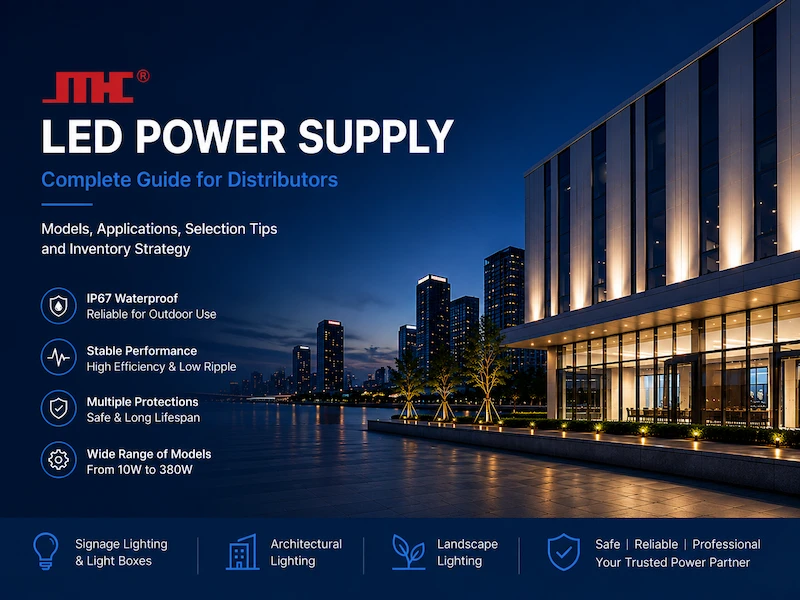
JMHC provides LED switching power supplies for indoor lighting, outdoor lighting, signage, architectural lighting, commercial decoration, security monitoring, industrial control, and OEM lighting applications.
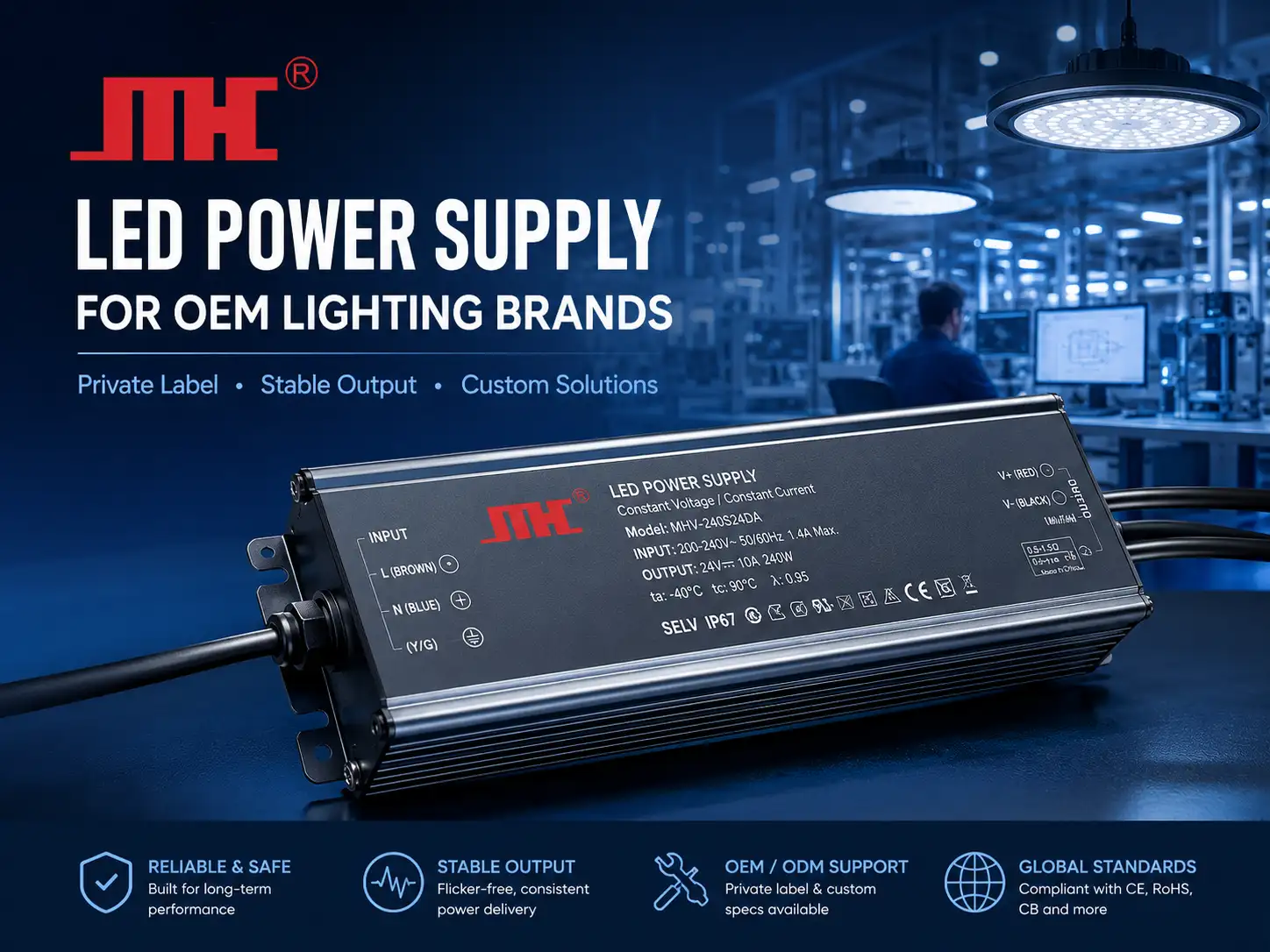
Why OEM Lighting Brands Need the Right LED Power Supply Partner
OEM lighting brands usually sell products under their own brand name. This means the final customer often does not see the power supply manufacturer. If the lighting product fails, the complaint goes directly to the OEM brand.
For this reason, power supply selection has a direct impact on:
- Brand reputation
- Product warranty cost
- Repeat order confidence
- Distributor trust
- Project acceptance
- Certification compliance
- Long-term product stability
- After-sales response pressure
A low-cost power supply may reduce the initial purchase price, but it can create higher total cost if it causes flicker, overheating, early failure, or certification problems after shipment.
What OEM Buyers Should Look for in an LED Power Supply
An OEM LED power supply should support more than basic electrical output. It should fit the product design, target market, application environment, and brand strategy.
| OEM Requirement | Why It Matters |
|---|---|
| Stable output | Reduces flicker and brightness fluctuation |
| Low ripple performance | Improves visual comfort and product quality |
| Long service life | Reduces warranty and replacement costs |
| Safety certification | Supports export, distribution, and project approval |
| Private label support | Helps build brand identity |
| Custom specifications | Matches fixture design and application needs |
| Batch consistency | Ensures stable quality in repeat orders |
| Engineering support | Helps avoid wrong model selection |
| Bulk production capacity | Supports long-term supply planning |
OEM buyers should choose a supplier that understands both electrical performance and commercial manufacturing requirements.
Common OEM Lighting Applications
Different lighting products require different power supply designs. A driver for indoor commercial lighting may not be suitable for outdoor signage or landscape lighting.
| OEM Lighting Product | Main Requirement | Suitable Power Supply Direction |
| LED strip lighting | Constant voltage, compact size | Indoor or waterproof LED power supply |
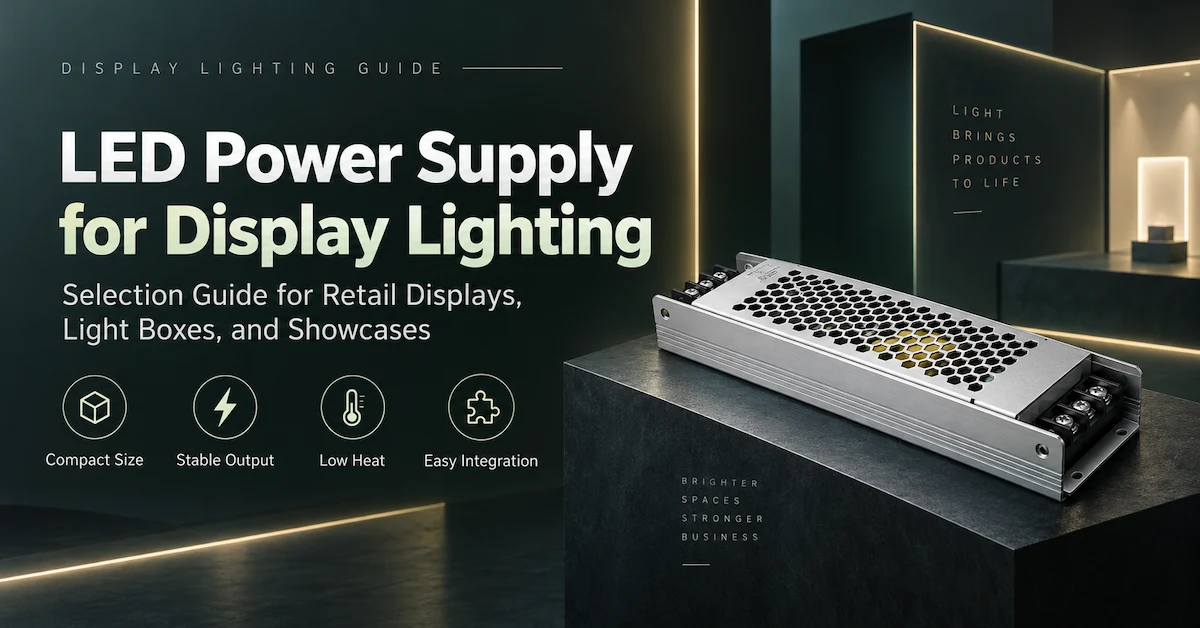
| Light boxes | Small size, stable output | Mini LED power supply |
| Commercial fixtures | Low ripple, stable brightness | IP20 indoor LED power supply |
| Outdoor lighting | Waterproof and dust protection | IP67 waterproof LED power supply |
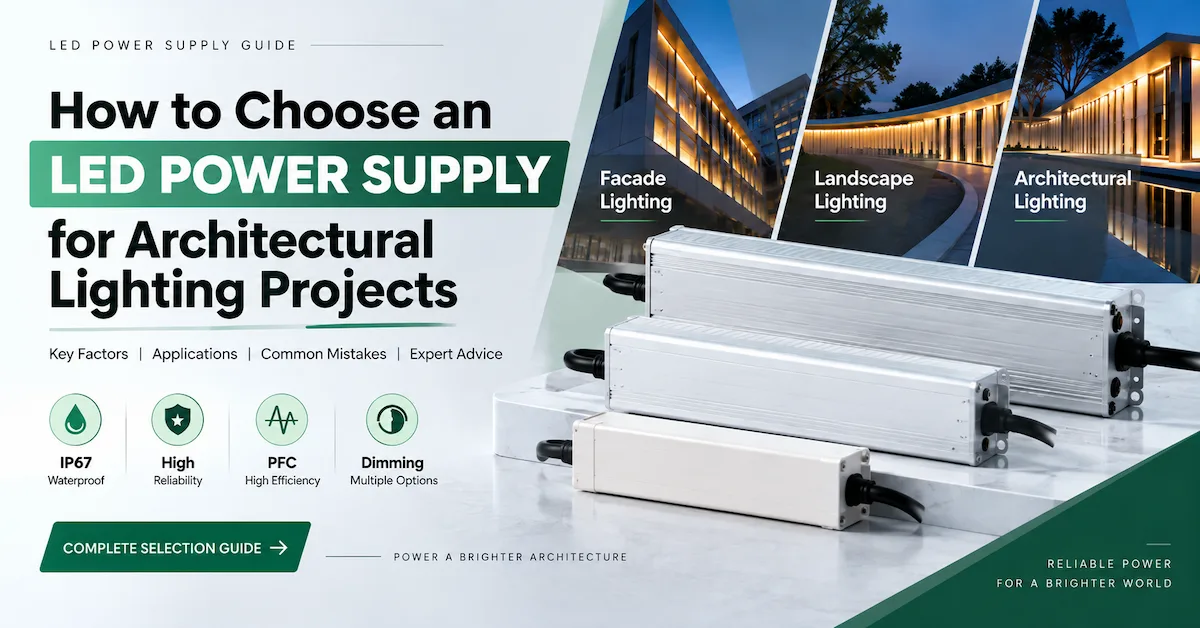
| Architectural lighting | Long service life, batch consistency | Waterproof or PFC LED power supply |
| Signage products | Continuous operation, low maintenance | Long-shape or waterproof power supply |
| Smart lighting products | Compatibility and stable output | Customized LED power supply |
| Industrial lighting | Protection functions and durability | Industrial-grade power supply |
Buyers can review different product directions through JMHC’s product center.
Key Factors When Choosing LED Power Supply for OEM Lighting Brands
1. Stable Output and Low Ripple
For OEM lighting brands, output stability directly affects final product quality. If the LED power supply has high ripple or unstable output, the lighting fixture may flicker, dim unevenly, or reduce LED lifespan.
Low ripple output is especially important for:
- Office lighting
- Retail display lighting
- Hotel lighting
- Commercial lighting
- OEM indoor fixtures
- Advertising signage
- Architectural lighting
A stable LED power supply helps improve user experience and reduce customer complaints. OEM buyers should ask whether the product has been tested under full-load operation and whether output stability is consistent across bulk orders.
2. Correct Wattage and Power Margin
Choosing the correct wattage is not simply matching the exact load. If the LED load is 100W, using a 100W power supply at full capacity for long periods may increase heat and reduce service life.
For OEM lighting products, a reasonable power margin helps improve long-term reliability. The right margin depends on working hours, installation environment, heat dissipation, cable length, and target application.
Before asking for a quotation, OEM buyers should prepare:
- Input voltage
- Output voltage
- Total LED load
- Working hours
- Indoor or outdoor use
- Installation space
- Dimming requirement
- Certification needs
- Expected order quantity
Complete information allows the supplier to recommend a more accurate model.
3. Safety Certification for Target Markets
OEM lighting brands often sell products to different regions. Certification requirements may vary by market, distribution channel, and application.
Safety-certified LED power supplies can help reduce compliance risk and support smoother sales in export markets. Buyers may need to check CE, CCC, BIS, UKCA, RoHS, EMC, LVD, IP rating, or other certification directions depending on the target market.
Before choosing a model, buyers should confirm:
- Which certification is required in the target market?
- Does the selected model already support certification?
- Can technical documents be provided?
- Will private label customization affect compliance?
- Can certified models be supplied consistently for repeat orders?
Certification support is especially important for distributors, project contractors, and brand owners who need reliable documentation.
4. Private Label and Packaging Support
OEM buyers often need their own logo, label, packaging, and product information. A good supplier should support private label requirements while keeping technical information accurate and compliant.
Common OEM customization needs include:
| Custom Item | OEM Buyer Benefit |
| Product label | Supports brand identity and model management |
| Packaging | Improves retail or distributor presentation |
| Output voltage | Matches fixture design |
| Wattage | Fits product series planning |
| Cable length | Improves installation convenience |
| Housing structure | Fits space and thermal requirements |
| Certification marking | Supports compliance communication |
| User documentation | Helps distributors and installers |
When customization is involved, OEM buyers should confirm whether changes affect certification, production lead time, or minimum order quantity.
Why Quality Control Is Critical for OEM Orders
One sample working well does not guarantee bulk order reliability. OEM lighting brands need consistent quality across repeated production batches.
A reliable LED power supply manufacturer should use structured testing and inspection processes.
| QC Process | Why It Matters for OEM Buyers |
| Incoming material inspection | Reduces component quality variation |
| Electrical testing | Confirms input and output performance |
| ATE testing | Improves accuracy and batch consistency |
| Full-load aging test | Helps reduce early failure risk |
| Temperature rise test | Checks thermal stability |
| Protection function test | Confirms safety response |
| Waterproof inspection | Supports outdoor product reliability |
| Final inspection | Improves order consistency before shipment |
JMHC introduces its manufacturing capability on the About Us page, including automatic vacuum glue filling production lines, ATE testing equipment, and full-load aging tests.
For OEM buyers, these processes reduce the risk of warranty claims and repeat-order quality problems.
OEM LED Power Supply for Indoor and Outdoor Lighting
OEM brands often need different power supply types for different product lines.
Indoor lighting products usually focus on compact size, stable output, low ripple, low noise, and cost-effective installation. Outdoor lighting products need stronger waterproof protection, sealing structure, heat dissipation, and long-term durability.
| Product Line | Recommended Focus |
| Indoor commercial lighting | Stable output, low ripple, IP20 design |
| Outdoor lighting fixtures | IP67 waterproof protection |
| Signage and light boxes | Compact or long-shape structure |
| Architectural lighting | Long service life and consistent output |
| Smart lighting systems | Compatibility and stable DC output |
| Industrial lighting | Protection functions and low temperature rise |
JMHC’s LED power supply solutions help buyers match product series with different lighting applications.
How a Reliable Supplier Helps OEM Lighting Brands Grow
A strong power supply partner does more than provide products. It helps OEM lighting brands reduce development risk and improve speed to market.
A reliable supplier can support:
- Product selection for new lighting lines
- Sample testing and evaluation
- Technical parameter matching
- Label and packaging customization
- Certification planning
- Bulk order production
- Repeat order consistency
- Long-term product upgrade support
This matters because OEM lighting brands often need to launch product series, not just purchase one model. A supplier with stable manufacturing capacity and engineering support can help buyers build a more reliable product portfolio.
Common Mistakes OEM Buyers Should Avoid
Mistake 1: Choosing only by the lowest price
A cheaper LED power supply may increase warranty cost if it causes flicker, overheating, or early failure.
Mistake 2: Ignoring certification requirements
A product without proper certification support may create export, distribution, or project approval problems.
Mistake 3: No power margin
Running a power supply at full load for long periods may reduce service life.
Mistake 4: Customizing labels without checking compliance
Private label changes should still match technical specifications and certification documents.
Mistake 5: Skipping sample testing
Sample testing helps verify output stability, temperature rise, installation fit, ripple performance, and compatibility.
Mistake 6: Not evaluating supplier capacity
OEM buyers need stable supply, repeat order support, and batch consistency.
Buyer Checklist Before Requesting an OEM Quote
To get the right LED power supply recommendation, OEM lighting brands should prepare:
| Information Needed | Example |
| Product application | Indoor lighting, signage, outdoor fixture |
| Input voltage | 100–240VAC |
| Output voltage | 12V / 24V / 36V / 48V |
| Total wattage | 60W / 120W / 240W |
| Power type | Constant voltage or constant current |
| Installation environment | Indoor, outdoor, humid, enclosed |
| Waterproof requirement | IP20 / IP67 |
| Dimming requirement | 0-10V, PWM, TRIAC, non-dimming |
| Certification needs | CE, UKCA, BIS, RoHS, CCC |
| OEM requirements | Label, logo, packaging, cable, housing |
| Order quantity | Sample order and bulk order forecast |
Clear information helps the supplier provide accurate recommendations, quotation, and production planning.
Why Choose JMHC for OEM LED Power Supply Projects?
JMHC focuses on LED switching power supplies and supports product solutions for lighting brands, contractors, signage companies, distributors, security system integrators, industrial buyers, and OEM customers.
For buyers looking for LED power supply for OEM lighting brands, JMHC can support:
- Application-based product selection
- Stable output LED power supply options
- Low ripple design direction
- IP67 waterproof power supply series
- Safety certification support
- ATE testing equipment
- Full-load aging tests
- Private label and packaging support
- OEM/ODM customization
- Bulk production and repeat order supply
Instead of choosing a random standard model, OEM buyers can work with JMHC to select a power supply based on product line planning, application environment, voltage, wattage, certification needs, and brand requirements.
FAQ
1. What is an LED power supply for OEM lighting brands?
It is an LED power supply selected or customized for lighting brands that sell products under their own brand name, often requiring stable performance, private label support, certification, and bulk supply consistency.
2. Why do OEM lighting brands need reliable LED power supplies?
Because power supply failure can lead to flicker, overheating, warranty claims, customer complaints, and damage to brand reputation.
3. Can JMHC support private label LED power supplies?
Yes. JMHC supports OEM and ODM requirements such as private label, packaging, custom voltage, wattage, cable, housing, and product matching.
4. What certifications should OEM buyers check?
OEM buyers should check certification requirements based on target markets, such as CE, CCC, BIS, UKCA, RoHS, EMC, LVD, and IP rating.
5. Is low ripple output important for OEM lighting products?
Yes. Low ripple output helps reduce flicker, improve visual comfort, and support stable product performance.
6. Should OEM buyers test samples before bulk orders?
Yes. Sample testing helps verify output stability, temperature rise, installation fit, certification needs, and compatibility with the final lighting product.
7. What information should I provide for an OEM quote?
You should provide application, input voltage, output voltage, wattage, waterproof requirement, dimming needs, certification needs, label requirements, packaging needs, and expected order quantity.
8. Can JMHC support waterproof LED power supplies for OEM outdoor lighting?
Yes. JMHC provides IP67 waterproof LED power supply options for outdoor lighting, signage, landscape lighting, and other exposed applications.
9. How does full-load aging help OEM buyers?
Full-load aging helps detect early failures before shipment, improving reliability and reducing after-sales risk in bulk orders.
10. How can I start an OEM LED power supply project with JMHC?
You can send your technical and branding requirements through the JMHC contact page. JMHC can recommend suitable models for sample testing and bulk production.
Conclusion
Choosing the right LED power supply for OEM lighting brands is essential for stable product quality, brand reputation, certification compliance, and long-term customer satisfaction. OEM buyers should evaluate output stability, ripple performance, power margin, safety certification, waterproof design, testing process, customization support, and manufacturer capability before placing bulk orders.
JMHC provides LED power supply solutions for indoor lighting, outdoor lighting, signage, architectural lighting, commercial lighting, security monitoring, industrial control, and OEM lighting products.
If you need an OEM LED power supply partner for your lighting brand, you can contact JMHC with your product application, voltage, wattage, target market, certification needs, label requirements, and order quantity.