
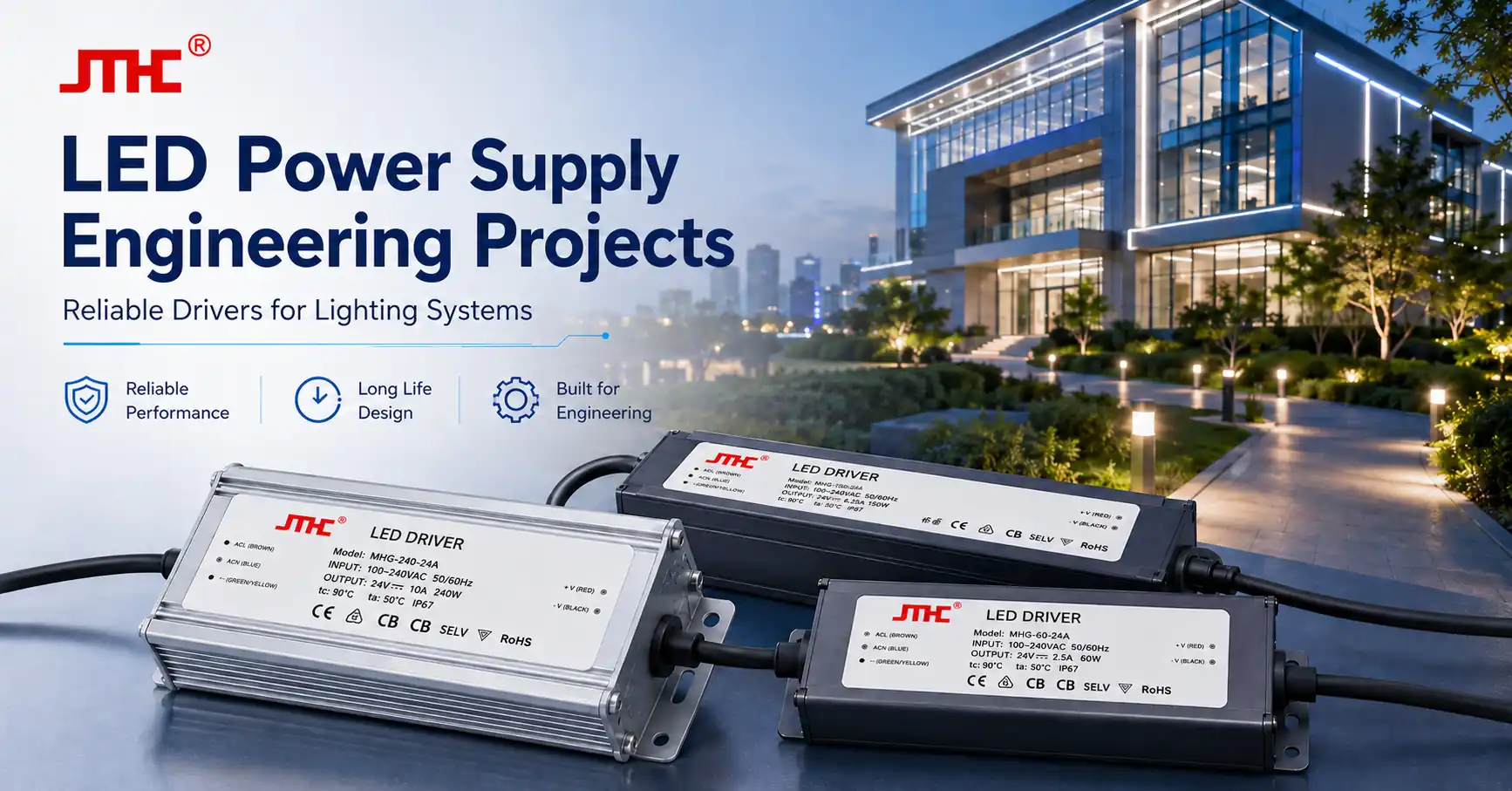
For LED power supply engineering projects, choosing the right driver is not only about wattage. Engineering buyers need to evaluate output stability, installation environment, waterproof rating, heat dissipation, safety protection, certification, and long-term supply reliability.
A power supply that works in a simple test may still fail in a real project if it is exposed to rain, dust, high temperature, long operating hours, or unstable loads. This is why contractors, lighting brands, signage companies, and project integrators often prefer to work with a professional LED power supply manufacturer instead of buying only by price.
JMHC provides LED switching power supplies for lighting, signage, architectural, commercial, security, and industrial applications. For engineering projects, the key is matching the right power supply series to the real installation conditions.
Why Engineering Projects Need Professional LED Power Supply Selection
Engineering projects usually involve larger installation areas, longer operating time, and higher maintenance costs than ordinary small lighting applications. Once the power supply fails, the cost is not limited to replacing one unit. Buyers may need to pay for labor, site access, equipment rental, project delay, or customer complaints.
Common risks in lighting engineering projects include:
- Outdoor power supplies damaged by rain or moisture
- LED lights flickering because of unstable output
- Overheating inside sealed light boxes or narrow spaces
- Wrong wattage selection causing overload
- Certification problems in export or public projects
- Inconsistent quality between bulk order batches
- Difficult maintenance after installation
A reliable engineering LED power supply should reduce these risks from the beginning of the project.
Main Applications of LED Power Supply Engineering Projects
Different engineering projects require different power supply designs. A product used for indoor commercial lighting may not be suitable for outdoor building facade lighting. A power supply for a light box may need a smaller size, while a power supply for landscape lighting may need stronger waterproof protection.
| Engineering Application | Working Environment | Key Requirement | Recommended Direction |
|---|---|---|---|
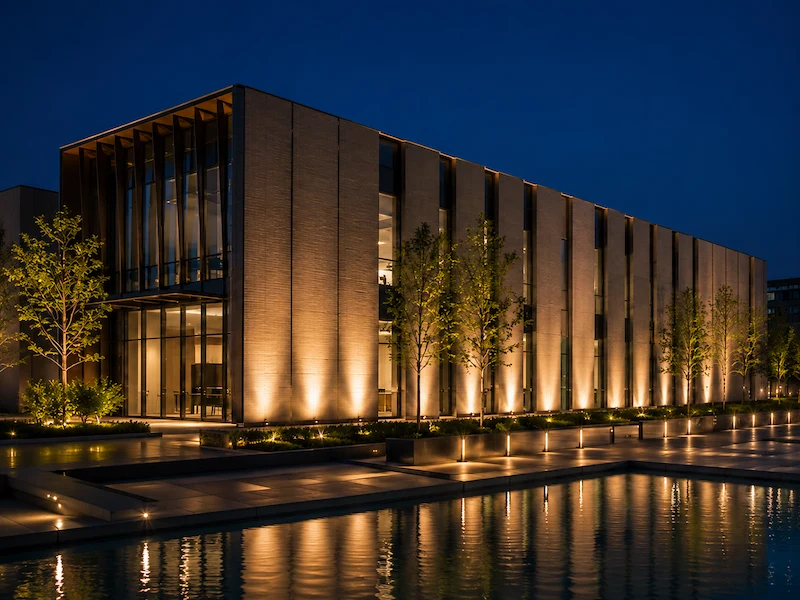
| Architectural lighting | Building facade, bridges, public spaces | Stable brightness, waterproof design, long service life | IP67 waterproof LED power supply |
| Landscape lighting | Parks, gardens, hotels, outdoor areas | Moisture resistance, low temperature rise | Waterproof power supply series |
| Advertising signboards | Light boxes, signs, channel letters | Continuous operation, compact installation | Mini or long-shape LED power supply |
| Commercial lighting | Shopping malls, hotels, offices | Low ripple, stable output, safety protection | Indoor IP20 LED power supply |
| Security monitoring | CCTV, access control, outdoor monitoring | 24/7 stable DC output | Reliable switching power supply |
| Industrial control | Control cabinets, automation equipment | Protection functions, consistent output | Industrial-grade LED power supply solution |
For buyers who need to compare different product types, JMHC’s product center provides waterproof, indoor, mini, long-shape, PFC, and project-based power supply options.
Key Factors When Choosing LED Power Supply for Engineering Projects
1. Match Wattage With Enough Power Margin
For engineering projects, wattage selection should not be calculated too tightly. If the LED load is close to the maximum output of the power supply for a long time, the driver may run hotter and age faster.
A safer method is to calculate the total LED load and leave a reasonable power margin. For example, if the actual LED load is 80W, buyers should not simply choose an 80W power supply. A higher-rated model may provide better long-term stability, especially in outdoor or enclosed environments.
When requesting a quote, buyers should provide:
- Input voltage
- Output voltage
- Total LED load
- Installation environment
- Working hours per day
- Indoor or outdoor use
- Dimming requirement
- Certification needs
This helps the supplier recommend a more suitable power supply for the project.
2. Choose the Right Waterproof Rating
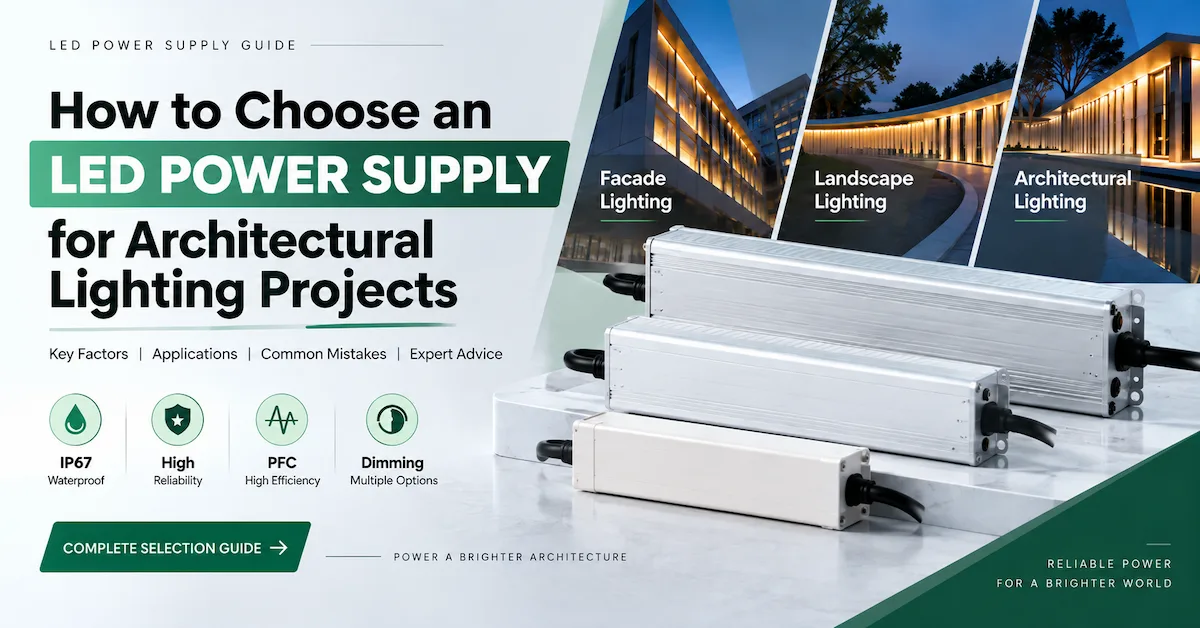
Outdoor LED power supply engineering projects usually require waterproof protection. For landscape lighting, architectural lighting, outdoor signage, and public lighting, IP67 waterproof design is often recommended.
However, waterproof performance is not only about the rating. Buyers should also consider the housing structure, sealing process, glue filling, cable connection, and heat dissipation. If the product is installed outdoors or in humid areas, poor waterproof protection can cause failure, corrosion, leakage risk, or unstable operation.
JMHC offers IP67 waterproof LED power supply options for outdoor and engineering lighting applications. Buyers can review waterproof product directions through JMHC’s LED power supply solutions.
3. Check Output Stability and Ripple Control
Stable output is important for both visual performance and product life. If the output voltage fluctuates, LED lights may flicker, dim unevenly, or experience shortened lifespan.
For commercial lighting and indoor projects, low ripple output helps reduce visible flicker and improve user experience. For outdoor signage and architectural lighting, stable output helps keep brightness consistent across long operating hours.
Before choosing a supplier, buyers should ask:
- Is the output voltage stable under full load?
- Does the product support long-hour operation?
- What protection functions are included?
- Has the driver passed aging tests?
- Is the product suitable for the actual LED load?
These questions help buyers avoid choosing a power supply that only looks suitable on paper.
4. Evaluate Heat Dissipation and Installation Space
Heat is one of the most common reasons for LED power supply failure. In engineering projects, drivers may be installed inside light boxes, cabinets, ceilings, outdoor enclosures, or narrow channels. These environments may limit air circulation.
A good LED power supply should have proper thermal design, efficient components, and a suitable housing structure. Aluminum housing, long-shape structure, and correct installation spacing can help improve heat dissipation.
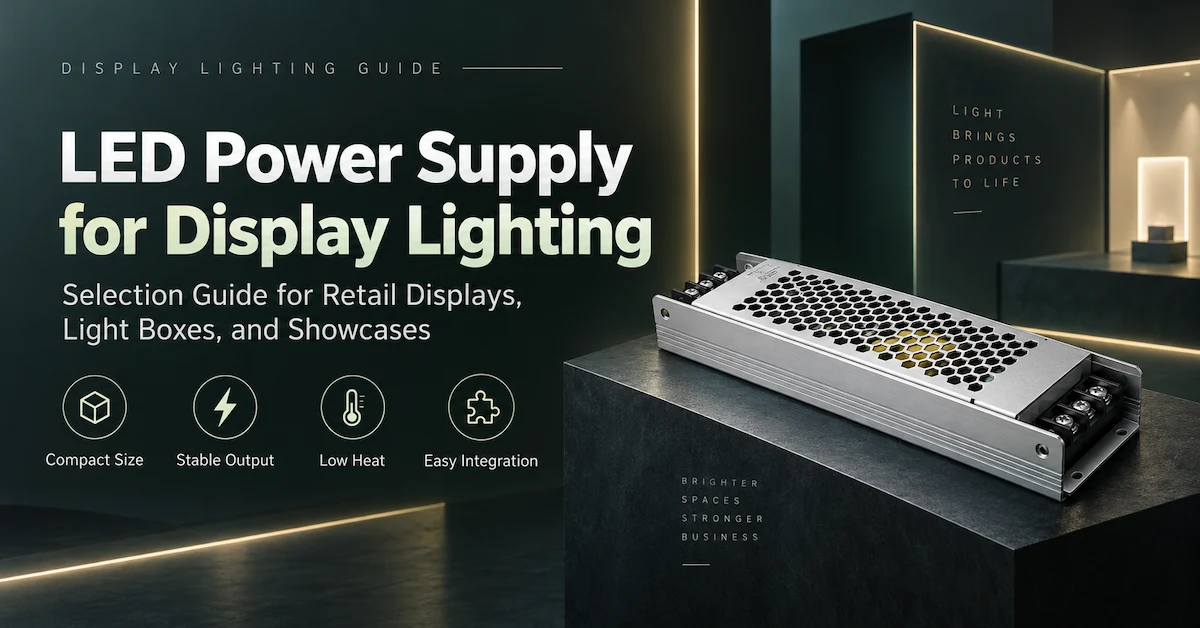
For narrow installation spaces or linear lighting systems, buyers may consider long-shape LED power supplies. For light boxes or compact signage applications, mini power supplies may be more suitable.
5. Confirm Safety Protection Functions
Engineering projects need stable and safe operation. A professional LED power supply should include protection functions such as:
- Short-circuit protection
- Overload protection
- Over-voltage protection
- Over-temperature protection where applicable
- Self-recovery function depending on model design
These functions help protect both the power supply and the connected LED system. For projects with difficult maintenance access, protection functions can reduce replacement risk and improve long-term reliability.
How JMHC Supports LED Power Supply Engineering Projects
JMHC focuses on LED switching power supplies and provides solutions for different lighting and engineering applications. As a manufacturer integrating design, R&D, production, and sales, JMHC supports both standard product supply and project-based selection.
For engineering buyers, JMHC can help match the correct product direction based on application, wattage, voltage, installation space, waterproof requirement, and certification needs.
JMHC’s power supply product range includes:
| Product Direction | Main Feature | Best For |
| IP67 waterproof LED power supply | Waterproof, dust-resistant, stable output | Outdoor lighting, landscape lighting, signage |
| PFC LED power supply | Higher power factor, efficient operation | Commercial and engineering lighting |
| Mini power supply | Compact size, easy installation | Light boxes, small signage, display lighting |
| Long-shape LED power supply | Slim structure, better fit for narrow spaces | Linear lighting, cabinets, architectural lighting |
| Indoor IP20 power supply | Cost-effective, stable indoor operation | Offices, stores, hotels, indoor decoration |
| Custom LED power supply | OEM/ODM support | Lighting brands and project-based buyers |
For company background, production strength, and quality control capabilities, buyers can visit JMHC’s About Us page.
Quality Control Matters More in Bulk Engineering Orders
For engineering projects, sample testing is only the first step. The real challenge is batch consistency. A supplier must be able to deliver stable quality across hundreds or thousands of units.
A reliable manufacturer should have a clear quality control process, including material inspection, electrical testing, full-load aging, and pre-shipment inspection.
Important quality checks include:
| QC Process | Why It Matters |
| Input/output testing | Confirms electrical performance |
| Full-load aging test | Reduces early failure risk |
| Temperature rise test | Checks thermal stability |
| Protection function test | Improves safety and reliability |
| Waterproof inspection | Supports outdoor project reliability |
| Batch inspection | Improves consistency in bulk orders |
For contractors and lighting brands, these processes can reduce after-sales problems and protect project reputation.
Certification and Market Compliance
For export projects, certification is often a key buying factor. Engineering buyers may need certified products for public projects, commercial buildings, regional distributors, or lighting system approvals.
A suitable LED power supply supplier should provide certification support based on the target market. JMHC power supplies cover certification directions such as CE, CCC, BIS, UKCA, and RoHS, supporting global project and distribution requirements.
Before placing an order, buyers should confirm:
- Which certifications are required for the market?
- Are certified models available?
- Does customization affect certification?
- Can the supplier provide technical documents?
- Are products suitable for public or commercial engineering projects?
This helps avoid compliance issues after project delivery.
OEM and ODM Support for Engineering Buyers
Some engineering projects need special voltage, wattage, label, housing, cable length, or packaging requirements. Lighting brands may also need private label support for long-term product lines.
JMHC supports OEM and ODM LED power supply requirements, including:
- Customized output voltage and wattage
- Private label and packaging
- Product series matching
- Project-based power supply recommendation
- Sample evaluation support
- Certification preparation
- Stable mass production
- Long-term supply cooperation
For buyers who need a customized LED power supply for engineering projects, early technical communication is important. The more complete the project information, the easier it is to recommend the correct model.
Common Mistakes in LED Power Supply Engineering Projects
Many project problems come from early selection mistakes. Buyers should avoid the following issues:
Mistake 1: Choosing only by price
Low unit price may increase maintenance cost if the product fails after installation.
Mistake 2: No power margin
Running the power supply close to maximum load for long hours can increase temperature and reduce lifespan.
Mistake 3: Wrong waterproof level
Using an indoor power supply outdoors can lead to moisture damage and safety risks.
Mistake 4: Ignoring heat dissipation
A driver installed in a sealed or narrow space needs better thermal planning.
Mistake 5: Not checking certifications
Wrong certification can delay export, installation, or project approval.
Mistake 6: No sample testing
Sample testing helps verify brightness stability, temperature rise, installation fit, and compatibility before bulk order.
Buyer Checklist Before Requesting a Quote
Before contacting a supplier, prepare the following project information:
| Information Needed | Example |
| Application | Landscape lighting, signage, indoor lighting |
| Input voltage | 100–240VAC |
| Output voltage | 12V / 24V / 36V / 48V |
| Total load | 60W / 120W / 240W |
| Environment | Indoor, outdoor, humid, enclosed |
| Waterproof requirement | IP20 / IP67 |
| Quantity | Sample order or bulk order |
| Certification | CE, UKCA, BIS, RoHS, CCC |
| Custom need | Label, cable, housing, packaging |
| Project timeline | Sample date and mass delivery date |
This information allows the supplier to provide a more accurate recommendation and quotation.
FAQ
1. What is an LED power supply engineering project?
An LED power supply engineering project refers to lighting or electrical applications that require project-based driver selection, such as architectural lighting, landscape lighting, advertising signboards, commercial lighting, security monitoring, and industrial control.
2. How do I choose the right LED power supply for an engineering project?
You should consider input voltage, output voltage, wattage, load margin, waterproof rating, heat dissipation, certification, installation space, and working environment.
3. Is IP67 necessary for outdoor LED lighting projects?
IP67 is recommended for many outdoor lighting projects because the power supply may face rain, moisture, dust, and temperature changes. The final choice depends on the installation location and exposure level.
Why Work With JMHC for Engineering LED Power Supply Projects?
JMHC provides LED power supply products and project-based support for lighting brands, contractors, distributors, and OEM buyers. The company’s product direction covers indoor, outdoor, compact, long-shape, waterproof, and PFC power supplies, making it easier for buyers to match different engineering scenarios.
For buyers working on LED power supply engineering projects, JMHC can support product selection, sample testing, technical communication, OEM/ODM customization, and bulk production.
If you are planning an outdoor lighting project, signage project, architectural lighting system, or commercial lighting installation, you can contact JMHC to discuss suitable LED power supply options.