Choosing the right LED driver manufacturer is one of the most important sourcing decisions for lighting brands, fixture manufacturers, distributors, contractors, and OEM buyers. The driver controls power stability, brightness consistency, thermal performance, safety protection, and long-term reliability across the complete lighting system.
A supplier may offer a competitive quotation and an acceptable sample, but that does not automatically prove its ability to support repeated production, certified products, customized specifications, or demanding lighting projects.
For B2B buyers, the goal is not simply to find a driver that turns the light on. The goal is to work with a manufacturer that can help reduce flicker, overheating, waterproof failure, certification risk, inconsistent batches, delivery delays, and after-sales costs.
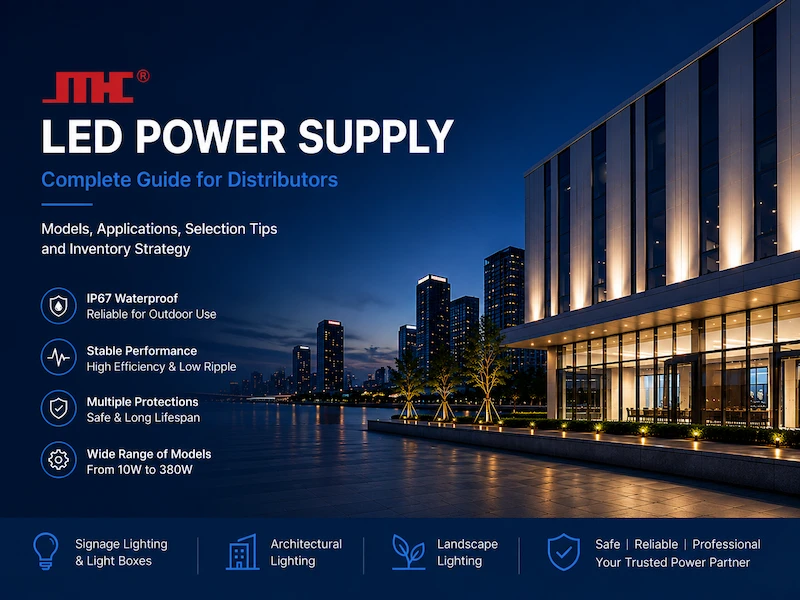
As a professional LED power supply manufacturer, JMHC provides LED drivers and switching power supplies for indoor lighting, outdoor lighting, advertising signage, architectural lighting, commercial decoration, security monitoring, industrial control, and OEM lighting products.
Who Needs an LED Driver Manufacturer?
This guide is designed for buyers who need more than small retail quantities or off-the-shelf replacement products.
Typical buyers include:
- LED lighting fixture manufacturers
- Commercial lighting brands
- Outdoor and landscape lighting companies
- Advertising sign and light box manufacturers
- Architectural lighting contractors
- Electrical distributors and wholesalers
- Security system integrators
- Industrial equipment manufacturers
- OEM and private-label lighting brands
- Project buyers requiring certified bulk production
A direct manufacturing partner is especially valuable when the buyer needs custom voltage, wattage, housing, cables, labels, packaging, certifications, or repeatable mass production.
For a one-time replacement or very small quantity, a local distributor may be faster. For long-term products, project supply, or private-label programs, working directly with a qualified manufacturer usually provides better technical control and supply continuity.
What Does a Professional LED Driver Manufacturer Provide?
A professional manufacturer does more than assemble electronic components. It should support the complete process from requirement analysis to bulk delivery.
| Capability | What It Means for Buyers |
|---|---|
| Product selection | Matching driver type to the final application |
| Electrical engineering | Voltage, current, wattage, ripple, efficiency, and protection design |
| Mechanical matching | Housing size, mounting, cable, and installation-space support |
| Environmental design | Indoor, waterproof, humid, dusty, or enclosed installation planning |
| Certification support | Product selection based on destination-market requirements |
| Sample development | Engineering samples and pilot production |
| Quality control | Material inspection, testing, aging, and final inspection |
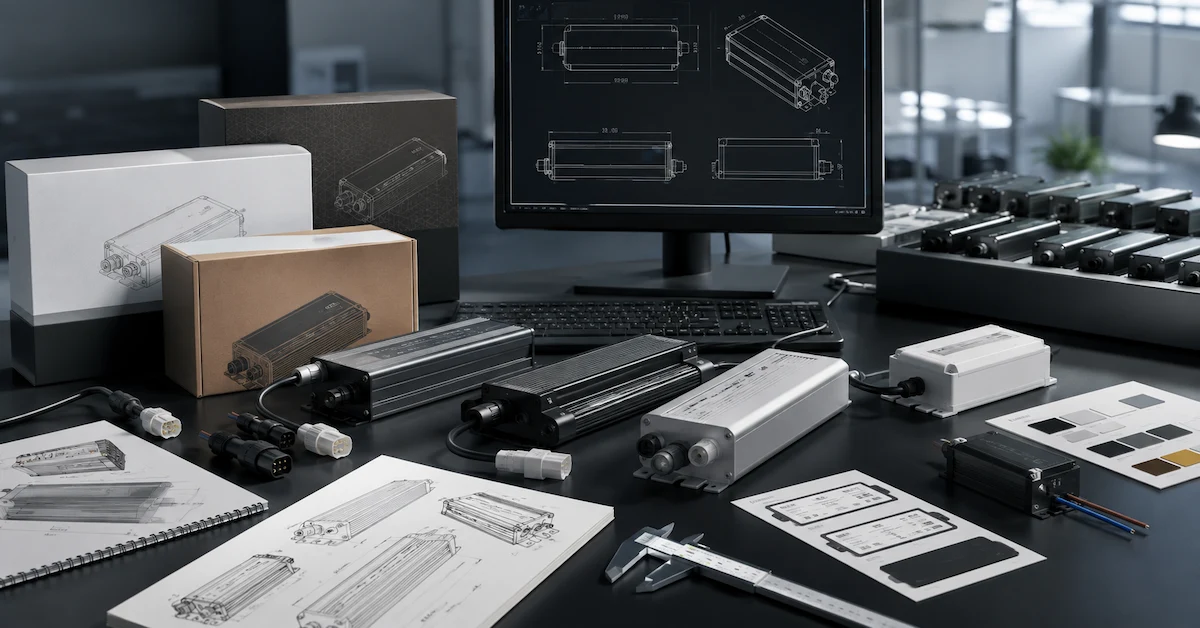
| OEM/ODM service | Customized label, packaging, specifications, and product structure |
| Mass production | Consistent batch quality and delivery planning |
| After-sales support | Technical communication and repeat-order continuity |
The strongest manufacturing partner combines product capability with application knowledge.
Start With the Lighting Application
The correct driver depends on where and how the final lighting product will operate.
An indoor commercial fixture does not have the same requirements as an outdoor sign, landscape lighting system, or industrial control cabinet.
| Application | Main Buyer Concern | Recommended Product Direction |
| Indoor commercial lighting | Low ripple, low flicker, compact installation | IP20 indoor LED driver |
| Office and retail lighting | Visual comfort and stable brightness | Low-ripple, flicker-controlled driver |
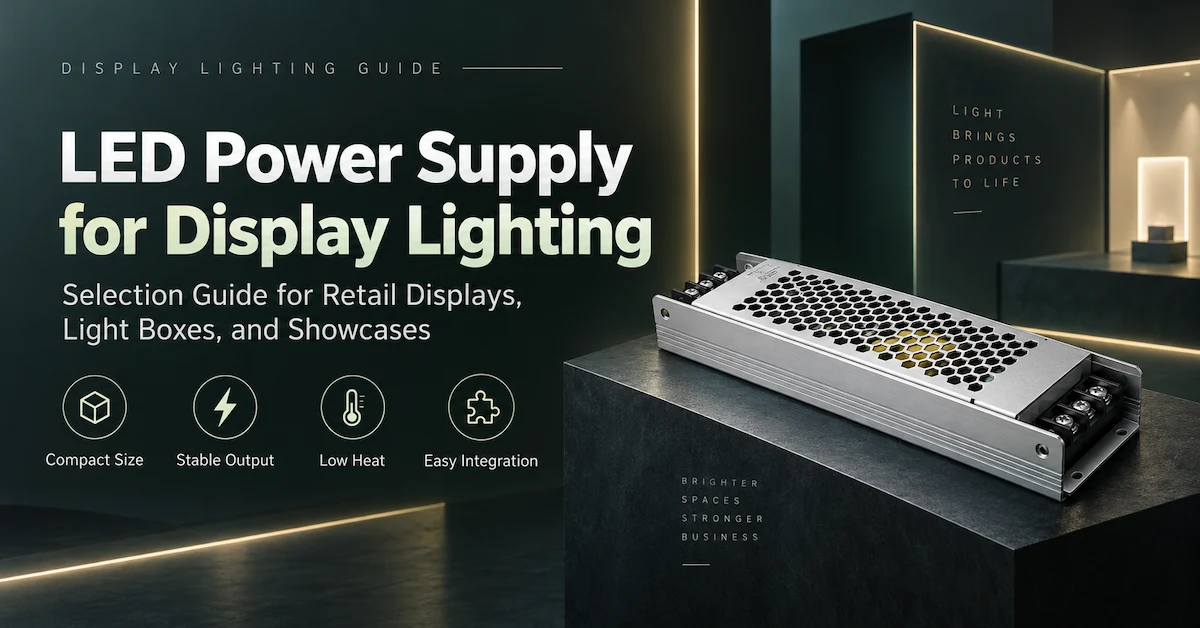
| Advertising light boxes | Long operation and limited space | Mini or long-shape power supply |
| Outdoor signage | Rain, moisture, dust, and maintenance | IP67 waterproof LED driver |
| Landscape lighting | Outdoor exposure and temperature changes | Waterproof potted power supply |
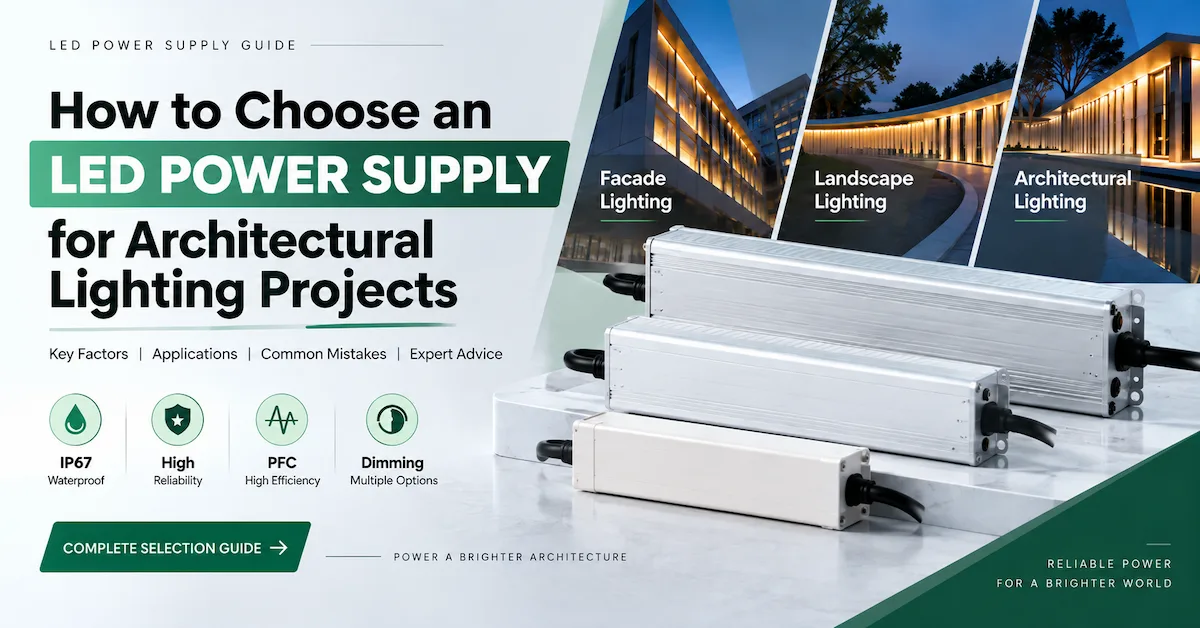
| Architectural lighting | Batch consistency and long service life | High-efficiency waterproof or PFC driver |
| Industrial control | Stable DC output and safety protection | Industrial-grade power supply |
| OEM lighting products | Private label and repeatable specifications | Customized OEM/ODM driver |
Buyers can review JMHC’s available product directions in the product center and compare solutions for different environments through the solutions page.
How to Evaluate an LED Driver Manufacturer
1. Check the Product Range
A broad but clearly organized product range shows whether the supplier can support different lighting applications.
Important product categories may include:
- Constant-voltage LED drivers
- Indoor IP20 power supplies
- IP67 waterproof power supplies
- Mini power supplies
- Long-shape power supplies
- High-power engineering series
- PFC power supplies
- Dimmable LED drivers
- Customized OEM/ODM models
The manufacturer should explain the differences between product families and recommend a suitable series based on the application—not simply promote the highest-wattage model.
A good product range also helps lighting brands build several fixture lines with one supply partner.
2. Confirm Constant-Voltage or Constant-Current Output
The driver type must match the LED load.
Constant-voltage products are commonly used for:
- LED strip lights
- Light boxes
- Advertising signs
- Channel letters
- Cabinet lighting
- Some architectural lighting systems
Common constant-voltage outputs include 12V, 24V, 36V, and 48V.
Constant-current drivers are often used for LED modules or luminaires that require controlled current through the LED load.
Before requesting a quotation, buyers should provide:
- Input voltage range
- Output voltage
- Output current
- Total load wattage
- Constant-voltage or constant-current requirement
- Dimming requirement
- Installation environment
- Expected daily operating hours
An experienced LED driver manufacturer should identify missing information before recommending a model.
3. Evaluate Output Stability and Ripple
Stable output directly affects lighting quality.
Excessive output variation or ripple may lead to:
- Visible flicker
- Unstable brightness
- Uneven illumination
- Additional stress on LED modules
- Higher temperature
- Customer complaints
- Reduced product life
For office, retail, hotel, education, and commercial lighting, low ripple and flicker control are especially important.
Buyers should ask:
- Is ripple data available?
- Is output tested under full load?
- How stable is the output during long operation?
- Is the product compatible with the final LED load?
- Does performance remain consistent across production batches?
A reliable manufacturer should evaluate output quality as part of the product design and testing process.
4. Check Power Margin and Thermal Design
Selecting a driver with exactly the same wattage as the LED load may create unnecessary stress.
For example, continuously operating a 100W driver at a 100W load may increase temperature and reduce long-term reliability, especially inside enclosed fixtures or outdoor housings.
The required power margin depends on:
| Factor | Why It Matters |
| Total LED load | Determines the minimum output requirement |
| Operating hours | Longer operation increases thermal stress |
| Ambient temperature | High temperature affects component life |
| Installation space | Enclosed spaces reduce airflow |
| Housing structure | Influences heat transfer |
| Outdoor exposure | Adds moisture and temperature variation |
| Cable length | May introduce voltage drop |
| Project reliability target | Affects the recommended safety margin |
The manufacturer should provide practical selection guidance instead of relying on a fixed rule for every application.
5. Assess Waterproof Manufacturing Capability
For outdoor applications, an IP rating printed on a label is not enough.
Reliable waterproof performance depends on:
- Housing design
- Cable-entry sealing
- Potting material
- Glue-filling consistency
- Complete internal coverage
- Controlled curing
- Waterproof inspection
- Thermal performance after potting
Poor potting can leave gaps, trap air, or create inconsistent environmental protection. Waterproof products must also dissipate heat effectively after sealing.
Buyers sourcing drivers for landscape lighting, signage, facades, garden lighting, or public projects should evaluate the manufacturer’s potting process and quality controls.
JMHC uses automatic vacuum glue-filling production lines for relevant waterproof power supply products.
6. Verify Protection Functions
Protection functions help reduce damage during abnormal operating conditions.
Depending on the product series, buyers should evaluate:
| Protection Function | Buyer Benefit |
| Short-circuit protection | Reduces damage from wiring faults |
| Overload protection | Protects the driver when the load is too high |
| Over-voltage protection | Helps protect connected LED modules |
| Over-temperature protection | Reduces thermal risk where supported |
| Self-recovery function | Restores operation after certain faults are removed |
| Insulation protection | Supports electrical safety |
| Grounding design | Improves safety for applicable metal-housing products |
Buyers should confirm the protection behavior, not only whether the feature appears in the product description.
Certifications an LED Driver Manufacturer Should Support
Certification requirements depend on the destination market, application, product model, and sales channel.
Common certification and compliance directions include:
| Certification or Standard | Main Relevance |
| CE | European market compliance |
| LVD | Electrical safety |
| EMC | Electromagnetic compatibility |
| RoHS | Restriction of hazardous substances |
| UKCA | UK market access |
| CCC | Relevant products for the Chinese market |
| BIS | Relevant products for the Indian market |
| IP rating | Environmental protection |
| SELV | Extra-low-voltage safety considerations |
| ERP | Energy-related product requirements where applicable |
Buyers should never assume that one certificate covers every model.
Before ordering, confirm:
- The exact certified model
- Covered input and output range
- Housing consistency
- Label requirements
- Available reports or certificates
- Whether customization affects compliance
- Whether component substitutions require review
JMHC offers relevant product certifications including CE, CCC, BIS, UKCA, and RoHS across applicable series.
Quality Control Beyond the Certificate
Certification does not replace production quality control.
A professional LED driver manufacturer should control quality throughout the complete manufacturing process.
| QC Stage | Main Focus |
| Incoming inspection | Components, housings, cables, labels, packaging |
| First-article inspection | Confirms the first units match approved requirements |
| In-process inspection | Assembly, wiring, workmanship, potting, appearance |
| Electrical testing | Input, output, current, voltage, and functional performance |
| Protection testing | Fault-response verification |
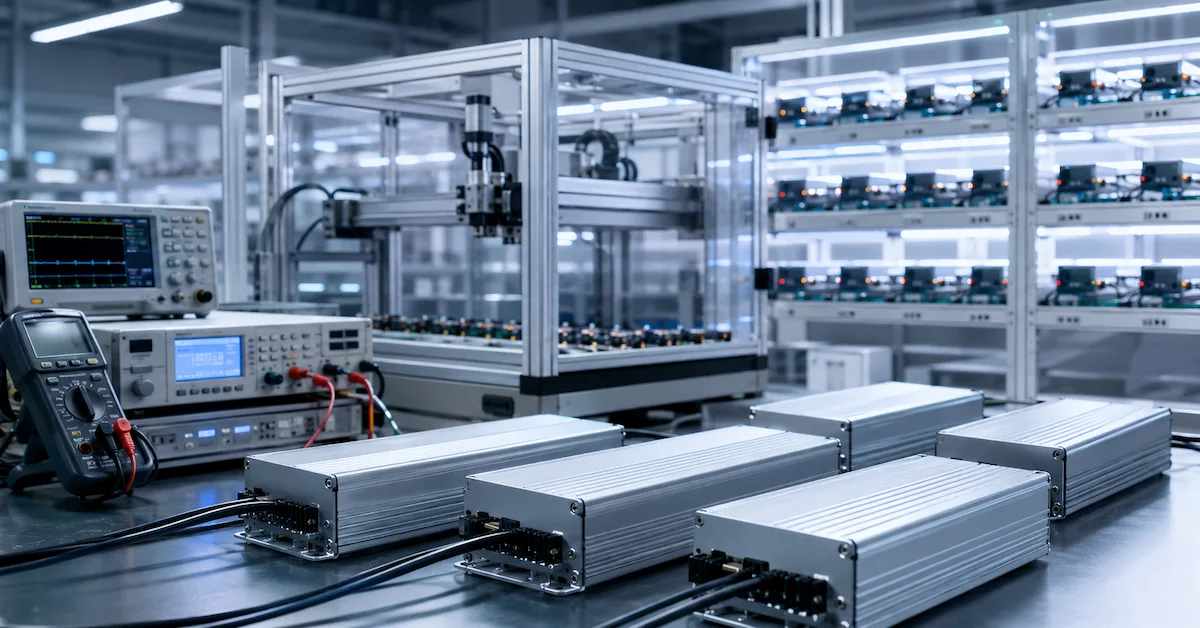
| ATE testing | Consistent automated electrical evaluation |
| Full-load aging | Early-failure screening |
| Final inspection | Electrical data, labels, appearance, accessories |
| Packaging inspection | Quantity, carton marks, and transport protection |
For bulk buyers, the goal is consistency—not only one successful sample.
JMHC’s manufacturing capability includes ATE testing equipment, production and aging equipment, and 100% full-load aging tests. More factory information is available on the About Us page.
Why Full-Load Aging Matters
A short functional test confirms that the driver turns on. It may not reveal early component failures, intermittent output, heat-related issues, or poor internal connections.
Full-load aging can help identify:
- Abnormal temperature rise
- Early component failure
- Unstable output
- Intermittent operation
- Protection issues
- Assembly defects
- Batch-level workmanship problems
For lighting projects and OEM products, aging helps reduce failures after installation.
Buyers should ask whether aging is performed on every unit, only by sampling, or only for selected product series.
Compare Factory Capacity, Not Just Sample Quality
Many suppliers can prepare a good sample. Fewer can maintain the same quality across thousands of units and repeated orders.
A reliable manufacturing partner should be able to explain:
- Available production lines
- Material-preparation lead time
- Daily or monthly output
- Testing capacity
- Aging capacity
- Waterproof-product capacity
- Customized-order handling
- Repeat-order component control
- Peak-season scheduling
- Partial-shipment options
JMHC operates from a manufacturing base of more than 5,000 square meters and supports an annual production capacity of more than five million power supply units.
Capacity should still be evaluated against the specific product series, quantity, customization, and required delivery schedule.
OEM and ODM Support
Lighting brands often need more than standard products.
Common OEM and ODM requirements include:
- Custom voltage
- Custom wattage
- Brand logo
- Product label
- Model number
- Cable length
- Connector type
- Housing dimensions
- Packaging design
- User documentation
- Certification planning
- Application-specific product development
A capable OEM LED driver manufacturer should support controlled approval before mass production.
The process should include:
- Requirement confirmation
- Product recommendation or engineering design
- Sample development
- Electrical and compatibility testing
- Label and packaging approval
- Pilot production
- Bulk production
- Aging and final inspection
- Shipment and repeat-order support
OEM customization should never be limited to printing a logo on an existing product. The electrical and mechanical design must fit the final lighting application.
Manufacturer vs Trader: What Should Buyers Check?
A trading company can still provide useful sourcing services, but buyers seeking engineering support and repeat production should understand who controls the manufacturing process.
| Evaluation Area | Direct Manufacturer | Product Trader |
| Engineering communication | Usually direct | May pass through another party |
| Production visibility | Higher | Depends on factory relationship |
| Custom development | Usually stronger | May be limited |
| Process control | Managed internally | Controlled by third-party factory |
| Change management | More direct | May require additional coordination |
| Product range | May focus on core expertise | May offer broader sourced products |
| Small mixed orders | May have MOQ limits | Can sometimes be more flexible |
| Mass-production support | Strong when capacity is proven | Depends on partner factory |
The correct choice depends on the buyer’s priorities. For technically controlled OEM products and repeated bulk orders, direct manufacturing access usually offers better transparency.
Common Mistakes When Choosing an LED Driver Manufacturer
Mistake 1: Comparing only unit price
A low quotation may exclude stronger components, aging tests, certification, or technical support.
Mistake 2: Selecting from wattage alone
Voltage, output type, load behavior, environment, ripple, heat, and certifications also matter.
Mistake 3: Accepting certification marks without documents
The certification must correspond to the exact model and specifications.
Mistake 4: Skipping sample and pilot testing
A sample validates basic performance. A pilot batch validates production repeatability.
Mistake 5: Ignoring component-change control
Unapproved substitutions can create differences between samples and later batches.
Mistake 6: Using indoor products outdoors
Outdoor applications require suitable waterproof and environmental protection.
Mistake 7: Not evaluating aging and test capacity
Testing must be scalable enough for the required order volume.
Mistake 8: Approving customization verbally
Labels, cables, housings, electrical data, and packaging should be confirmed in writing.
Buyer Checklist Before Requesting a Quote
| Information to Provide | Example |
| Final application | Strip light, signage, facade, commercial fixture |
| Input voltage | 100–240VAC |
| Output voltage | 12V, 24V, 36V, or 48V |
| Output type | Constant voltage or constant current |
| Total load | 60W, 120W, 240W, or custom |
| Working hours | 8 hours, 12 hours, or 24/7 |
| Installation | Open, enclosed, narrow, or inside fixture |
| Environment | Indoor, outdoor, humid, dusty |
| IP rating | IP20, IP67, IP68, or project requirement |
| Dimming | Non-dimming, 0–10V, PWM, TRIAC, or other |
| Certification | CE, UKCA, BIS, CCC, RoHS |
| Quantity | Sample, pilot order, and annual forecast |
| Customization | Logo, label, cable, connector, housing, packaging |
| Delivery | Required sample and mass-production dates |
Complete information leads to faster product selection and a more accurate quotation.
Why JMHC Is a Reliable LED Driver Manufacturer
JMHC integrates LED power supply design, research and development, manufacturing, testing, and sales.
For global buyers, JMHC supports:
- Indoor LED power supplies
- IP67 waterproof power supplies
- Mini and long-shape models
- PFC and high-efficiency series
- Dimming-compatible product directions
- Application-based selection
- Automatic vacuum glue filling
- ATE testing
- 100% full-load aging
- OEM and ODM customization
- Certification support
- Stable mass production
JMHC products are used across LED lighting, landscape and building lighting, advertising signage, commercial and residential decoration, security monitoring, and industrial control equipment.
The company supports lighting manufacturers, brands, distributors, contractors, project buyers, and OEM customers that require stable output, product consistency, and long-term supply.
FAQ
1. What does an LED driver manufacturer do?
An LED driver manufacturer designs, produces, tests, and supplies power solutions that convert input electricity into controlled output for LED lighting systems.
2. How do I choose a reliable LED driver manufacturer?
Evaluate product range, technical support, certifications, testing equipment, aging process, component control, OEM capability, production capacity, and delivery performance.
3. Should I choose constant voltage or constant current?
The correct choice depends on the LED load and fixture design. Constant-voltage drivers are common for LED strips and signage, while other LED modules may require constant-current output.
4. Why is low ripple important?
Low ripple helps reduce flicker, stabilize brightness, improve visual comfort, and reduce electrical stress on LED modules.
5. Do outdoor applications require IP67 drivers?
Many exposed outdoor applications require IP67 or another suitable environmental-protection level. The correct rating depends on the installation conditions.
6. What certifications should I request?
Certification requirements vary by market. Common directions include CE, LVD, EMC, RoHS, UKCA, CCC, BIS, and IP testing.
7. Can JMHC customize LED drivers?
Yes. JMHC supports OEM and ODM requirements including voltage, wattage, labels, packaging, cables, connectors, housings, and application matching.
8. Why is full-load aging important?
Full-load aging helps identify early failures, unstable output, abnormal heat, workmanship issues, and protection problems before shipment.
9. What should I send for a quotation?
Send the application, input and output requirements, load wattage, environment, IP rating, certifications, quantity, customization, and delivery schedule.
10. Can JMHC support bulk production?
Yes. JMHC supports samples, pilot orders, customized production, mass production, testing, aging, and long-term repeat-order supply.
Conclusion
Choosing a reliable LED driver manufacturer requires more than comparing product catalogs and prices. Buyers should evaluate application knowledge, product range, output stability, thermal design, waterproof capability, certifications, quality control, aging tests, OEM support, and mass-production capacity.
A strong manufacturing partner should help buyers reduce technical risk before production and maintain consistent quality after the first order.
JMHC provides LED driver and power supply solutions for indoor, outdoor, commercial, architectural, signage, security, industrial, and OEM lighting applications.
To receive a suitable product recommendation, send JMHC your lighting application, voltage, wattage, working environment, certification requirements, quantity, and customization needs through the contact page.