In LED lighting projects, power units are often selected based on voltage, wattage, and price. While these parameters matter, many long-term issues—such as flicker, unstable output, or early failure—are usually linked to how the power conversion system is designed, manufactured, and validated rather than to basic electrical ratings.
A switching power supply plays a key role in converting and regulating energy for LED systems. However, differences in circuit optimization, component selection, and production control can lead to very different results once products are installed in real environments.
Why Switching-Based Designs Are Widely Used in LED Applications
LED lighting requires efficient and stable electrical conversion. Compared with linear designs, a switching power supply offers higher efficiency, lower heat generation, and better adaptability to varying load conditions. These characteristics make it suitable for indoor lighting, outdoor installations, and commercial or architectural projects.
In practice, performance differences do not come from the switching principle itself, but from how well the design is matched to the application and how consistently it is manufactured.
Product-Level Design Factors That Influence Performance
From a product perspective, switching-based designs must be adapted to real application requirements rather than treated as universal solutions.
Key considerations include:
-
Output configuration
Constant voltage outputs such as 12V and 24V are commonly used for LED strips and linear lighting, requiring tight regulation under changing load conditions. -
Dimming compatibility
Support for 0–10V, PWM, or TRIAC dimming depends on circuit optimization to avoid flicker, especially at low load or partial dimming levels. -
Environmental protection
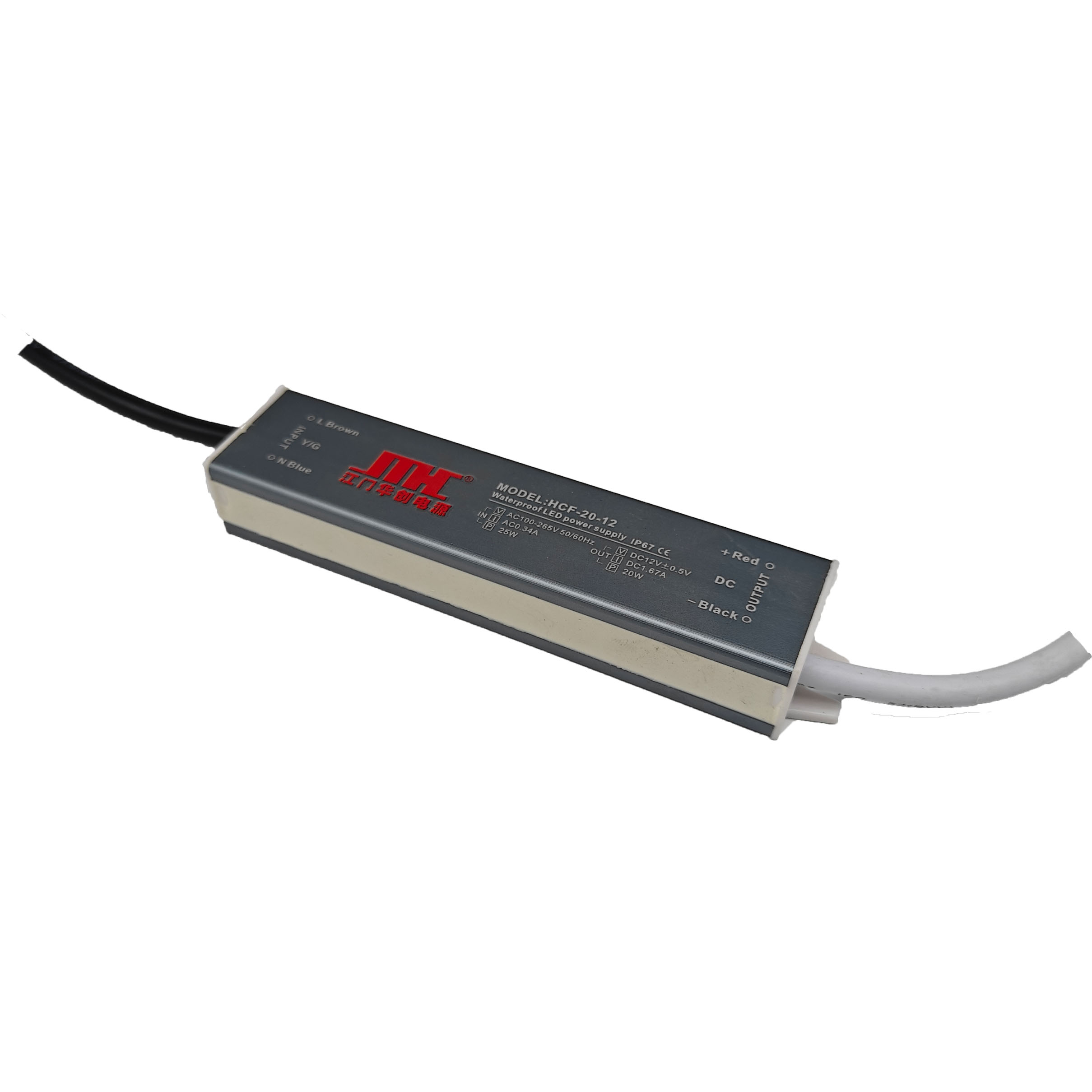
Outdoor and semi-outdoor installations require waterproof structures and encapsulation processes to protect internal components from moisture and temperature stress.
These design priorities are reflected across JMHC’s indoor, outdoor, and dimmable LED power supply product lines, where conversion circuits are adapted rather than reused without modification.
Manufacturing and Processing: Where Reliability Is Actually Decided
Many power units appear similar on datasheets, yet reliability differences usually emerge during production.
At JMHC, manufacturing control focuses on:
-
Component consistency, reducing electrical variation between units
-
Vacuum glue filling for waterproof models, improving insulation and moisture resistance
-
Thermal layout optimization, limiting internal temperature rise
-
100% full-load aging tests, applied to every unit before shipment
Through these steps, each switching power supply is validated under operating conditions that more closely resemble real use rather than ideal laboratory scenarios.
From Design Review to Mass Production: A Practical Workflow
A typical customized power conversion project follows a structured process:
-
Requirement confirmation and electrical parameter review
-
Circuit design and component selection
-
PCB assembly and functional verification
-
Encapsulation or housing assembly for IP-rated models
-
Full-load aging and performance testing
-
Final inspection, labeling, and batch traceability
This workflow allows customization while maintaining consistency across repeat orders and long-term OEM programs.
Performance Comparison: Generic vs Professional Manufacturing
| Performance Aspect | Generic Supplier | Professional Manufacturer (JMHC) |
|---|---|---|
| Full-load stability | ~88% | >98% |
| Waterproof reliability | Limited | IP65–IP67 verified |
| Aging test coverage | Partial | 100% full-load |
| Dimming compatibility | Basic | Multi-mode support |
| Certification readiness | Inconsistent | CE / UKCA / RoHS / EMC / LVD |
| Typical MTBF | ~25,000 hours | >50,000 hours |
For projects with long operating hours or difficult installation environments, these differences directly affect maintenance cost and system reliability.
Common Issues Without Proper Switching Power Supply Customization — and How to Solve Them
Without proper customization, a switching-based power solution may meet basic electrical specifications but fail under real project conditions. The most common issues buyers encounter are not random defects—they are predictable outcomes of mismatched design, manufacturing, and application requirements. Understanding both the cause and the solution helps reduce long-term risk.
Flicker When Integrating Dimming Systems
Why it happens
Flicker typically occurs when dimming requirements are added after the power unit is selected. Generic designs may claim dimming compatibility but lack circuit optimization for specific control methods such as 0–10V, PWM, or TRIAC. Instability becomes more visible at low load or partial dimming levels.
How to solve it
The solution is to define the dimming protocol early and validate performance under real operating conditions. Customization should include circuit tuning for the selected dimming method, as well as functional testing during full-load and partial-load aging. This approach ensures smooth output across the entire dimming range rather than only at nominal load.
Best-fit scenarios
-
Commercial or architectural lighting with centralized dimming control
-
Projects requiring flicker-free performance for visual comfort
Premature Failure in Humid or Outdoor Environments
Why it happens
Outdoor and semi-outdoor installations expose internal components to moisture, condensation, and temperature cycling. Standard housings or incomplete encapsulation allow gradual moisture ingress, leading to corrosion, insulation degradation, and thermal stress.
How to solve it
Customization must focus on environmental protection rather than only electrical output. Selecting the appropriate protection level (such as IP65 or IP67), combined with controlled glue filling and sealing processes, significantly improves resistance to moisture and temperature variation. Validation through extended aging tests further reduces early-life failure.
Best-fit scenarios
-
Landscape lighting and façade lighting
-
Advertising signage and outdoor LED strips
Frequently Asked Questions
Q1: What information helps define the right power conversion solution for LED projects?
Clear output requirements, dimming method, installation environment, certification targets, and expected production volume allow engineers to optimize designs early.
Q2: Does a switching-based design always improve efficiency?
High efficiency is achievable, but only when circuit design, component quality, and thermal management are properly balanced.
Q3: How is consistency ensured across large orders?
Through standardized production parameters, full-load aging tests, and batch traceability throughout manufacturing.
Working With a Reliable Manufacturing Partner
JMHC integrates design, R&D, production, and sales to support customized power conversion solutions for LED lighting systems. By combining controlled manufacturing processes with full-load aging verification, the focus remains on long-term stability rather than short-term cost.
To explore available product ranges and application solutions, visit our homepage:
👉 https://www.jmhce.com/
If you are planning a lighting project or evaluating a customized power solution, our team can support specification review and production planning:
👉 https://www.jmhce.com/contact-us